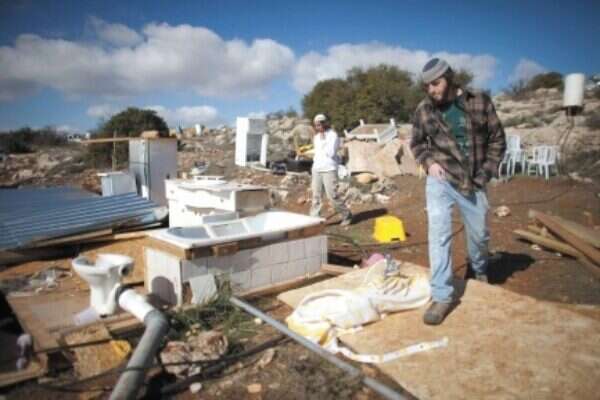
Dozens of school principals and education specialists traveled to Samaria and the Binyamin regional council on Tuesday in order to try and get a sense of how the hilltop youth -- extremist right-wing youth who believe in exacting "price-tag" acts of revenge" -- came into being. Dr. Amnon Eldar and a number of principles from his network of educational institutions known as AMIT, the largest association of schools from the religious-Zionist stream, toil in frustration on a daily basis while trying to instill in their students the values of pluralism, democracy, and reverence for state symbols. The price-tag policy is certainly not AMITs cup of tea, and it is a far cry from the experiences to which they have become accustomed in their schools. Yet even in its defined educational realm that lies in the little Israel within the Green Line, religious Zionism is disturbed by the stepson that grew in its flowerbed and is now setting fire to mosques and targeting IDF soldiers. At the end of an education-filled day, the principals found themselves at a religious high school for girls in Ofra, where they heard two figures who represent different world views. There was Rabbi Eli Sadan, the "high priest of moderation in the religious Zionist movement, who also heads a pre-conscription military academy in Eli. He was met by a an insightful, candid young boy who offered a glimpse into his private world. I am a hilltop youth, said Gilad (not his real name), who actually grew up on Kibbutz Shaalvim. It was bad for me at home. My parents did not understand me. I went from school to school. For a while I volunteered to work with autistic kids, but my teachers were not sensitive enough to my needs. Today I know that I just needed a hug and some caring words. I wanted to be sure that I was loved and accepted despite all of my difficulties. Gilad told the principals that he and his friends, love the land of Israel and want to build it. But it crushed our souls to watch the repeated evacuations of outposts, the destruction of homes in the outposts by the IDF. Nobody understands how much psychological energy we invested in building these places. From the standpoint of those who are known as the hilltop youth as well as those who conduct price-tag activities, which is usually two different things, the price tag is aimed at preventing the next evacuation. I, myself, harmed IDF soldiers, he acknowledged. It hurt them, and it hurt me as well. Afterward, I cried because of the pain that was caused both by the evacuation and razing of homes as well as the harm that I did to them. The last stop before the hilltops The story of Avinoam Almagor, head of the Havruta high school yeshiva in Raanana, which is also a part of the AMIT network, is somewhat more complicated. Almagor's institution annually enrolls 150 youths who were ejected from the mainstream educational systems in the country. Our institution is the last stop before the hilltops, Almagor said. Children who have been marginalized for many years, including those from broken homes or who those who have had difficulties in school, have been coming to us. These are kids who get poor grades, but each and every one of them has a spark and a talent in one area or another, and this is what we work on, whether it is in music or field trips or knowledge of the land of Israel. The most important principle that we adhere to is not to judge them. The second thing is a great deal of love. We have been in existence for 17 years, and this works. The entire staff of instructors is made up of graduates of the yeshiva. Since the pain and the difficult scenes of evacuation and destruction have proven too difficult for youths like Gilad, who also completed his studies at the yeshiva, to bear, Almagor makes efforts to balance these images with an overdose of reverence for state symbols. Every month, past graduates come to Havruta to tell their stories of heroism and sacrifice. They take the youths to uncharted waters while making sure to treat them with respect and love. The curriculum that Almagor formulated includes field trips with the alumni to IDF museums, the Knesset, Air Force bases, and workshops that offer tips on developing life skills as well as insights into business ventures. After being bombarded with messages that preach reverence for the state and its institutions, the youths' perspectives shift. Three Havruta alumni who traveled to Ofra on Tuesday will enlist into elite IDF units within the next few weeks. Over 90 percent of the institutions graduates either matriculate at a pre-military academy, enroll at a hesder yeshiva, or enlist in the army. Not all of them believe One curious observer who listened intently to Sadan and Gilad was David Hatuel, the principal of the AMIT yeshiva in Beer Sheva. Hatuel was first introduced to the public as the man who lost his wife, Tali, and his four daughters in a terrorist attack at the Kissufim junction in Gaza before the 2005 disengagement plan. On one point, Hatuel is in total agreement. These problematic children need to be embraced, he said. When this boy, Gilad, spoke about how he was not hugged, I almost cried. Hatuel recalled seeing many youths in Gush Katif who simply lost their way. Youths who were raised on values suddenly turned to alcohol and drugs, but there was no price tag because at the time there was somebody who gave them direction, something that is missing today, he said. One of the more riveting lessons during the principals' "learning day" came courtesy of the commander of the armys Binyamin brigade, Col. Saar Tzur. The meeting was closed to the media, but there was one attendee who jotted down the main points of the encounter. Tzur is well aware of the environment which spawned the price tag philosophy. In addition to dealing with lawbreakers through legal avenues, he also seeks to advance joint projects with the settlement of Beit El. As part of the project, kids who are troubled are enrolled in half-day armament workshops, with the other half of the day devoted to studying and learning. Tzur believes that the program will put the youths back on the right track. There are upwards of 200 disconnected youths, he said. They are quite extremist. There are a few thousand who provide support in varying degrees
The hardcore of the alienated youths can be divided into two groupings. There are those who do not believe their parents and their families and have no god. These can be found in Zion Square drinking alcohol. Then there are those who dont believe their parents and their family, but who do have a god. They go to the hilltops. Is it conceivable for a Jew to open fire on an IDF soldier? I dont see that scenario unfold, Tzur replied. I cant envision a Jew firing on IDF soldiers or soldiers opening fire on a Jew. One of the principals asked the officer why the mosque arsonists have yet to be apprehended. I dont gather information about Jews. That is the job of the police and the Shin Bet and they are in a serious crisis. Some 1,600 [Palestinian olive] trees have been tainted. There was an investigative unit that looked into every complaint, but no criminal cases were actually opened.. Four mosques were set on fire and no one is deemed guilty. If a big mosque is burned to the ground, there will be an explosion. There will also be an explosion if a Palestinian civilian patrol apprehends a Jewish mosque arsonist. Jewish Fatahland What is of greater interest to the educational professionals is societys strategy for dealing with the price-tag attack and its roots. The armys former chief rabbi, Avichai Rontzki, provided some insight into the wider perception of these hilltop settlements. These settlements are portrayed as some kind of Jewish Fatahland, Rontzki told the principals. When Dan Halutz appointed me to the post of chief rabbi, he gently hinted to me that perhaps it would be best if I would move from my home in Itamar to someplace else, so as not to taint the military rabbinate. Rontzki is infuriated by this unjustifiable reputation. We have close to 100 percent conscription of youths from these areas. Even in Yitzhar, which is perceived as the most militant area, the most problematic group, where there are the adherents of Rabbi Yitzhak Shapira [an extremely right-wing rabbi who published a book condoning Jews killing non-Jews]. They have a small yeshiva. Even within Yitzhar itself, there is strong disagreement. Judge for yourself, Rontzki told his listeners. Itamar is a settlement that lost 20 of its residents in terrorist attacks. Most of the perpetrators came from one village, and nobody from Itamar harmed anyone from this village. This is typical. This is due to education. Not only is the price tag uncharacteristic [of the settlers], but it is forbidden by Jewish law. The same goes for my yeshiva, which produces boys who go on to serve in elite IDF units. I swear to you that to this very day I have no idea who these price tag individuals are. Whoever is arrested is subsequently released. So who am I supposed to denounce? The yeshiva in Elon Moreh is moderate and respects state institutions. I am intimately familiar with what takes place there. There is no support for price tag there. Shmuel Burkash, the former inspector of the state-religious high school education department who today serves as an advisor to AMIT, said in response, We know from original biblical texts that Rabbi Yohanan Ben Zaccai complained of thugs who would not allow him to make peace with the Romans. The thugs of our generation inflict great damage on the religious public in general and the settlement enterprise in particular. Youre right, Rontzki said. There is decent, sound education, but at times there is a but alongside it, and it confuses the youth. We need to educate them without the but. Boaz Giladi, a high school principal from Afula, took it upon himself to respond. With all due respect to the rabbi, what I'm hearing goes like this: What do you want from us? We are doing this and that. Perhaps the problem is what we are not doing. Eldar took Giladis point a bit further. What is missing from your statements is a clear, unequivocal expression that democracy is part of our story here, he said. Until we do not hear this from you, it is not something that should be taken for granted. This morning I visited the Yeshuv Hadaat Farm, where I met Nati Rom, a likeable, upbeat person who has done quite a bit for youths as well as for the Jewish people. From his point of view, democracy is not something that is a given with him. Im not a democrat, he said. The state as a positive commandment At the girls' yeshiva in Ofra, Eldar and his group heard what they wanted to hear about democracy from Sadan, who spoke about the doctrine to which he adheres. The state of Israel is the greatest thing to happen to the Jewish people in the last 2,000 years, he said. The state is not just a civic privilege for us to enjoy, but it is also a positive commandment from the Torah. This is what makes the state a holy entity. The commandment of sanctifying the land compels us to reject the saving of individual life, and there is no way to uphold this commandment without risking life. But this state has many problems that are heartbreaking. We knew it would be difficult, but nonetheless every generation prayed that we would get to this period. Now it has come. What, were not going to deal with it- The major rift is over the fundamental question of Jewish identity, according to Sadan. Still, not one iota of our deferential and respectful world view will change because there are problems. In 1897, at the Zionist Congress in Basel, most of the Jewish people obeyed the Torah and performed commandments. Nonetheless, the secular majority that led the Congress accepted this. Even today, Israel cannot continue to exist without all of us jointly taking part in the struggle for its existence and its development. With all due respect to Rabbi [Eliezer] Melamed, who said that we would not enlist if women were allowed to sing before religious soldiers, I see this as a statement of There wont be anything, either for you or for me. If he thinks that the army will capitulate and wont give up on us, he is living in a bubble, Rabbi Sadan said. And after the army does give up on us, what will happen next? The army will get weaker. Is this not a consideration that should be taken into account- Strength begets strength, Sadan said. Violence begets violence. Anyone who doesnt grasp this is living in a fantasy. Look at Amona. The youth there swore not to give in, and the state also did not give in. And what was the end result? By miracle, there werent any deaths. A few years ago, the IDF massed forces in Ariel in order to evacuate Givat Haroeh, an outpost that [former prime minister Ariel] Sharon was eager for it to be built. [Yesha council member Zeev] Zambish [Hever] tried to stop him. He explained to Sharon that the status of these lands was in dispute, but Sharon kept pushing because the Arabs were ready to pounce on lands nearby. With the troops massed in Ariel, I got to the Central Command headquarters, the rabbi recalled. I knocked on the door of the room in which the defense minister waited and I asked him to put a stop to this. They demanded that I prove to them that the initiative [for building the outpost] was taken by Sharon and the army. The evacuation was suspended for three days. I showed them the proof, and the evacuation was averted. This is much smarter than clashing at any price. Sometimes, we dont succeed in preventing bad things from happening, the rabbi told the educators. Thats how it is in a democracy. The idiot wanted to declare the state of Judea didnt grasp that there is no way to establish a Jewish state without forging a consensus. In a democracy, there will always be people who are unsatisfied. This is the way, and there is no other way to ensure the existence of the state of Israel. Anyone who believes otherwise is a delusional person who is simply unwilling to wrestle with reality, he said. After the expulsion from Gush Katif, there were those who called for dismantling the partnership. I believe this is tantamount to the Judgment of Solomon, to cutting the child in half. The former settlers from the Gush understood this as well, and they were removed with bowed heads and tears in their eyes. The IDF was in shock. They had set aside 600 beds for dead and wounded in Soroka. The YAMAM anti-terror unit had the entire Gush surrounded with snipers. Late that evening, the school principals returned to Jerusalem. Each one has his or her hilltop to tend to. They will try to stop the cracks that have been cropping up in settlers attitudes toward the state from affecting their constituencies. On Tuesday, they came away with some good pieces of advice.
What turns a child into a 'price-tag' exacting hilltop youth?
A delegation of education specialists from a number of state-religious high schools, championing the principles of pluralism and democracy, take a trip into the underbelly of religious Zionism.
Load more...