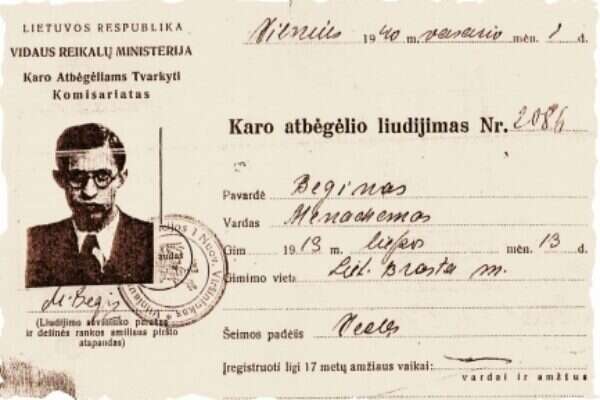
Yad Vashem, Israel's Holocaust museum and memorial, has a new artifact in its collection: the KGB file of former Prime Minister Menachem Begin. Begin was arrested in September 1940 by the Soviet Union's secret police, who were then known as the NKVD. He was 27 and serving as the head of Beitar Poland, the country's largest Zionist movement, at the time. The NKVD compiled a thick file, no fewer than 150 pages, about the future Israeli prime minister. It includes a photo of the young Begin in a suit and tie, his home address and many other private pieces of information regarding his personal life. The file also mentions Begin's law studies at Warsaw University, his law apprenticeship, that his father was a civil servant and that his mother was a homemaker. It also mentions Begin's membership in a revisionist Zionist movement, which he had been active in from 1930 to 1939. Yad Vashem is publishing Begin's file as part of a broader effort to gain a better understanding of the scope of the Holocaust in territories controlled by the former Soviet Union at the time, events which have mostly been shrouded from history. According to its website, the Yad Vashem International Institute for Holocaust Research "has been intensively researching and identifying a vast amount of relevant documentation, photos and testimonies; so that this relatively neglected part of Holocaust historiography can now begin to be told." The newly acquired artifacts - made possible through the support of the Genesis Philanthropy Group and the European Jewish Fund - reveal a newer, clearer picture of the scope of murder and persecution of Jews in the former Soviet Union. "In the documents we examined in the KGB's archives we found fascinating legal testimony that shed light on the scope of the persecution of Jews, the Jewish leadership and how they were murdered," Dr. Haim Gertner, director of Yad Vashem's Archives, said on Thursday. "Furthermore," continued Dr. Gertner, "the files contain new information about murder sites that were previously unknown, and about the fates of entire communities and the ways in which they managed to function during the war. The former Soviet Union was a black hole for us as far as collecting documentation until we were able to photograph a million documents there, which happened only recently. This is important information because it retraces what happened back then to the Jews, most of whom were murdered following their interrogations. For example, through books belonging to various Jewish housing committees that came to use from Latvia, we were able to map out the Jewish homes according to street, and reconstruct what happened to the residents during the Holocaust." In related news, the U.N. General Assembly will gather Friday to commemorate International Holocaust Remembrance Day. Israel's ambassador to the U.N., Ron Prosor, is expected to tell his counterparts from across the globe that in a world which bore witness to the horrors of the Holocaust, anti-Semitic voices are still heard; while every year the president of Iran rises to this podium and denies the Holocaust, while his government threatens to carry out another one.
Introducing Menachem Begin, prisoner of Stalin's secret police
Yad Vashem acquires millions of new documents, including those from Stalin's secret police, to better understand the scope of the Holocaust in the former Soviet Union • Among the documents is a file on former Israeli Prime Minister Menachem Begin.
Load more...