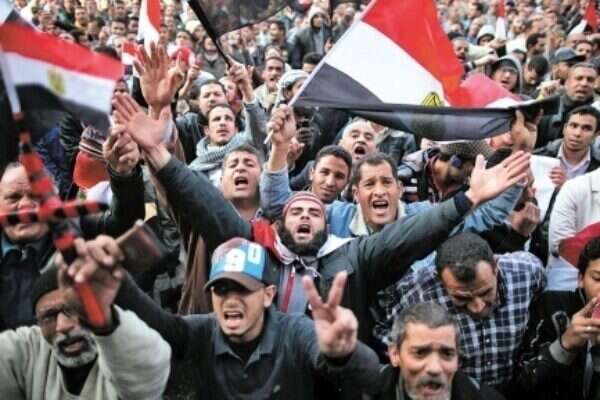
As scores of young Egyptian protesters marking the one-year anniversary of the Arab Spring uprising bedded down in the now-famous Tahrir Square, vowing to stay put until the ruling military council hands power over to civilians, Israel offered its congratulations to the Egyptian parliament on its efforts to achieve "freedom, democracy and economic development." "We send the new parliament our wishes of constructive and fruitful work for the well-being of the Egyptian public," Israel's Foreign Ministry wrote in a statement, three weeks after the third and final round of the first elections since the ouster of long-time ruler President Hosni Mubarak. "We trust Egypt will continue to uphold the importance of peace and stability in our region," the statement said, in reference to the peace agreement between Israel and Egypt, signed in 1979, which has been in doubt since Islamist parties won a parliamentary majority in Egypt's recent elections. United last year by anger at Mubarak and his 30-year rule, Egyptians were in high spirits but divided between activists demanding a swift end to army rule and those celebrating the strides their country has taken with its first free elections in 60 years. Egypt, the second country to embrace the so-called Arab Spring, erupted in protest on Jan. 25, 2011 in a call to end Mubarak's decades of autocratic rule. Weeks of violent and deadly demonstrations ensued, with the masses eventually succeeding in deposing Mubarak and placing the Egyptian military council, Supreme Council of the Armed Forces, in charge until a democratically-elected government could be installed. Wednesday's attempt to extend the protest, which the military had hoped to limit to a daytime celebration, raised the prospect of violence. A series of sit-ins in recent months have ended in clashes with security forces and left dozens dead. "There will be a sit-in until they leave, by any means but they should leave," said Alaa Abdel Fattah, a blogger who was detained by the army after clashes outside the state media offices, or Maspiro, left 25 protesters dead in October. Abdel Fattah was speaking outside the Maspiro tower in central Cairo where hundreds of protesters were gathered after spilling out of Tahrir Square. "The day was great today, the marches were huge ... the differences in the square are natural. We always had different stages competing with each other but it isn't important," said Abdel Fattah, prominent among Egyptian youth activists. The army has promised to relinquish power after a presidential poll in June but some protesters, who complain that the army has used the same heavy-handed tactics against opponents as Mubarak did, want the transfer of power speeded up. The 83-year-old Mubarak is currently on trial for his life and a new parliament was installed this week that is dominated by his Islamist adversaries. Some of the activists who launched last year's revolt currently oppose army rule but fear the Islamists may stifle their hopes. By sundown, some 30 tents had been pitched on the traffic island in Tahrir Square and outside a nearby government complex. The Revolutionary Youth Coalition, one of the main protest groups, said there was no agreed decision to camp out but some individuals had decided to do so. "We have no choice but to hold a sit-in, nothing was achieved except through a sit-in," said Hamed Mohammed, a 28-year-old engineer who was bedding down in the square. "We will decide whether to close the square or not depending on the numbers but people must know the last thing we want is to cause the country any harm." The Muslim Brotherhood, whose followers were in Tahrir Square to celebrate their dramatic elections victory had warned against a sit-in. However, it appeared some Brotherhood members would remain in the square to try to avert any attacks on the protesters. "We have not taken a collective decision to hold a sit-in," said Amr Sayyid, in charge of the Brotherhood's podium. "But given that some youths and those representing the injured and martyrs have decided to remain in Tahrir, teams of Brotherhood members will remain in the square for security purposes to prevent a security gap which leads to thugs entering the square and conflict ensuing." In Alexandria, Egypt's second largest city, about 100 protesters set up tents a few hundred meters (yards) from the police headquarters, demanding the army hand over power immediately. In the vote for the parliamentary lower house that took place in 2011, a coalition led by the fundamentalist Muslim Brotherhood won 47 percent, or 235 of the 498 parliamentary seats. The ultraconservative Al-Nour Party took second place with 25%, or 125 seats.
Eyeing Islamist triumph, Israel congratulates Egypt's 'freedom'
Egyptian protesters threaten to stage sit-in, urging end to military council rule • Israel's Foreign Ministry: We trust Egypt will continue to uphold the importance of peace and stability in our region.
Load more...