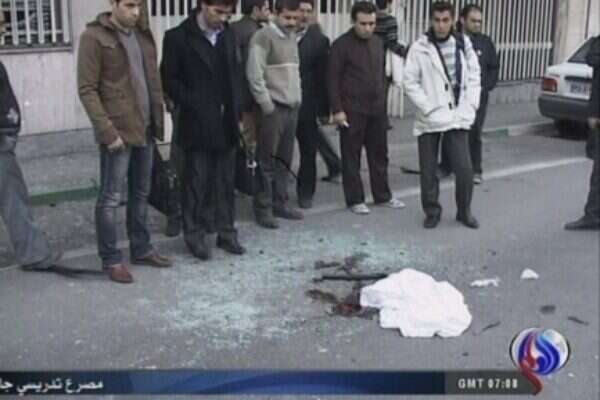
Iran charged on Thursday that assassins who killed an Iranian nuclear scientist in Tehran last week may have used information obtained from the U.N. On January 11, during the morning rush hour in Tehran, a passenger on a motorbike put a magnetic bomb on the car of Mostafa Ahmadi-Roshan, a 32-year-old department supervisor at Iran's uranium enrichment plant at Natanz, killing him and wounding his driver and body guard. Iran, at odds with Western governments over its nuclear program, has accused U.S. and Israeli agents of being behind the killing. Iran's deputy U.N. ambassador Eshagh Al Habib said there was a "high suspicion that ... terrorist circles used the intelligence obtained from U.N. bodies, including the sanctions list of the Security Council and interviews carried out by IAEA (International Atomic Energy Agency) with our nuclear scientists, to identify and carry out their malicious acts." Ahmadi-Roshan recently met with IAEA inspectors, Al Habib told the Security Council, "a fact that indicates that these U.N. agencies may have played a role in leaking information on Iran's nuclear facilities and scientist." He also accused the world body of failing to observe secrecy over its inspections of nuclear facilities. U.N. Spokesman Martin Nesirky said he was looking into the allegations. The Vienna-based IAEA is the U.N. nuclear watchdog and has played a key role in trying to determine whether Tehran's atomic program has military dimensions. The murder of Ahmadi-Roshan was the fifth daylight attack in two years on technical experts involved in Iran's nuclear program, which Western countries believe is aimed at producing an atomic weapon but Tehran says is for peaceful purposes. The U.S. has denied involvement in the killing and has condemned it, as has U.N. Secretary-General Ban Ki-moon. An Israeli minister also said this week that Iran's charges of Israeli involvement were "completely baseless." Al Habib, addressing a Security Council debate on justice and the rule of law, said it was "odd" that the council had said nothing about attacks on Iranian scientists. "Is it the way to advance the rule of law at the international level-" he asked. Iran's Supreme Leader, Ayatollah Ali Khamenei, has also commented on the incident recently, saying that those behind the killing of the nuclear scientist will be punished. "We will continue our path with strong will ... and certainly we will not neglect punishing those responsible for this act and those behind it," Khamenei was quoted as saying last week. "This cowardly terror ... has been designed or helped by the intelligence services of CIA and Mossad and shows that the arrogant powers have reached a dead end in the face of the strong Iranian nation," Khamenei added, according to IRNA, Iran's official news agency. U.S. President Barack Obama and Prime Minister Benjamin Netanyahu held a phone conversation about Iran the day after the assassination, but the White House remained mum on whether the two discussed the death of the scientist. A statement issued by the White House did, however, say that Obama and Netanyahu "discussed recent Iran-related developments," including the diplomatic pressure related to its nuclear program. Netanyahu reportedly told Obama, "The security of Israel dictates that Iran must not be a nuclear power." The Prime Minister's Office denied any link between the phone call and the death of the Iranian scientist. Iran's nuclear confrontation with the West had already been escalating in the weeks before Roshan's killing, with the U.S. tightening sanctions against Tehran, and Iranian officials warning that they would respond by blocking the Strait of Hormuz, a waterway vital to global oil shipping. Earlier this month Tehran concluded 10 days of exercises in the waters off of the strait, and has announced that it plans to hold another set of naval drills in February. The New York Times recently reported that the U.S. has warned Iran that if it closes the strategic Strait of Hormuz it will have crossed a red line that the U.S. would see as a casus belli.
Iran hints at UN involvement in scientist's killing
Recently assassinated Natanz uranium enrichment facility official Mostafa Ahmadi-Roshan had met with U.N.'s nuclear watchdog prior to his death • Tehran's deputy U.N. ambassador: High suspicion that terrorists used intelligence derived from U.N. bodies.
Load more...