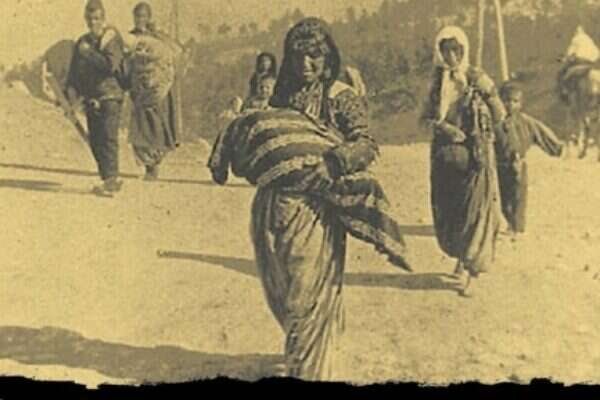
In the Armenian collective memory, Deir al-Zour in northeast Syria is where the road to hell ends. There, in 1915, the Turks brutally slaughtered those Armenians who had survived the death marches from the Antalya region. Many of the Armenians whom the Turks marched to Deir al-Zour did not survive. They were murdered along the way, or died of starvation, thirst or exhaustion. Those who nevertheless managed to survive the agonizing journey fed on animal carcasses and children's corpses. Some of the Armenian children themselves became living testimonies: They documented accounts of their dreadful ordeal on their skin and camouflaged the words with layers of dust. When they were caught, the Turks poured water on them to expose the writings. Ottoman Turkey tried in vain to cover up the destruction it perpetrated, which its successors deny to this day, but a few years ago one of the more persuasive accounts of the events was published: Photographer Bardig Kouyoumdjian, the grandson of an Armenian genocide survivor, and French journalist Christine Simeone published an album of Deir al-Zour. They interviewed and photographed survivors of the massacre, but focused mainly on their children. Veteran Israeli journalist Joseph Algazy uploaded some of the images to his website. Eitan Belkind, a former member of the Ottoman-era Jewish espionage group Nili, witnessed the burning of thousands of Armenians at the hands of Circassian soldiers serving in the Turkish army. Belkind describes what he saw: "The Circassian soldiers ordered the Armenians to gather thorns and thistles and pile them into a tall pyramid; then they bound all the Armenians there, nearly 5,000 people, hand to hand, surrounded them in a ring of the thorns and thistle and set it aflame, sending smoke into the sky along with their miserable cries
I escaped from that place because I couldn't watch the horrible scene
After two days I returned to that place and saw the charred corpses of thousands of people." Henry Morgenthau, U.S. ambassador to Turkey from 1913 to 1916, who documented some of the horrors and tried to help the Armenians, wrote in his journal at the time: "As a Jew, I have a duty to help these people. The Armenians are like the Jewish people in captivity, the just don't have a Moses to lead them." Yet nearly 100 years later, Israel, the state of the Jewish people, still belongs to the club of countries that have yet to recognize the Armenian genocide. Toeing Ankara's line There is almost no one in Israel who "buys" the Turkish denial, but the code word used by Israel's decision-makers to excuse its warped conduct regarding the Armenian genocide is "interests." This year it is "the critical and fragile relationship" (more than ever), with Turkey, or as Irit Lilian, head of the Foreign Ministry's European Department, put it: An uncalculated move could lead to "extremely serious strategic re." Therefore, as in previous years, the Knesset abstained from recognizing the Armenian tragedy as genocide, acceding to the request from a Prime Minister's Office and Foreign Ministry concerned with jeopardizing already strained economic and military ties with Turkey. However, Israel has for years been adopting Turkish terminology. During the "honeymoon" period of relations with Turkey, in which annual trade between Jerusalem and Ankara reached some $3.5 billion, Israel even helped Turkey explain itself to the world. Shimon Peres, as foreign minster under Ariel Sharon, took pains at the time to meet Abraham Foxman, national director of the Anti-Defamation League, to persuade his organization to moderate the wording of a decision recognizing the Armenian massacre as genocide. A few weeks ago, Ankara recalled its ambassador from France after the French lower house of parliament passed a law seeking to punish deniers of the Armenian genocide. This wasn't the first time that France recognized the Armenian genocide. Professor Yair Oron, an expert on genocide, reveals that some 10 years ago, Turkey retaliated against France for a similar decision by canceling large arms deals. "Shamefully, the country that won those deals, worth hundreds of millions of dollars, was Israel," he says. Last year, Turkey recalled its ambassador from Sweden after its parliament also approved a decision to define the Turkish massacre of Armenians as genocide. Turkey has also threatened Israel, which has always capitulated. This happened when two Israeli ministers in a five-year span tried changing Israel's official policy. The first was Yair Tzaban, a member of Yitzhak Rabin's second cabinet, followed by former Education Minister Yossi Sarid, who served in Ehud Barak's cabinet. They arrived at a memorial service at the Armenian Church in Jerusalem and effectively recognized the Armenian genocide, after which both were swiftly renounced by their governments. Pogrom sounds better For years, even Israel's education system has tip-toed around the issue of the Armenian genocide. Some 10 years ago the Education Ministry asked Professor Oron to write a lesson plan about genocide in the 20th century, including the Armenian genocide. Two former education ministers, Shulamit Aloni and Yossi Sarid, approved the plan, but their successors succumbed to pressures from higher up and shelved it. In the Israeli education system words like "pogrom," "tragedy" and "massacre" are used in the Armenian context, but "holocaust" and "genocide" are avoided. Historian George Hintlian, former secretary of the Armenian Patriarchate in Jerusalem who had 70 family members killed in the genocide, was comforted in the past by what he calls the difference between "the attitudes of the Israeli public toward the Armenian holocaust to that of the Israeli leadership." However, Armenian community leaders today find it hard to grasp the disregard perpetuated specifically by the Israeli education system. April 24, 1915, is widely regarded the day the Armenian genocide began. On that day, the Young Turks, a nationalist party that in 1908 ousted the sultan and then ruled over the Ottoman Empire it until its collapse during World War II, ordered the arrest of 250 Armenian leaders in Istanbul and had them shot dead. Later, hundreds of thousands of Armenians -- including elderly people, women and children -- were led to the Syrian desert. Thousands were killed daily. From one death march of 17,000 people, only 180 survived. The estimated number of victims fluctuates between 1.2 and 1.5 million people. Two doctors from the Turkish city of Trabzon testified to seeing children being rounded up in two school buildings and gassed to death. In other cases, it was reported that women and children were placed on boats and sunk at sea. The parliaments of France and 20 other countries, including Greece, Austria and Canada, have recognized the genocide. Throughout the years, hundreds of researchers from across the globe have confirmed that what happened was a genocide, but the Turks only refer to "civil war," tragedy" or "disaster," and place the number of deaths at 300,000. Revised life stories Professor Oron, whose book "Denial: Israel and the Armenian Genocide" documents in detail Israel's problematic conduct on the matter, mentioned this week that on the eve of the Holocaust of the Jewish people, in August 1939, Hitler smugly asking his SS officers: "Who remembers today what was done to the Armenians-" Oron, whose eye-opening book is a must-read for every Jew and human being, laments the fact that the Armenian holocaust can only be formally studied in Israel today at the Open University. Meanwhile, Hebrew Universitys Professor Yehuda Bauer, a renowned Holocaust scholar and historian, also told Israel Hayom that Israel has a "moral obligation of the first order to recognize the Armenian genocide." Historians the world over, emphasizes Bauer, "have recognized that a genocide took place in Ottoman Turkey." Bauer is not concerned about comparisons to the Jewish Holocaust. "The comparison can actually be useful," Bauer says, "because you can't highlight the Holocaust of the Jewish people as an unprecedented event, without comparing it to earlier cases of genocide." The bottom line is that the story of Israeli conduct over the Armenian genocide is one of morals versus interests. In July 1945, after the Jewish Holocaust, poet Nathan Alterman wrote the poem "Interests." Using witty sarcasm, Alterman ridiculed the downfall of nations in the face of the Jewish Holocaust. This is how interests won out: On one occasion Israeli national television capitulated to the Foreign Ministry and refrained from screening Theodore Bogosian's documentary film, "An Armenian Journey." Even a petition signed at the time by a number of influential cultural figures including Haim Gouri, Amos Oz, Hanan Porat, S. Yizhar and Amnon Rubinstein, didn't help. Interests also won out in the case of Naomi Nalbandian, a Haifa native of Armenian descent, who lived with her family in east Jerusalem and worked as a senior nurse in the rehabilitation ward at Hadassah Medical Center. Nalbandian was chosen to light a torch at Israel's official 55th annual Independence Day celebration. She wrote a brief summary of her life, pointing out, among other things, that she was a "third-generation survivor of the Armenian holocaust." When the Education Ministry began circulating pamphlets with the life stories of each torch lighter, Turkey threatened that circulation of the pamphlets would endanger economic and military ties with it. Nalbandian protested but in the end compromised on the wording, which was changed to "daughter to the long-suffering Armenian people." Two thousand copies of the original pamphlet were destroyed, while the life stories of the torch lighters were reprinted. Lieberman blocks the way The ambiguous term "interests," apparently, includes more than the sinking strategic relations with Turkey. Azerbaijan is also in the picture. A little background is necessary: The Azerbaijan Democratic Republic shares a border with Armenia in the west, and with Turkey. The Azeris, a Turkish-Muslim people, an ally of the Turks (against the Russians) in World War I, make up the majority of Azerbaijan's population. They adopted the Turkish stance that what happened to the Armenian people was not genocide, rather mass death during wartime. Some 17 years ago, Azerbaijan conducted a bloody war with Armenia for control over the Karabakh Province. Now to the Israeli matter: Azerbaijan also shares a border with Iran, and Israel exports hundreds of millions of dollars worth of weapons to Azerbaijan. For its part, Azerbaijan supplies Israel with a large portion of its oil needs. One of the main patrons of the special relations Israel has woven with Azerbaijan is Foreign Minister Avigdor Lieberman (Yisrael Beitenu). Lieberman and Foreign Ministry officials were concerned that Turkey and Azerbaijan would interpret last week's discussion on the Armenian genocide in the Education Committee as Israeli revenge against Turkey for its denunciation of Israel following the Mavi Marmara incident in May 2010, when Israeli commandos boarded a Gaza-bound aid ship and clashed with Turkish activists, resulting in nine deaths. As for Turkey's Azeri allies, they could see an Israeli recognition of the genocide as ungratefulness, a move that could hurt oil supplies. The Prime Minister's Office turned to Knesset Speaker Reuven Rivlin, asking him to postpone the discussion. Rivlin refused. He has followed the Armenian story for two decades already, and every time is frustrated anew that the leadership prevents the Knesset or its committees from recognizing the Armenian genocide. "Economic and security interests do not afford Jews the right to ignore the tragedy of another people," he says. The discussion took place, but this time as well it concluded with a "parve" decision that had no teeth. Moshe Arens, a former defense minister and foreign minister, told Israel Hayom: "Israel needs to ask itself if it would accept a lack of recognition of its Holocaust, by whichever country of the world, because of economic or security interests. Despite the unprecedented nature of the Jewish Holocaust, the moral yardstick is the same regarding the Armenian holocaust. It was a mass crime, a genocide in which over a million people were murdered, and no economic, security or political consideration can challenge that fact. "I would compromise with my conscience only if I were convinced that recognizing the Armenian holocaust would risk the existence of the state of Israel," Arens said. "But that isn't the case, and in the name of moral principle, especially as Jews, the Armenian genocide should be recognized, even if we a pay a price with our imports and exports of arms and oil." According to Arens, during his time in government the issue was never raised, and therefore never required a decision. Benjamin (Fouad) Ben-Eliezer (Labor), a former defense minister and national infrastructure minister, was exposed to the economic and military relationship with Turkey and Azerbaijan, and chose not to be interviewed on the matter this week. On his decision not to address the issue, Ben-Eliezer's spokesperson explained: "The wise man knows when to keep quiet."
Israel and the moral obligation to recognize the Armenian genocide
Many Western countries have recognized the Armenian genocide at the hands of the Turks, but Israel has refrained from doing so due to "economic and security interests" with Turkey.
Load more...