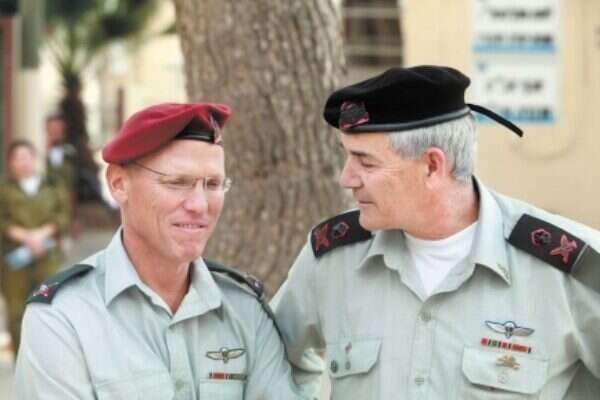
Like the clich goes, Nitzan Alon was simply in the wrong place at the wrong time when he decided to act like the rest of his comrades in "The Unit," the General Staff Reconnaissance Unit, and put his red beret in his pocket rather than in its epaulet, as rules required. That was accepted practice in The Unit, just like combat soldiers refuse to wear their insignia of ranks as corporals when they get them and wait until they can proudly show that they're sergeants. These were the 1980s, the chief of general staff was the late Maj.-Gen. Moshe Levy, and the overall feeling at the top of the IDF was that discipline had become lax. Levy, who decided to put an end to it, chose the cream of the crop, the elite: He ruled that any soldier from the special units caught on a disciplinary infraction would be kicked out immediately. He also asked that he be personally updated about every such incident, so he could make an example of them. "It must have been fate but it was Nitzan of all people who was caught coming out of the base with his beret in his pocket," says Michael Kafri, head of Alon's first squad ("Michael's Squad") and later deputy commander of the General Staff Reconnaissance Unit. "He was a very disciplined soldier, but at the corner he was nabbed by a military policeman who wrote up a citation for the offense. Naturally the matter reached the chief of general staff, who sent the commander at the time, Omer Bar-Lev, an order that the rules had to be the same for everyone and that he had to drum Nitzan out of the unit." But Alon didn't give up. Rather than finishing up his track of training with the General Staff Reconnaissance Unit, he moved to the Maglan Unit, which operates behind enemy lines, and served eight months there. "It was incredible that the best soldier in the squad was the one who got kicked out," says one of the senior officers who served in the unit at the time. "And what was even more amazing was that there was absolutely nothing that could be done about it. It was the chief of general staff's own decision." But fate had other plans for Alon. As commander of The Unit, Brig.-Gen. (res.) Omer Bar-Lev was asked to decide who would attend the officers' training course, and in doing so he remembered Alon the soldier whom both his commanders and comrades thought was the best among them and who got the best scores on the sociometric exams, measuring social relationships. "Bar-Lev decided that even though Alon had not completed his track in the unit, he would send him to the officers' training course," the former senior officer recalls. "He called Alon into his office, and asked if he was ready to go to officers' training school and sign on for two more years of service in the regular army. Alon agreed. We are talking about a very unusual move because not completing a full track in a unit is tantamount to violating their holy of holies. They really did something special for him because they valued him." Wait a minute, but he was kicked out of the unit, wasn't he- "Bar-Lev updated the head of Military Intelligence at the time, Amnon Lipkin-Shahak, who approved this move," the senior officer recalls. "Dan Shomron also took over as chief of general staff, so everything worked out. They understood that if Alon was so outstanding, it would not be a problem for him to make up what he missed in the course and become a good squadron leader. By the time he finished the officers' training course the unit had a new commander current Likud MK Moshe "Bogey" Ya'alon. By those who know him, Nitzan Alon, soon to take charge of Central Command, is been said to be one of the most modest, the kindest to his subordinates. His name has made headlines many times in recent months, partly because of his complex job as commander of the Judea and Samaria Division, in the hottest sector. Here, a commander has to maneuver between fighting Palestinian terror, cooperating with the Palestinian Authority, maintaining good relations with the settlers and adhering to the political echelon's instructions. His worst detractors since his upcoming appointment were some settler leaders with whom he worked closely as division commander. Their work together started off positively but over time deteriorated to the point where last summer, several dozen right-wing activists demonstrated outside his home on Moshav Nir Banim. "Even Eichmann was just a screw in the overall operation," one of the demonstrators yelled. "Alon is the Hebrew translation for Eichmann; all he did was Hebrew-ize his name." The demonstration followed the revelation of a document Alon wrote regarding the evacuation of outposts, in which he instructed his officers "to assign soldiers who could potentially damage national security to jobs where they are not exposed to sensitive material." The settlers saw this as a clear reference to religiously observant soldiers. Another incident that further sullied the atmosphere took place after Ben Yosef Livnat was shot and killed by Palestinians at Joseph's Tomb in Nablus this past April. Brig.-Gen. Alon said that it was a random shooting incident and not a planned terror attack, but the settler community viewed it as a murder. The settlers also believed Alon was behind a comment made after the slaughter of the Fogel family on Itamar in March, calling the five shocking murders an "Arab 'price-tag' attack in response to a Jewish 'price-tag' attack." Israel Radio attributed the comments to a "senior officer," but Alon denied issuing them. "Price-tag" attacks are what the radical settlers call their attacks on Palestinian and IDF targets, carried out as the "price" for the demolition or planned demolition of any settler outposts. "He essentially shifted responsibility onto the settlers and that is something that just shouldn't be done," said a senior member of the Yesha Council. "If he sees the murder of the Fogel family as an Arab 'price-tag' attack, then we have a real problem here." The same settler leader rejected the claim that all IDF Judea and Samaria division commanders had experienced similar friction with settlers and cited Maj.-Gen. (res.) Moshe Kaplinsky and current Likud MK and former Chief of General Staff Moshe "Bogey" Ayalon, who were believed to get along well with Judea and Samaria residents and Yesha Council leaders, as examples. In his farewell ceremony from the Judea and Samaria Division, Alon managed to anger the settlers even more, criticizing their responses and handling of "price-tag" attacks. "A radical minority, small in number but not in influence, could lead to a wide-ranging escalation of these 'price-tag' attacks which actually are acts of terror," he said. "These incidents deserve condemnation for their injustice and stupidity and they need to be stopped. Their perpetrators should be arrested in a manner that is more effective than what we have seen so far." The protest against Alon reached its ugly peak when his car was attacked at the Tapuach junction in Samaria in July. Several young men surrounded his car, calling him a "traitor." It was just pure luck that the incident ended without anyone getting hurt, but Alon was heart-broken by it all. He had been fighting for years on behalf of these young people and their security. The criticism of his methods did not even end after his appointment to his new position. Radical right-wing activist Noam Federman said he felt like the appointment was a declaration of war against the settlement enterprise. "Alon is a radical left-winger whose wife is active in the Machsom (Barrier) Watch and he will make our lives all the more bitter," Federman said, referring to the letter of support for Machsom Watch that Alon's wife, Mor, signed in 2006 protesting Beersheba mayor Yaakov Turner's cancellation of a photo exhibit of the group's activities. "There's something wrong with this," said a settler leader. "Imagine what would happen if the wife of the OC Central Command was a member of Kahane Chai (a radical outlawed right-wing organization)? How would the media respond to that one? It's not that different." The settler leader continued, saying, "This appointment, and it is not Nitzan's fault, is Ehud Barak's attempt to stir things up. Everything that happened last week is a Barak maneuver, because he is interested in making the Israeli public disgusted with the Judea and Samaria residents. It began with the evacuation of outposts and continued with the appointment of Nitzan Alon." Alon appeared calm in the face of the controversy. "This slander of me won't have any influence," he said. "I will continue to do my job and implement government directives in the territories as they are passed on to the IDF. I still believe that my path is just. You don't need a kippah on your head to believe that." Naftali Bennett, the outgoing Yesha Council secretary-general and a former General Staff Reconnaissance Unit fighter, said, "Nitzan is a terrific person, a brilliant and professional officer. I hope that as OC Central Command, he will understand that the residents of Judea and Samaria feel that their lives are in his hands. That is why this is a much more complex job than the one he filled before, and it must be carried out with great sensitivity. The settlers will want to see him cooperating with them. The settlers want him to understand that we are talking about a community of 350,000 loyal citizens, who serve in army reserves and do their other duties and want to be seen as people and not enemies." The demonstrations outside his home and the clashes of the past few months haven't been easy for Alon, a man who prefers to stay out of the spotlight. He asked his neighbors in Moshav Nir Banim not to provide any interviews to the press, even if they are positive. "It is only due to his modesty, he has no interest in a high media profile," one of his neighbors explained. "I only have praise for him," said Noah Brasky, 82, a veteran moshav resident. "It's too bad I didn't know about all these bleeding heart settlers who demonstrated against him and then attacked him, because if I had known about it when it was happening I would have taken a stick to them." Alon's Neighbor Zvi Margalit. 85, added, "We all love and appreciate him and are certain he'll be chief of general staff one day. He's a modest man, with a modest house that's not gated off. We have lived opposite him for dozens of years already, and I can say that in his case, 'Better is a neighbor who is near than a brother far away." (Proverbs 27: 10) Alon is 46. He and his wife, Mor, have four children. He has a degree in physics and materials engineering. His father died a few years ago at age 80. His mother lives near him on the moshav, as do two older siblings: Ram, who works with computers, and Netta, a doctor, who lives with their mother. His other sister lives in the Galilee. Alon's mother, who is not in good health, attended her son's farewell party from the Judea and Samaria Division in a wheelchair. The neighbors on the moshav say the four siblings are fiercely dedicated to her. Alon studied in the regional school at Be'er Tuvia and was a good student who was well-liked by his peers. "He frequently went on the moshav movement trips on the weekends," said a childhood friend from the movement. "He was always very modest, surrounded by friends." Many friends we spoke with, both from his childhood and today, painted a similar picture: A quiet, reserved guy, one you would never guess held such a senior position. If he was up for placement in a reality television show, it is likely that the casting director would select him for the next season of "Beauty and the Geek" rather than for "Survivor." "Nitzan is a very personable guy, optimistic and smiling, and that's one of the things separating him from the others," said Bar-Lev, his commander in the General Staff Reconnaissance Unit. "There are undoubtedly many excellent officers who are serious and tough and you get frightened just looking at them. When you look at Nitzan, you become calm. Aside from his professionalism, what stands out, he has a pleasant nature about him and ever-present smile." But don't let appearances fool you. We're talking about one of the IDF's bravest officers, a man whose name has come up more than once in closed discussions as a potential future candidate for chief of general staff. As we said, he enlisted in the General Staff Reconnaissance Unit in 1984 and when he finished the officers training course came back to The Unit as a squad leader. His friends say that even then he displayed operational creativity. In one of the secret missions he commanded beyond our borders, he earned a citation from Chief of General Staff Dan Shomron, the same chief of staff who agreed to take him back into the unit. "Cpt. Alon commanded the squad heroically and displayed outstanding ability as a fighter and force commander. He carried out the mission thoroughly, with composure, professionalism and complete control," the citation read. "The operation was ground-breaking, no less," said a former unit fighter. Incidentally, Nitzan's brother, Ram, also received a similar citation in 1983 when he performed a rescue under fire to extract soldiers from a tank that had been hit. "It took me four months to recognize Nitzan's potential to be an officer, and it was clear to me that he would go to the officers training course and be a squad leader," said Michael Kafri, who worked very closely with Alon as a squad leader and in several operations. "He's a charismatic kid, with very great ambition and discipline, creative, responsible - a born leader. His leadership sweeps you along and you feel a part of it, he's not the 'Me and only me' kind of leader, but rather the kind who takes the whole squad forward. The bottom line is that he has no ego. He is accepting others and people different from him, and it is especially the weak ones whom he makes an effort to help." When MK Doron Avital, commander of the General Staff Reconnaissance Unit from 1992-1994, went on his first mission, he singled out young Alon to command the operation in the field. "It was a gamble because he was relatively young, and there were more veteran and experienced officers than him, but I always think you should bet on the best thing you have. In retrospect the gamble paid off, because that operation earned the unit the chief of general staff's citation." That operation is also still being kept secret. The most fitting person Alon climbed up the chain of command in the unit. He was made a company commander and participated as squad commander in the failed operation to rescue kidnapped soldier Nachshon Wachsman. Two other company commanders who were on the mission, Captain Nir Poraz and Lior Lotan, were killed when they stormed the house where Wachsman was being held. Alon also participated in the successful 1989 kidnapping in southern Lebanon of Sheikh Abdel Karim Obeid, leader of Hezbollah in Lebanon at the time. A former senior officer in the unit said, "He showed incredible courage, both in the kidnapping and the rescue operation. He always ran ahead, even when there was gunfire. He was very determined, displayed a lot of bravery, but was also quiet. On the other hand, despite his natural politeness, Nitzan always made sure to say what he thought, to his commanders as well, even if they didn't like it." When current MK Moshe (Bogey) Ya'alon was commander of "The Unit" there was a training accident in which Nitzan severely wounded another soldier with a live bullet. The story was never reported. An internal investigation was launched, and Alon was court-martialed. Nevertheless, he wasn't kicked out of the unit. An IDF spokesman said in response to a query about the case: "The incident took place more than 20 years ago, was extensively investigated and as a result, the officer was put on trial." Alon continued his climb up the ranks, and was appointed deputy commander of the General Staff Reconnaissance Unit. In 1998, he realized his dream of becoming its commander. "It was a very easy decision for the chief of general staff and head of army intelligence to make," Kafri recalled, "because unlike other competitions, here this was clearly the most fitting person. That is what is so outstanding about him: very humble on the one hand, and on the other his command skills and way of thinking allow him to summon up the needed power and ability, without any bullshit or politics." After a successful three-year term, Alon was replaced by Hertzi Halevy (today a brigadier-general, commander of a division in Galilee) and made a colonel. He then moved to Washington, where he served as a research fellow at one of the universities, and in 2003 returned to Israel as commander of the "Arrows of Fire," made up of reservists from the paratroopers and other special units. Two years later he was appointed commander of the Etzion Regional Brigade, responsible for the Gush Etzion region and Bethlehem. During the Second Lebanon War, Alon commanded a force of 200 soldiers from the General Staff Reconnaissance Unit and the Air Force's Shaldag commando unit as part of "Operation Sharp and Smooth," which then Defense Minister Amir Peretz called "an operation that will change the course of the war." It didn't. The fighters raided homes and took over the Dar al-Hikma Hospital in Baalbek, northeast of Beirut, suspected of being a Hezbollah headquarter. They also gathered weapons and intelligence and captured five civilians, one who was unfortunate enough to have the same name as Hezbollah leader Hassan Nasrallah. All of the civilians were released after the cease-fire. During this operation, Lt. Col. Emmanuel Moreno, an outstanding soldier who was considered "the soul" of The Unit, was killed. In 2007, Alon was promoted to major-general and appointed head of the Israel Defense Intelligence Operations Division, a new job created in the aftermath of the Second Lebanon War. Alon was the natural choice for the post. "I can't think of a better commander than him," said Maj.-Gen. (res.) Shahar Argaman, who served as head of the General Staff Reconnaissance Unit with Alon as his deputy commander. "It was always clear he would make it to the top, even though he never discussed his ambitions." In October 2009, Alon was appointed commander of the Judea and Samaria division, and now, after two stormy years in the post, will be promoted to major-general. Senior officers in the general staff pointed out this week that despite all the positions Alon has filled during his outstanding career, he has never commanded an armored division, something very important for the OC Central Command. It is believed that a lack of such experience was an obstacle to division commanders in the Second Lebanon War. Nevertheless, Alon's colleagues have absolute faith in his abilities. "I have no doubt that he has enough experience," Bar-Lev retorted in response to the criticism. "While it is true that command of a mechanized unit would be helpful, I don't think there is any track that one has to follow. His career path has been marked by many stops along the way, and he proved himself at all of them ... He has the skills for this job even if he hasn't been a brigade commander in an armored unit. His knowledge about intelligence and how to fight terror is an important tool for eradicating Palestinian terror ... Nitzan invested many years in learning about hostile countries and terrorist organizations, and I have no doubt he has the proper training." Bringing modesty and respect to the top of the IDF Alon's name regularly pops up as an almost certain candidate for chief of general staff after Lt.-Gen. Benny Gantz completes two terms. A reserve major-general said, "Nitzan is an officer of the variety who grew up to be chief of general staff, one of the finest the IDF is blessed with. "He is extremely professional and has outstanding leadership skills that evolve from his desire to set a personal example. His soldiers follow him because they understand it is worth doing so. He is completely apolitical he doesn't look for supporters and he doesn't create lobbies for himself when matters of appointments come up. He's an officer of the highest degree. The problem is that I just don't know whether the military establishment prepared him well enough in the last few years. I'm sure that he will make a great OC Central Command, but his commanders have not put him in the two proper brigadier-general jobs that would have given him enough experience. He has not served in the classic posts like commanding a battalion of regular soldiers, a brigade or a division and has never commanded a mechanized division. Instead of the job he did at military intelligence, it would have been worthwhile to make him commander of a reserve mechanized division." According to his commanders and those he commanded, there is no one more fitting that Alon to be chief of general staff in the future. "He'll bring a degree of modesty and respect to the top of the IDF," a colleague says, "after a stormy period in which one chief of general staff resigned because of the failure of the war in Lebanon (Dan Halutz), the term of the next (Gabi Ashkenazi) was not extended following his conflict with the defense minister, and another's entry into the position was canceled at the last minute (Yoav Galant)." Kfir Adam, former commander of a squad in the General Staff Reconnaissance Unit and author of the book "Closing the Circle," which is about The Unit, is convinced that Alon is ready for the job. "In Nitzan's case there won't be any doubts," Adam said. "The defense minister will simply have to call him on the phone and tell Nitzan he's appointing him. His greatness lies in his ability to not get himself involved in any dirt or accumulate any enemies. He has great human relations abilities, and couldn't hurt anyone, so I don't think anyone will try to trip him up. But even if he isn't appointed, one of his outstanding qualities is that he isn't closed-minded. I remember when a reservist came to him when he was commander of The Unit with a proposal for drastic change related to an operational concept. Other commanders would have totally rejected it, but Nitzan listened patiently and approved the changes. That was brave at the time." "I don't know anyone who has a negative opinion of him aside from the settlers," said Avraham Levy, a former officer and squad commander in the headquarters of the chief of general staff. "Nitzan is one of the most talented officers in this generation, and I am sure he will fulfill every post he's given, not only in the best way but also in the smartest way. His orders are always given in a pleasant manner and with everyone in agreement, without raising voices or pulling rank. He's simply an outstanding man." In "The Unit's Son," Yehoram Gaon sings, "The camaraderie growing all around us is true camaraderie," words written about the General Staff Reconnaissance Unit. Alon's friends are convinced that once he's completed his term as OC Central Command, the song's chorus, in which "The Sambation River will stand still and applaud an operation carried out perfectly," will ring true.
An officer and a gentleman
As commander of the Judea and Samaria division, he incensed the settlers • His commanders and subordinates speak of a born leader, modest, creative and inspiring • Brig.-Gen. Nitzan Alon, 46, will be appointed GOC Central Command within weeks.
Load more...