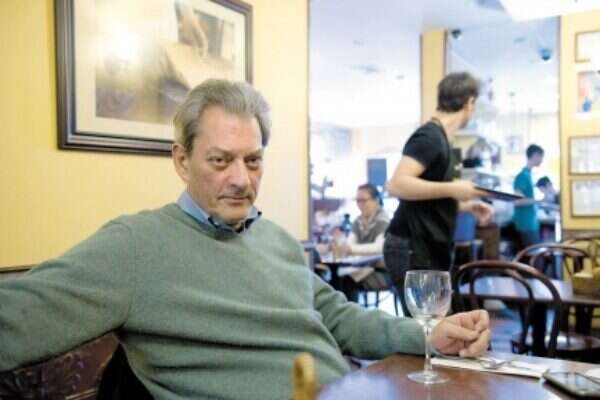
When the Q subway line clatters over the Manhattan Bridge toward Brooklyn, the view suddenly changes. The darkness of the subway and the constant shadow that the skyscrapers cast are replaced by bright, sparkling sunshine. It's cold, but delightful. The dark bank and pharmacy storefronts that formed most of the view before give way to other kinds of businesses once you get off: a tire repair shop with an out-of-date calendar on the wall, a greengrocer that sells a disorganized array of produce, and a small, charming tobacconist's shop just like Augie's the one run by the character played by Harvey Keitel in the movie "Smoke." Auster feels completely natural in these surroundings. With a short cigar, black wool jacket and trademark dark shades, he frequently takes short walks on Park Slope's Seventh Avenue from the apartment where he writes, near his home, to the local coffee house or newsstand. With his hands shoved into his coat pockets and his graying, carefully combed hair he suddenly departs from his regular route. The passersby don't notice the author walking among them. Despite being one of Brooklyn's trendiest neighborhoods and the bohemian digs of many artists actors Steve Buscemi, Maggie Gyllenhaal and John Turturro and even the "royal couple," authors Nicole Krauss and Jonathan Safran Foer Park Slope is more an ideal environment for young, rich mothers and for yoga centers where chairs worth as much as a small house line the entrance. In any case, Park Slope, and to a certain degree Auster himself, offer the most human if somewhat fractured reflection of New York as seen from the other side of the river. On the cover of the Hebrew version of Auster's new novel "Sunset Park" (published by Am Oved and translated by Bruria Ben-Baruch) this message comes across very clearly. A twilight photo features the far off Manhattan skyline a gray line occasionally lit up by neon lights flickering in skyscrapers. In front of this distant, far-off line we see Brooklyn's buildings 19th-century brownstones, peeling and faded but full of charm and personality. This contradiction between Manhattan's crystallization and Brooklyn's earth tones are the novel's message: the failed search of young New Yorkers finding it hard to survive in the economic and emotional jungle of the city. "America is going backwards" Even after all these years, Auster himself doesn't sit back comfortably in the wooden chair at Sweet Melissa, a crowded patisserie in the heart of the avenue. His body is coiled, he leans forward from the first moment of our interview and says that he just finished reading about the winter plans of the "Occupy Wall Street" activists, the young protesters who took over at Zuccotti Park in lower Manhattan for about two months and were violently evicted by the police on Nov. 15. Despite the evacuation, Auster is encouraged by the expansion of the protest movement throughout the country. "America, like many other places in the world, is going through a very tough time," he says. "The unemployment rates are rising steadily. People are losing their homes and their jobs. The Great American Dream that held that each generation advanced and did better than the preceding one, is over. We're going backwards, and the despair that's part of going backwards is trickling down to these young people. I'm particularly concerned about the young people." Auster says this concern led him to write a novel that, for the first time, takes place in present-day Brooklyn. Not another slow digestion of reality or retrospective observation mixed with mild nostalgia, but rather a description of a situation as it unfolds: old-time baseball players have died, author Liu Xiabo is fading away in a Chinese prison, and rent in downtown Manhattan has gone sky-high all of this quickly unfolds step by step in the novel. "Some of the books I've written were about Brooklyn," says Auster, beginning to name them as he counts on his long fingers. "The New York Trilogy" described Brooklyn of 1974. "Oracle Night" spoke of Brooklyn in 1982. "The Brooklyn Follies" was about Brooklyn of 2000. And of course there was "Smoke," in 1990. Each of those books was written several years after they time they depicted. "Now, in 'Sunset Park' it's Brooklyn of 2008," Auster says. "This was the first time I found myself writing about things that happened three or four months earlier. There are many things in the book that are true, like all the baseball players who died while I was writing it. The whole experience was very refreshing for me." The main characters of "Sunset Park" are a group of young people in their thirties who become squatters in a deserted building in Sunset Park, a rundown section of Brooklyn adjacent to the huge Greenwood Cemetery. No one even raises an eyebrow over the fact that the takeover is by "regular" folks: a photographer who documents evacuated homes; a doctoral film student, and the owners of an esoteric second-hand shop. They're all lost souls in terms of their relationships with their parents, with themselves and with their partners. It's about their inability to commit or connect, the race after money that's been forced upon them, the struggle to survive resulting in either a sane life in New York or a death somewhere far away. One mustn't fall apart, the lead character of the book, Miles Heller, says. And from that moment on he falls apart. "My heart is with the protesters" Auster, 64, isn't the kind of author who goes to academic cocktail parties and doesn't travel as much as he used to. He's still mentor of sorts to many young people in New York. "Most of the people I work with in my publisher's office, in film and many journalists I meet and hang out with are young people. I have a daughter in her twenties (the singer and actress Sophie Auster, whose mother and Auster's second wife is writer Siri Hustvedt) and I closely follow what she and her friends are doing. So I'm not out of touch when it comes to the lives of young people these days, and I'm certainly not isolated in some old age home," he says with a smile, and adjusts his sleeves. Nonetheless, Auster believes that despite the great amount of optimism he feels coming from young Americans, they're trapped. "The U.S. education system is awful. University classes cost a fortune. People don't have $250,000 for a degree. Since most people aren't rich, too many young people take out loans to pay for their studies. And then, when they get their degree, they find themselves with tremendous debt. This is a deathly existence. "What kind of world is it where the children we're raising have to start their lives with a boulder on their backs that they'll never be rid of? People talk about the difficulty in paying back these loans, but no one addresses the root of the problem and talks about the American system. We have to make education here free or at least accessible tor everyone. Otherwise our society won't be able to exist. So the characters in "Sunset Park" collapsed under that boulder and took over an abandoned house in Brooklyn- "I don't think they gave in. They're fighting, like many others. They aren't worthless. They have a little money it's not like they're living on the street. But despite their situation they don't stop struggling, and that's what worries me. The lack of decent jobs is something that very much concerns these young people. At the beginning of the Wall Street protest I saw a picture in the paper of a young man standing in the middle of the street holding a sign that said it all: 'Young, educated, unemployed.'" Do you really think something different is happening this time- "This protest is very special, and you're talking with someone who witnessed the anti-war protests of the 1960s. It makes me happy to see that something is happening because too much time has gone by where nothing was. People are simply saying 'no' to the situation as it is today, and that's the most interesting thing, because these people don't have clearly defined leaders and their messages are a little unclear. We see that an angry discourse has broken out in the U.S. completely." Yet many criticize this spontaneity, and the ambiguity of the protest. "The protesters are saying that things have to change, but it's not their job to say how to change the situation," says Auster. "They see the problem in a wider context. I think the more unclear they are, the more popular the protest will be. If they would protest in a traditional fashion via a party or funding from some group they wouldn't enjoy the continuity they're enjoying today. What's happening now is good. Very good. I wasn't at the protest myself, in the streets, because I was busy writing. But my heart is with them. With only a typewriter "Sunset Park" is Auster's 20th novel in more than 30 years of writing. And that's not counting three books of poetry, five screenplays and a few collections of articles and essays. His long stay in Europe in the 1970s, his long romance with French existentialism and his membership in Pen, the international organization of writers that fights for freedom of expression, keeps his image fresh and intriguing. Auster isn't an American writer in the patriotic, limited and overused sense of the word. In a country where only 900 books a year are translated and people refuse to look beyond their shores, he's even a cosmopolitan author. His books are more successful in Europe because America loves to keep its successes exclusive, and also because the U.S. still hasn't come to terms with authors who are also intellectuals, an equation that Auster feels comfortable with. Auster speaks precisely and quickly, even when he's thinking about every word. Once in a while he stops to look at the mothers hurrying to finish their coffee so they can pick up the kids from the school across the street. In a green knit sweater and matching shirt and a glass of sauvignon blanc in his hand, Auster trades silent smiles with the waiters, and straddles the fine line between revered artist and intelligent, approachable man. He works hard, he says, even though now he's just in the thinking stage, before writing something new. When things come together he will sit down in front of his Olympia typewriter, which became the protagonist of one of his short stories, and type himself to death. Not on a laptop sporting a bright apple on its back like those surrounding him in the coffee shop, and certainly not on a thin tablet hidden in the jacket of most subway riders. He's had the Olympia for 30 years a real relationship. "Yes, it's kind a philosophical stance," he admits, "but it's complicated. I love my typewriter so much that I wouldn't want it to ever change. I have a computer that I use to write screenplays, but I don't like it because it doesn't resist my fingers when I write with it, compared with the typewriter. The typewriter is comfortable for me, I'm used to it, so I have no need to change anything." The cellular world has also disappointed him, though for Auster, every disappointment is mixed with thought that leads to a mysterious and curious smile. "I had a cell phone for a while but I didn't use it," he explains. "It was when my daughter was a teenager. She asked me to buy her one, so I told her: 'Take mine, but don't lose it.' And she didn't lose it." Internet? He doesn't ignore it and uses the Web occasionally. "But I have an assistant, and if I need any kind of information she looks it up for me. She also sends e-mails for me. I use the actual technology, but I don't want to own it. Everyone I know is unhappy with the technology they own. They're all busy complaining. I hear someone say; 'I got 275 e-mails today how can I answer them-' It just creates despair. I decided I didn't want to live this way. If someone wants to get in touch with me he will find the way. It's not a moral stand, just a matter of feeling comfortable with myself." Auster recently completed another autobiographical work one that's "different than anything I've written in recent years, a kind of continuation, 30 years after 'The Invention of Solitude,'" he says. "Nonetheless, it's written in a completely different way. In a sentence: It's a book about the history of my body. But that sentence has many sides to it, of course." In the past he talked a lot about the authors who influenced him, mainly James Joyce, Samuel Beckett, Franz Kafka classics that made an impression on many authors. Do any contemporary authors alive today interest him enough to become a fan? "I'd only read every book written by a very short list of authors," he says. "David Grossman is on the list, J.M. Coetzee, Don DeLillo, Peter Carey, Michael Ondaatje and, of course my wife, Siri Hustvedt. That's it. Philip Roth wrote about 32 novels, but I didn't read more than eight of them." Mixed feelings about Israel Auster was 9 months old when the U.N voted on the creation of the state of Israel. He was born in Newark, New Jersey to Polish Jews Samuel, who worked in real estate, and Queenie, who was sorry about marrying Samuel even on their honeymoon but didn't dare leave him. Like every family on the East Coast in the years following World War II, the fate of European Jewry after the war interested them. "I grew up with Israel," he says, "Every morning I would go to the Hebrew school in New Jersey, knowing that part of my lessons would be devoted to raising money for the young state. We were busy all the time with planting trees and writing little greeting cards to people in Israel. We felt as though we were part of the state, even though physically we lived far away from it. We, the children and the adults, felt as though we were helping to build a place with new ideals. We were very excited about it. This excitement continued all these years- "I said that I grew up with Israel, and to a certain extent Israel has been a part of me all my life. My ties to it go beyond the fact that I have friends and acquaintances there. We could discuss the complexity of Zionism and its foundations forever, but at the time of the destruction that World War II left in Europe there was a lot of logic to creating the state of Israel, both in terms of the Jews who survived and how the whole world saw the situation. "I confess, I have mixed feelings about Israel today, because Israeli society has changed. It changed from an idealistic state to a socialist one. But now it's a country with too many fanatic religious foundations. I don't think Israel's founders believed that religion would be such a substantive and fateful subject in the years ahead." I attended your conversation with David Grossman at the Writer's Festival in Jerusalem in May 2010. What I remember most from the conversation was what you said about the different atmosphere on the Israeli street compared to your visit 13 years earlier. Try to describe these feelings. "I only visited Israel twice in January 1997 and in May 2010. The situation in 1997, as I saw it, was very tough. It was just more than a year since Yitzhak Rabin's assassination and people in the street were still mourning. The feeling was of one big trauma in the air. The prime minister then, as now, was Benjamin Netanyahu, someone whose opinions I don't agree with. Nonetheless, at that point Netanyahu signed the Wye Agreement committing Israel to withdrawals from West Bank territory, which turned out to be a huge step in the peace process with the Palestinians. So there was hope. People were talking about something. In addition, I remember that I stayed in Jerusalem and on Shabbat the streets were buzzing and the stores were open. "During my second visit to Israel, last year, the Jerusalem streets were closed and empty on Shabbat, except for one coffee shop that stayed open. I traveled to Tel Aviv to visit a friend and when I told him about what was going on in Jerusalem, he answered in that cynical way Israelis have: "Jerusalem? That's not a city, it's a disease. "The festival I participated in at Mishkenot Sha'ananim was extremely well organized, and it seemed like there was a real hunger in Israel for an artistic life, for some kind of spiritual existence. But from a political point of view, I understood that people didn't know what to think anymore and that they didn't see any hope on the horizon. "One of the authors who participated in the festival told me, justifiably, that the feeling is that the Israelis live between despair, which characterizes the Left, and denial, which characterizes the Right, with very little in the middle. The denial is insufferable, it can't survive, and the despair it also doesn't arouse hope. So everything is stuck." My friend, David Auster speaks as an observer, careful not to preach. Suddenly he says that he closely followed Israeli soldier Gilad Shalit's release. Every answer he gives about the situation in Israel ends with a desperate attempt to confirm what he's said. Nonetheless, Auster says that more than anything he cannot reconcile with the settlers who came to Israel from the U.S. "Many of the settlers came from here, even from Brooklyn," he says. "This is an issue that concerns me a lot because most of them are not Israelis from birth but fanatic Americans who live in a Wild West fantasy world where the Palestinians are the Indians. These people don't live according to any real logic, and that complicates the situation. This irrationality also characterizes American politics. People are so set in their way of thinking that they can't look at the world differently and maybe change their minds. You can't have any kind of dialogue with such people, which is why you can't create anything with them. This is what's happening in Israel, it's happening in America, and in too many countries around the world." What place do intellectuals have in this discourse- "Whenever I or my colleagues did something it was much more effective when we acted as regular citizens, and not intellectuals. I say this while still a member of Pen, which espouses intellectual intervention. We, the organization's authors, conducted many public political discussions. Last year we held a lot of events related to the U.S. government's torture policy. Many people came, and I saw that as very important, but along with that you also have the slight feeling that you're preaching to the choir and not persuading anyone new. Still, it's important to hold such events in public." Auster's connection to Israel also stems from the special connection he has to Israeli author David Grossman. He dedicated his novel "Man in the Dark" to Grossman and Grossman's wife and children in memory of their son Uri who fell in the Second Lebanon War in 2006. On the stage at Mishkenot Sha'ananim in the spring of 2010, it was easy to see that the friendship between Auster and Grossman goes beyond that of two author colleagues, and includes, along with inside jokes about publishers, rare candor when they meet privately. When Auster talks about Grossman, he withdraws a bit, not wanting to really talk about that friendship, so as not to disturb the intimacy of the connection that became so fateful and grew stringer after Uri fell. "I've known David for a while now, and he is one of the people I most admire," he says after a long silence. "The tragedy, sadness and horror that all came together in Uri's death moved me so much that I wanted to pay some kind of public tribute to David, Michal, Yonatan and Ruti. The dedication of the book is nothing but a tribute of love." Who needs another memorial- If there is any thread that runs through Paul Auster's novels, stories and screenplays, it is weaved from either or both sides of loneliness. His characters love and are loved, communicate, but nonetheless always run into a wall and end up with themselves. Auster tries to stress the difference between two English words "solitude" versus "loneliness," and in Hebrew the difference is even clearer: between purposely choosing solitude and loneliness. "Solitude is a word that describes a situation in which a person is by himself, and most of us are indeed alone much of the time. We don't really talk about it, and don't acknowledge it, but most of what we do requires that we be by ourselves. Loneliness, on the other hand, is a difficult word that confirms that people are social creatures that require love and contact from the moment they are born. "Loneliness proves we are human, because it's the point where we are cut off from our basic needs. It represents a longing to be with other people. Loneliness is the opposite of solitude, which can be by choice. A person can never be in a state of loneliness by choice." The loneliness in the new book "Sunset Park" also ties into the inability of the American collective to feel true empathy after the Sept.11, 2001, terrorist attacks. In American literature, a black hole has popped up in the plots of novels by many authors, a hole that contains memory, discomfort and fear just as a corner is left unfinished and exposed in the homes of religious Jews as a memorial of the Temple's destruction. At the end of "Sunset Park," one of the characters escapes a difficult fate, and in running away he looks from the Brooklyn Bridge at the huge buildings across the East River and thinks of the missing buildings, the crumbling buildings, those that burned down and no longer exist. Auster says, however, unfortunately, that Americans can't just commune with themselves, but have to talk themselves to death. "There aren't many quiet moments in American life," he says. "We have to talk, do, build. The real inclination I had after the towers fell on Sept. 11 was to leave the site of the disaster empty, put up a park there, just grow grass. Everyone would understand what the grass was all about. "But no we have to build another big tower because we are America and we have to show the world how strong we are. We had to build a huge monument because we're sentimental. If they had asked me, I would have acted differently. I think that if so many people were killed in one spot the ground at that site becomes holy, and we should simply leave it alone."
Like our newsletter? 'Like' our Facebook page!
The author and the shadows
Paul Auster is concerned with the despair of young Americans, "but encouraged by the wave of protests" • He's a Zionist, "but fearful of the fanatic institutions in Israel" • The author sat down with our reporter for a conversation full of solitude.
Load more...