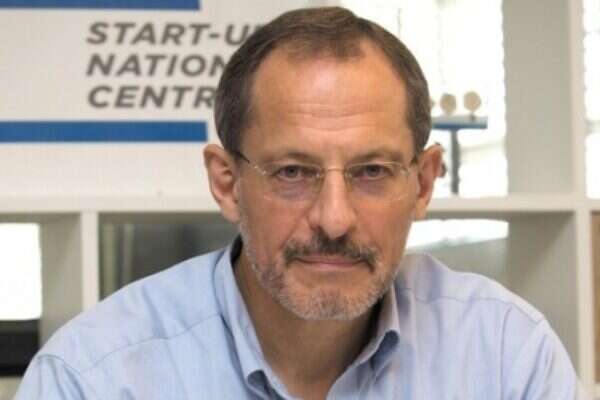
Four years ago, when Prime Minister Benjamin Netanyahu was looking for a new governor for the Bank of Israel, he offered the position to Professor Eugene Kandel. What could be more logical than to offer the job to someone who earned his doctorate in finance at the University of Chicago, taught at the University of Rochester for eight years and was already an economic adviser to the prime minister and serving as chairman of Israel's National Economic Council? In an interview with Israel Hayom at the offices of Start-Up Nation Central in Jerusalem, Kandel gives his signature straightforward answers: "I'm not suited for that job. Dr. Karnit Flug [the candidate ultimately selected to serve as the Bank of Israel governor] is a far better choice. I lack the necessary diplomatic skills -- I say what I think and I do it bluntly -- and it could hurt the markets. In addition, my knowledge of the banking system is superficial. Flug came from the banking world." During the course of the interview, I come to learn more and more what Kandel meant. Even when his media adviser shifts in his sit uncomfortably at the sound of his replies, Kandel doesn't hesitate -- he says everything that's on his mind. Perhaps that's why Kandel didn't end up in politics or in a senior government position. Today, besides being an economics and finance professor at Hebrew University, Kandel heads Start-Up Nation Central -- an initiative built around the narrative of the book "Start-Up Nation: The Story of Israel's Economic Miracle" (a 2009 book by Dan Senor and Saul Singer about Israel's high-tech economy). The initiative is financed by American billionaire Paul Singer for Zionist reasons. The idea is to improve Israel's global image by way of one of Israel's strongest assets: technology entrepreneurship, or as Kandel prefers to call it, industry of innovation. The initiative confronts the challenges head-on, seeing as the Israeli high-tech industry is a double-edged sword. As Kandel attests in the interview, the industry is not reliant on a geographical location. Most of the workers in high-tech don't require a workshop and can pick up and relocate at the drop of a hat. In fact, tech companies all around the world do it every day, adapting to the changing realities in their respective countries. When I ask Kandel if Start-Up Nation Central also lobbies government ministries to facilitate growth in the industry, he is rather surprised. "All we have to do is explain to the ministries how their decisions impact the industry," he says. He doesn't need to lobby, he clarifies -- the initiative could easily have been a part of the Prime Minister's Office because in its vision it aims to benefit the state, he says. This interview reveals the pitfalls of the high-tech industry. The negative public view of wealth, success and entrepreneurship worries Kandel, as it should every citizen in the country. According to him, the success of the industry could potentially drive the standard of living up for the entire country, but it could also be destructive. Clearly, some of Kandel's fears about the future are actually problems we are facing in the present. Cutting edge technology could become a hotbed of brain drainage, just as it could draw Jews from poorer countries to Israel. Higher productivity in high-tech could exacerbate wealth inequality but it could also be a catalyst for higher productivity in other fields. The growth in the Israeli high-tech sector over the last decades could be obscured by the growth in parallel sectors in other countries that have placed an emphasis on technology, but at the same time it could solve Israel's growth problem and encourage the government to instate conducive policies for growth. The industry needs to grow both in the number of companies and in their size. One of the industry's main resources, and the most important one at that, is its manpower. Just recently, the state allocated larger budgets to technology education and more advanced math education among students as young as middle school age. Kandel believes that young people need guidance in choosing what to study. "If someone really wants to study biology, for example, and that is their dream, they should study biology. But such a student's abilities could make him just as well suited for computers and engineering studies. Perhaps if this young student had all the information about future employment opportunities, understanding that a biology degree would fetch a salary that is about half that of a technological field, it might impact their decision." Another question that the interview raises is the use of technology innovation as a form of public diplomacy. Israeli entrepreneurs that I've spoken to have argued that this is the right direction. The global media has painted Israel as a military state, preoccupied mainly with occupation and warfare. The boycott, divestment and sanctions movement, which includes quite a few Israeli supporters, also contributes to this false image of Israel as a militant aggressor. Any attempt to deny their claims only serves to help their cause. The only way to confront their efforts is to highlight Israel's true assets, thereby generating a more accurate image of the country and ultimately drawing a more positive response from the world. Q: So what do you tell international investors when you approach them? What do you say when you propose a collaboration? "I explain to them that we have very attractive laws to promote investment. In general, our objective is to ensure that when a delegation leaves Israel, they are leaving with the knowledge that they have no choice, they can't afford not to collaborate with Israeli technology. In most instances, they land in Israel wondering what they are doing here, but then they meet us and they go back with a completely different mindset." Q: Is it true? Are we really too good to pass up- "Currently, 9.3% of the Israeli workforce is in high technology -- that's the highest rate in the world. Companies from all over the world take a particular interest in Israelis working in the field, because we have the necessary skills and the state has invested a lot of resources into training and knowhow. The fact is that we are world leaders in innovation. "Our 'Finder' system lists 5,200 Israeli companies. Every month we get 60,000 visits, with half coming from outside Israel, exploring the technology and the solutions that the companies here offer. We are seeing interest mainly from the U.S., India and Britain, but actually from all over the world. And these are not necessarily avid Zionists, they come for the solutions that we offer." Q: Can you give me an example? "We recently brought a giant Indian company, with representation in 36 countries -- the SAR group -- together with one of the Israeli companies in our Finder system. Turns out that the Israeli company is a tiny, interesting group from Haifa, comprising four partners -- two Jews and two Arabs. The Indian company deals with water purification technology, clean energy technology and clean transportation and things like that. "We brought the founder and president of the [Indian] company Rakesh Malhotra to Israel. It was his first time here. We introduced him to a few people and finally a business connection was struck between the Indian giant and the Israeli tech company. We're talking about a deal worth tens of millions of dollars. "Another example is AXA, the French insurance giant. We organized visits to Israel for their senior management and introduced them to local technologies. About two months ago, thanks to our meetings, they decided to launch an office in Israel to research Israeli insurance technologies. There are already about 12 employees working in their Israeli office today and now Israeli technology companies can directly sell solutions and collaborate with an insurance giant. We also introduced Israeli technology to the Bank of New York Mellon, which has assets in the trillions of dollars, and there are plenty of other examples." Kandel is a true joy to interview, thanks to his extensive knowledge and his integrity. Unlike other economists, who tend to focus on market failures (perhaps, like doctors, their view is naturally skewed by the very fact that they treat problems), Kandel has his eye on building. He sees the positive in work, in people and in business. For example, he is very sorry about the recent onslaught of criticism directed at Israeli pharmaceutical giant Teva. "After their latest big acquisition, the newspaper lauded the management and wanted to award prizes to the CEO. But when doubts arose as to the acquisition, that it may have been a mistake, they rushed to sling mud at them. This creates a very problematic atmosphere and hinders management. It is imperative to allow managers to make mistakes," he says. When I ask Kandel about the particular challenges that we face, he says, "There are two economies in Israel. The growth engine in Israel is the innovative, technological field. That's what the world is interested in with regard to Israel. But 60% of the population doesn't even have access to this field, and 90% aren't working in it. The main challenge is to increase accessibility and expand the workforce in this industry. "It is essential for many reasons. It would balance the social gaps and it would ensure that this unique field survives in Israel. If it doesn't grow, it shrinks. There are many threats -- many companies around the world actively search for Israelis and encourage Israelis to come work for them [overseas]. Generally speaking, when a CEO of an Israeli technology company relocates to another country, the company loses its foothold in Israel. "The reason people stay here, besides this being their home and the comfort of living in a place where you belong, is that there is a big technology industry, like in San Francisco. But if this industry shrinks, that will no longer be a factor. It will be finished. We have to ensure growth. "The challenge facing the other industries is productivity. Productivity in Israel is 30% lower than the norm in developed countries -- and that's when you factor in the productivity of the tech industry, which has a higher growth rate than the global average. There are industries where Israeli output is about half the output of parallel industries in other developed countries. "I served on the [Health Ministry's] German committee, which studied Israel's health system budgets, and I saw the data comparing public and private operating rooms. The output in the public sector was far lower. Unless we step up our productivity, we will be in deep trouble. Society will polarize even more. Again, like in San Francisco -- they really don't want Google and Facebook there anymore. "The successful industries give rise to a wealthy class of people with the ability to pay more, ultimately driving up the cost of living for everyone. The gaps need to be closed from both directions -- increase the size of the tech field and simultaneously increase the productivity of the other industries." Q: Does that explain the high cost of living in Israel- "I don't think so. Housing is expensive in Israel because of planning mistakes that were made starting in 1998. In my opinion, the steps that have been taken in recent years will result in price drops in the future. But when you look at high cost of living, it's not just the prices at the supermarket, it's also education, health and other things. "If you look at the entire basket, Israel is not any costlier than other developed countries. But, as I've said, if the economic engine, the high technology industry, stops growing, there could be a reality where 5% are employed in the industry and 95% envy them. That would be extremely unhealthy for society and for the economy." Q: How can productivity increase when at least half the workers are protected by tenure agreements- "Somewhat ironically, the inflated salaries of electric company and port workers, for example, actually contribute to productivity because productivity is measured by income. But you're right that there is a problem there, because if you measure the output of the port in Israel and compare it to the output of ports in other developed countries you will find that the output in Israel is half the norm. "The problem is the lack of correlation between output and salary. After all, we have no problem with worker earning more if the justify their salary. A German engineer, for example, earns more than an American engineer, but also produces more. Additionally, the government needs to have more faith in industry and reduce regulation. I don't understand why a product that has been approved by several standards institutes in the world needs to go through the entire approval process in Israel, too." Start-Up Nation Central is a nonprofit initiative aimed at promoting Israel and engaging in public diplomacy around the world by marketing Israeli technology innovations. The initiative numbers 50 employees working at offices in Tel Aviv and in Jerusalem. The group recently purchased a building on Tel Aviv's Lilienblum Street, designated to become a home to the innovative industry community and introduce this industry to potential partners around the world. Over the last three years, SNC matched up 635 Israeli companies with clients in 40 countries. The clients include corporations, governments and nonprofit organizations. Over the last 18 months, 68 connections were made between foreign groups and Israeli companies, leading to 25 proof-of-concept deals. SNC initiatives have yielded three new innovations centers in Israel, built by large foreign groups, thereby increasing the exposure of Israeli companies to the world. In the coming weeks, SNC plans to launch a new version of its Finder system -- the platform it uses to introduce Israeli technology to interested bodies. Israeli technology companies can ask to be listed in the Finder database at no cost and enjoy greater exposure for their product. The platform gathers and organizes extensive data on the technological "ecosystem" in Israel. The Finder database currently lists detailed information on 6,000 active Israeli technology companies, investors, accelerators and multi-national corporations operating in Israel. The Finder data is managed by the SNC research team, which comprises ten analysts specializing in different sectors and different fields. The platform allows entrepreneurs update their profiles independently and increase their shot at a deal. The team adds 150 new companies monthly and updates more than 1,000 profiles, making the platform one of the most accurate and reliable databases of its kind. Experience so far suggests that most searches from other countries focus on cyber, digital health, finance technology and information technology. The searches focus mainly on companies offering solutions for business.
'Technology is Israel's economic engine'
Eugene Kandel, who turned down the job of Bank of Israel governor, may "lack diplomatic skills," but as the head of an initiative promoting Israeli technology, he has plenty to say • Israel must ensure the growth of the tech industry, he warns.
Load more...