Uruguay's government is asking political and religious leaders what it should do with a bronze Nazi eagle recovered in 2006 from a sunken German warship off its coast, the country's defense minister said Wednesday. The eagle came from the stern of the German battleship Admiral Graf Spee, which was scuttled off the coast of Uruguay in the early months of World War II. Defense Minister Jorge Menendez said he would talk with members of the country's four political parties Wednesday about dealing with the bronze eagle, which weighs more than 800 pounds and has a swastika under its claws. He met with members of Uruguay's Jewish Central Committee on Tuesday. "Our concern is that the eagle doesn't generate a Nazi sanctuary in Uruguay that will draw Nazis from all over the region," said Israel Buszkaniec, the committee's president. "We'd have no problem if it's sold and leaves the country." The Graf Spee was considered one of the most sophisticated battleships of its time. It prowled the South Atlantic and sank several Allied merchant ships before warships from Britain and New Zealand tracked it down and damaged it during the Battle of the River Plate, which began on Dec. 13, 1939. The damaged Graf Spee limped into Montevideo harbor, where injured and dead sailors were taken ashore. Its captain ordered the ship scuttled to prevent it from falling into enemy hands, sinking it a few miles off the coast of Montevideo. In February 2006, a recovery team removed the eagle from the ship's stern. It has since been kept in a navy warehouse. The salvage team initially sued to demand the right to sell the piece. But Uruguay's Supreme Court ruled in 2014 that the eagle belongs to the Uruguayan state. The ruling said, however, that if the piece is sold, the salvage group would have the right to 50% of the proceeds. Opposition lawmaker Jorge Gandini has proposed exhibiting or selling the eagle to raise funds for the Uruguayan military. Former President Julio Maria Sanguinetti suggested in a recent newspaper article that the eagle go on display in Uruguay because of its historical importance. "To imagine that, as some say, it could lead to a certain Nazi cult, is really absurd, because it is actually the contrary: It's a monument to their defeat," he wrote.
X
שיתוף כתבה
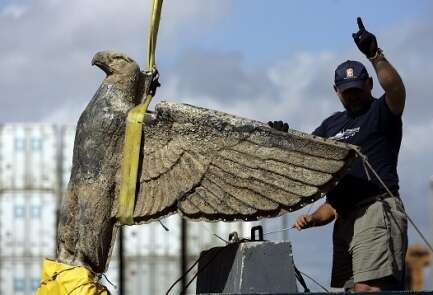
Uruguay weighs what to do with Nazi eagle from battleship
Defense Minister Jorge Menendez holds talks over 800-pound bronze eagle with swastika that was recovered in 2006 from scuttled German ship and has been in storage since • Uruguay's Jewish Central Committee worries the eagle will draw Nazi sympathizers.