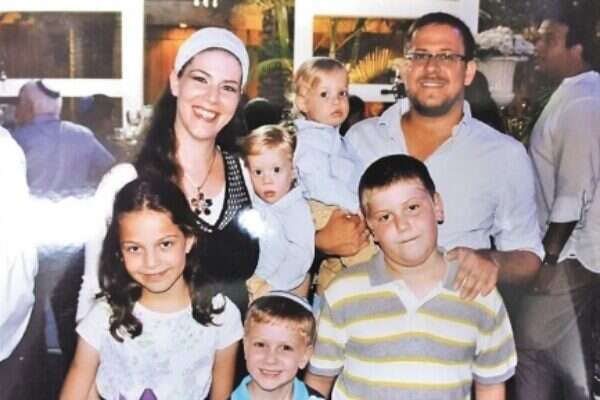
It's 1 a.m. between Saturday and Sunday. Tova Salomon wakes up after surgery. She was seriously wounded in a terrorist attack after witnessing her husband Yossi, son Elad and daughter Chaya being butchered by a terrorist. One of her surviving children, daughter Orit, is by her side at the hospital, reeling with pain. "We were in the recovery room," Orit recounts. "Mom opened her eyes and asked about Dad, Chaya and Elad. I didn't answer. She closed her eyes, fell asleep again for a while and then woke up and asked again. I told her that Dad was gone. She asked about Elad. I told her Elad was gone. She asked about Chaya. When she heard about Chaya, she let out a scream. She couldn't take it." In the mourners' tent outside Elad's house, the three surviving Salomon siblings sit on low chairs together with Elad's widow, Michal. Yossi's brother Benzi Salomon and sister Leah Friedman are also there, with torn shirts and swollen, red eyes. The siblings have a lot to say. They don't want their father, a kind, joyful man, to be remembered only for the shocking images of a blood-smeared kitchen floor. They don't want their generous, wonderful brother to be remembered only in the context of a massacre. They don't want their sister, a devoted teacher and loving aunt, to be etched into the collective memory just as a victim butchered on a doorstep. Their lives should be remembered no less than their death. Yossi Salomon was the son of Holocaust survivors from the Romanian town of Dej. His father, whose wife and four children were murdered in the Holocaust, married his cousin after the war. Their first child, Yossi, was born in 1945. When he was 12, the family left Romania and moved to Israel. When Yossi married Tova, the couple initially built a home in Beersheba. But in 1983, after having three children, they joined the settlement of Neve Tzuf (Halamish), east of Ben-Gurion International Airport. They joined the fledgling community for ideological reasons, but also to enjoy a better quality of life. Tova worked as a kindergarten teacher and just recently retired. Yossi worked as a medical supplies manager in the IDF and later doing maintenance at Talpiot College of Education. To supplement their income, he worked as a night watchman in the community as well. Their children say that after a lifetime of hard work, they only recently began enjoying life: going to hotels, taking hikes, celebrating birthdays with the grandchildren. Yossi traveled to Jerusalem three times a week to study Torah. The rest of the time he worked on enjoying the peaceful joy of retirement. At the urging of his children he wrote down his memories of his childhood in postwar Romania. Tova and Yossi raised five children in a beautiful, two-story house in Neve Tzuf. They were a close-knit family that spent Shabbat and holidays together and often gathered to celebrate family events. Chaya, the eldest, was 46 when she was murdered. She was a well-loved first and second grade teacher. In recent years she taught at a religious public school in Lod. She was taken from this world without having had any children of her own. She also never married. The school was her entire world. Her students were like daughters to her. Their parents describe her as a warm and dedicated teacher. She loved her nieces and nephews like she would her own children. Chaya was diagnosed with Type I diabetes when she was 10 years old. "As the years progressed, she found it very difficult to be away from our parents," says Orit. "Dad was always glued to her on trips. Worrying about her. She even did her national service within the community. Maybe that's what stopped her from getting married, and maybe it was a question of chance or a life course." Chaya lived with her parents her entire life. She was their support system and they were hers. She stayed in her narrow childhood bedroom even after her siblings moved out and she could have her pick of larger rooms. Several years ago, she underwent gastric bypass surgery and shed 30 kilograms (66 pounds). When Shmuel, the youngest brother, talks about the car seat Chaya bought for his newborn son, born into this tragedy, he bursts into tears. "She bought the best car seat there is, so that he would be safe. So that nothing bad would happen to him," he says. After Chaya, came Orit, now 43. Orit lives in Modiin and has two children. She works as a special education teacher. "I'm the eldest now," she says in horror. The third sibling is Racheli, 40, works in behavioral analysis in the field of special education. She lives in Har Bracha and has seven children. "Our parents encouraged us to go into education," they both say. After the girls, Elad was born. He was 36 when he was murdered while courageously fighting off the terrorist. He worked in QA in the computer industry. He lived in the city of Elad and was a father of five. When Orit was diagnosed with leukemia some 20 years ago, Elad, then 16, donated his bone marrow to save his sister. Since then, the bond between has been very deep. The youngest sibling, Shmuel, 31, lives in the Hadassim youth village, where his wife works as a counselor for disadvantaged girls. He works in pest control. Last Thursday, a day before the attack, his first child was born. An eternal child About a year ago, a string of arson attacks burned 17 houses in Neve Tzuf to the ground. "We actually wanted our house to burn down," they say with a smile. "The kitchen was old, the whole place needed to be renovated." The floors at their parents house had just been replaced due to a plumbing problem. "The first time I saw the new floor was on Shabbat," says Michal, Elad's widow. "It was a white, bright floor. It was reflective. Afterward, it was all red. I will never go back to that house." The siblings talk about their father, who radiated warmth and love. "Dad was an introvert. His emotions came out not in words but in action. In the way he worried about us. In touch," says Orit. Racheli adds that she never once heard him say "no" when asked to help. Yossi was a prominent figure in the communal town. He was the first gabbai (synagogue administrator) in the town synagogue. Every Shabbat, he donated the food for kiddush. At events he would walk around the room with a bottle of alcohol and pour drinks for everyone. "When the doctors told him he couldn't drink anymore, he started raising a glass of water with the revelers just to be part of the celebration," Shmuel says. Michal, Elad's widow, sits beside the siblings and welcomes the guests. She is 35 years old, grew up in Rehovot and works at an insurance company that insures foreign workers. In a T-shirt and denim skirt she looks like a teenager. A mother of five, and tough as a lioness. Her co-workers, who came to console her say they weren't surprised to hear how she protected her children on that horrible night. She met Elad while spending Shabbat at a friend's house in Neve Tzuf. The girls decided to join a group of three boys on a hike in the Galilee. "We were careful not to touch the boys until I fell out of a kayak and Elad rescued me," she laughs. She says they immediately fell in love. Four months after that hike, they were almost engaged. Michal's mother begged her not to rush into the engagement, so she waited two more months. And then, atop the snowy Hermon mountain, Elad proposed. "His lips were always smiling. He was my rock. I lost my mother, we went through some difficult times, but he was always there to make me happy. To reassure me about who I am. He loved life, he loved his friends, he loved his country. When his reserves unit was disbanded, he volunteered to serve in the Homefront Command." "Elad was an eternal child. When we bought a giant box of Legos for one of the kids, the sales clerk asked who it was for, and we both smiled. It was clear to both of us that it was actually for Elad. Now, during the shiva [weeklong mourning period], we received a donation of toys for the kids. I saw the packages and thought that if Elad were alive, they wouldn't stay closed for more than a minute." Over the last eight months, since the end of Michal's maternity leave, Elad had been at home a lot and spent much of his time with the children. Two weeks ago he started working at a new job, overseeing sports gambling. The day before he was murdered he attended a social gathering with his new work team. "He was so happy," Michal says. "I regret not having talked more" Last Thursday afternoon, Shmuel's son was born -- Yossi and Tova's 15th grandchild. Tova finished getting ready for Shabbat dinner on Thursday, set the Shabbat table, and on Friday morning she went over to Shmuel's apartment at Hadassim to get it ready for the arrival of the baby. "I took mom home on Friday afternoon," Shmuel recalls. "I got a chance to hug my father. I also saw Chaya and Elad, but I was in a rush and I was upset about something insignificant, and I regret not having talked to them more." "I regret not having been there when the terrorist was in the house. Not being with Elad, not fighting with him or helping him. I wouldn't mind dying with him, together. The only thing keeping me going is my son and my wife. My son was born a day earlier, to help me and give me strength. There was a time when it was just Chaya and me living at home. I stopped being religious, and it bothered Chaya more than it bothered my parents, who ultimately accepted it. She had a true fear of God." On Friday morning, a memorial was held for Michal's grandmother. Every year, after the annual memorial service, the family would always take a trip with the children in Jerusalem after leaving the cemetery, but this year they decided to forgo the outing because of security tensions and the threat of terrorism. "We didn't expect to have this evil to come find us, on Shabbat, at his parents' house." "On Friday afternoon we ate with the kids in Mevasseret Zion, we then went home to pick up our bags for Shabbat and headed to his parents' house. Yossi wanted to go to synagogue on time so that at 10 p.m. everything would be ready for the 'shalom zachar' ceremony in honor of Shmuel's son." The terrorist smiled At the end of the Shabbat dinner, the three oldest grandchildren played with toys in the living room. Avinoam, 10, Reut, 9 and Amiti, 5. Upstairs, the 1-year-old twins, Ariel-Ziv and Avishai-Lavi, were asleep. "After dinner, the kids were sitting around me, playing. I didn't stop reading the paper and the door opened. This town is a community -- one big family -- and still I was surprised that someone would just come in without knocking." The terrorist, who had been watching the family from outside the window, knew that there were three people in the kitchen. He came in and immediately turned right, toward the kitchen. He had his back to the living room, where Michal was sitting with her children. When the door opened, and a man wearing a white shirt and blue trousers came in, the family thought he was one of the guests. He held a long knife. Chaya was stabbed on the doorstep. She ran outside to call for help, screaming with her final breaths. It was Chaya's screams that alerted an off-duty combat soldier living across the way to the threat. He fired at the terrorist through the kitchen window and neutralized him. But by the time Chaya's screams alerted the neighbors, the terrorist had already attacked the rest of the family. Tova was standing by the kitchen sink, thinking the man was a guest coming to raise a toast. She pointed to the knife as if asking a question. He smiled, and swung the large blade. She ducked, and the knife pierced her back. Yossi was standing next to the oven. The terrorist stabbed him with a few quick strokes and he fell. Elad immediately came to his senses and pounced on the terrorist, trying to subdue him. He growled like a lion, Tova later told her children. He grabbed the terrorist by the shoulders and struggled with him. When the terrorism pinned him to the ground, Elad, wounded, rose back up to fight him. "Everyone was a hero in their way," Shmuel says. "Chaya who screamed for help; my father, who I believe fought back; Michal, who took the children upstairs; and Elad, who confronted the terrorist with courage." With a deep stab wound in the back, Tova went upstairs to her room. The fear that rescue personnel wouldn't find her and that she would bleed to death made her turn back. She collapsed on the couch in the upstairs living area, between the doors to the rooms. Michal displayed chilling composure. All her senses became sharp as she was determined to protect her children. "I put the three of them into the room where the twins slept," she says. "I couldn't find the key so I leaned on the door and held the handle tight. The children started crying and I told them that they had to be quiet. They understood." "Once it became quiet, I opened the door and saw Tova on the couch, screaming for Elad. I asked her if the terrorist was still there but she didn't know. I took my phone from another room and went back to the children and called the police." "I reported a terrorist attack in Neve Tzuf. I couldn't give the address because in this little community there are no streets or street numbers. I was angry when the dispatcher insisted I give her an address. I think I was yelling and whispering at the same time. I whispered because I was afraid that the terrorist was still in the house, and I was yelling because everything was so emotional. When I opened the door I saw the father of the soldier who neutralized the terrorist with a gun in his hand. I understood that the situation was under control." "I couldn't find Chaya. I saw Yossi, but only the lower part of his body, on the floor in the kitchen. I saw Elad lying on the ground in the entrance to the kitchen. I knew that he had fought to protect the children. There was nothing vulgar or aggressive about him, but when he wanted something he knew how to go for it, to the end." "I know he saw us running upstairs. He knew it was his job to do everything possible to keep the terrorist at bay. I saw him take his final breaths. I longed to touch him, to hug him, but I knew that if I did that I wouldn't be able to go back to the children. I was wearing a light-colored dress and Elad was covered in blood. I made a personal sacrifice at that moment. It was for a greater good but it was still a sacrifice. It will stay with me for the rest of my life." "He was facing me. He took three breaths and didn't move again. It may be that he needed to see that I was okay before letting go. He knew that he had fulfilled his mission -- to protect us. I went back upstairs to the children. Then a lot of people from the community came in -- first responders and people who came to help." Michal and the children were evacuated to a neighbor's house and then, accompanied by a military escort, to Michal's sister in Oranit. It was only at 3 a.m. that she managed to get the children to sleep, and even then it was only for a few hours. In the morning she told them that their father, the hero, had died. "I don't feel like a hero. I did what I had to do. During the entire event and the whole night afterward I didn't shed a single tear. I decided that I wouldn't cry, for the sake of the children. I was not going to fall apart. On Saturday morning, when I told them, I cried with them. I told them that they are not alone, that we are together in this." "That night, I decided that the children and I would sleep at home. Since then, I have allowed myself to fall apart. To go home and see his bag, his things, and scream, 'Who is going to take the trash out now? Who will be with me-'" "There was a lot of crying today. There are questions like, 'Where's Daddy-' and a lot of 'I want Daddy.' We can't change the outcome. It is hard for me to believe that I am continuing on this journey without Elad. But I have strength. Elad left me five gifts and each one of them is an entire world. In each one of them I see Elad." "But still, I miss him so much. I still look for his nodding approval. He would always say to me, 'You decide. Do whatever you think is right,' and he always waited to hear so that he could reply, 'Great.' I miss that. But I also know that this friendship, this togetherness, our love, no terrorist can take that away from me, ever." No answer When reports of the attack began to circulate, Orit was at her house in Modiin. She immediately recognized her childhood home from the photos on the various news sites. When she called home, there was no answer. "Gradually, the news reported that another wounded victim had died, and another one and another one, and I am learning that my family is gone from the news." The three siblings who weren't at the family home soon realized the extent of the horror -- Racheli in Har Bracha, Shmuel at the hospital with his wife in Kfar Saba and Orit in Modiin. Orit and her husband Dror were the first to hear the news. Orit rushed to Shaare Zedek Medical Center in Jerusalem where her mother was being treated. Dror went to Neve Tzuf and tried to gather information about the victims. Meanwhile, a soldier was dispatched to accompany Racheli to Shaare Zedek. "I talked to the emergency rescue team at Neve Tzuf and they refused to give me details. I know that three people were murdered at my parents' house but I don't know who. I screamed at them over the phone: 'Who died? My mother? My father-'" recalls Orit. Finally, Michal called Dror from the room where she was barricading herself with her children. Speaking in English so that the children wouldn't understand, she said quietly, "My husband is dead." Orit then tried to contact Racheli but couldn't immediately reach her. "Orit called me and told me, 'They killed everyone,'" Racheli says. Racheli says she is having trouble with the knowledge that the terrorist is still alive. "I am not blaming [the soldier]. I cherish him for his daring action. But he should have killed the terrorist." "It makes me crazy to think that the terrorist will get a degree on my dime and maybe even be released from jail a few years down the road," Shmuel adds. Orit echoes her siblings. "When the security forces came, the terrorist got up again. They yelled at him, 'Lie down or we'll shoot.' Why warn him? Why didn't they shoot him immediately when they saw him get up-" Michal, on the other hand, is not as perturbed. "Avinoam asked me if I was angry at the man who murdered his father. I told him no. I don't feel anger or a need for revenge. I explained to him that when a person is angry they get burned from the inside and expend a lot of energy, and that I just don't have that much energy to waste. I prefer channeling that energy toward our children." None of the children plan on going back to the house in Neve Tzuf. Neither does Tova. "This is the house where I grew up," says Shmuel, "There are memories in every corner. But I can never set foot there, where my father's, brother's and sister's blood was spilled."
'We will never go back to that house'
A week after Yossi, Chaya and Elad Salomon were brutally murdered in their home by a terrorist while celebrating the birth of a baby boy, the family heartbreakingly recalls their lives, so that they won't be remembered only for their gruesome death.
Load more...