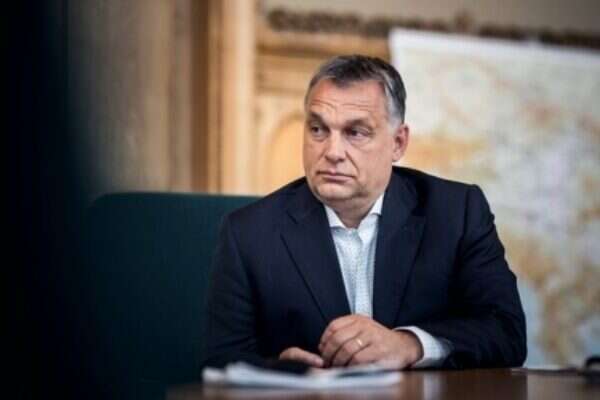
Hungarian Prime Minister Viktor Orban could finally breathe a sigh of relief. He had just presided over a historic visit by Israeli Prime Minister Benjamin Netanyahu, a visit that was held amid tension with the local Jewish community. The visit also coincided with the summit of the Visegrad Group, a bloc of central European countries aimed at boosting regional cooperation, which Orban hosted as well. Netanyahu was invited to attended that summit during his visit. Just before we sat down for the interview, Orban showed me the view from his office overlooking the Danube River. "Netanyahu was extremely awed by this view," he tells me. "He was touched by the fact that he was visiting the city where [the founder of political Zionism] Theodor Herzl was born. He was moved every time he mentioned Herzl. This wasn't just an official visit, it was an emotional visit." It didn't take long before Orban expressed his pleasure at having successfully moved the countries together by presiding over the first official visit by an Israeli prime minister. "I'm proud of being the prime minister of Hungary who opened a new chapter of cooperation between Israel and Hungary," he says. What was the meaning of Prime Minister Netanyahu's visit for you personally and for Hungary- "Nobody knows exactly how it happened that no Israeli prime minister visited this country for 30 years [since the establishment of relations, considering it has] the huge Jewish community by European standards, the second-biggest in Europe, and having so many Hungarian Jews in Israel. So it's difficult to find an answer how it happened. And he [Netanyahu] was aware that it's an unnatural state of affairs and we should change it. ... We can say that the leadership of Hungary and Israel enjoy not just a political bond, but also have a connection that is based on mutual trust." The relationship between you and Prime Minister Netanyahu goes well back ... "I know him back for decades basically, because his party Likud has a privileged relationship with the EPP, the European People's Party in the European Parliament, that my political party belongs to. So therefore he was on my radar for decades, but the first important personal meeting happened when I visited Jerusalem and Tel Aviv. "I visited the Knesset and I invested some time to get know the personal political leadership of that time Israel, and I visited him also. And the conversation of that time was quite good. And I was aware how successful he was as a finance minister. Because he has a special understanding on economy. He's pro-market and at the same time a patriot. A good combination for Hungary. That was my idea. And I asked him, 'Could you advise us, because sooner or later our political community is getting back to power, because the Socialists [in government at the time] are destroying the country.' And he said, 'Of course.'" Netanyahu said that Israel defends Europe. Do you agree- "We are living in a time when the security interest of Israel and the security interests of Europe, including Hungary, are coinciding. It's so obvious. It's evident. So if Israel is not fighting against the militant terrorist groups, if Israel is not ready to support and cooperate with the moderate Arab states, a new invasion of migration will come to Europe." You stated that Hungary has a lot to learn from Israel. Can you elaborate on that- "The facts are obvious. Israel is a small country and has a per capita GDP that is three times bigger then ours. You do something [right] -- understand the figures, so you do something very well, which is quite unprecedented in the world economy. ... And Hungary belongs to European Union, but we would never give up our national identity. And Israel is strong on that. How do you organize your communities living outside Israel? Diaspora? How to create a community worldwide? I would like to say that we should understand Israel because we Hungarians like Israelis as a world nation. ... We have a diaspora also. Hungary suffered a lot throughout history and we lost many of our citizens. They left the country or they were persecuted or they fled from the country. And we have an understanding and challenge to put them together, to keep them together and Israel is doing that really well." You said you have a policy of zero tolerance to anti-Semitism. But what do you say to the Jewish community members here in Hungary that claim that the campaign initiated by your government against Hungarian-born financier George Soros has evoked anti-Semitic feelings- "Is this a paper where I can be honest on that issue-" Sure. "So first of all, the relationship between the political Right, center-right, Christian democratic, patriotic political camp I belong to and the Jewish community is very difficult. First of all because of history. We in our political community have to understand that the Jewish community suffered the biggest ever loss throughout the Holocaust, here in Hungary when a Christian democratic political party was on power. So therefore, when a political community like ours is declaring itself Christian, patriotic, and so on, it is automatically a red light in the minds of the Jewish community in Hungary, which is unavoidable because of history. So we have to invest energy to dissolve that kind of contradiction. ... Second, you know, anti-Semitism here in Hungary does exist sometimes ... and I have to be very clear on that: We will never tolerate any kind of anti-Semitic approach to issues; zero tolerance as we call it. ... So the Jewish community has sometimes a legitimate reason to feel that not everything is going in the proper way in Hungarian politics. The third one, which makes the relationship very complicated, is that at the same time the communists and the Left regularly use accusations of anti-Semitism against those who are not anti-Semitic. Even sometimes me. ... It's unfair. ... So all those issues make the cooperation between the Jewish community and the political Right -- patriotic Right or Christian democratic Right -- very complicated here in Hungary." Your statement when you talked about sins of the Hungarian government during the Holocaust -- are we talking about sins or crimes- "Crime is a legal interpretation of sins. ... I think saying sin is a stronger expression than a crime." You have mentioned the issue of immigration. It seems that you are going to face a new wave arriving this summer. Is there anything that can be done to stop these human waves- "I think Europe should make a decision whether we would like to survive, flourish, blossom, or dry out." This is exactly what Netanyahu said. "That's his sentence, and I think he is right. So a community, a group of countries without having an outside border which is defended, is not a community. So if you are not able to defend your community and you are not able to defend your border you will disappear, whether you like that truth of life or not, but this is a fact." One of the things that the extremes, Left and Right, are cooperating on is anti-Zionism. French President Emmanuel Macron said this week that anti-Zionism is the face of the new anti-Semitism. Do you agree and do you think the EU should recognize it officially- "I find this description a reasonable one. ... So, first of all I have to respect that but, this discussion should [come up] first inside the Jewish community. We are ready to take part in that discussion, but first of all we would not like to interfere in that discussion. Because I think first the Jewish community should clarify how they understand anti-Zionism, because anti-Zionism sometimes comes not from non-Jews, but ... from the Jewish guys. So therefore we should be very cautious with that, especially with Hungarian history. "But I think I share the point of Netanyahu saying, look, guys, you can't say that I like Americans, but I don't like the United States. You can't say that I like the Jewish people, but I don't like Israel. So you can't say, I like the French people, but I disagree with having a state called France. So it sounds very obvious, but first of all I would like to remind you, that the Jewish community itself should discuss this point."
Hungarian PM: We share the same security concerns as Israel
In interview with Israel Hayom, Hungarian Prime Minister Viktor Orban reflects on PM Benjamin Netanyahu's historic visit and says a "new chapter" has opened in relations • Orban admits anti-Semitism exists in Hungary, but vows "zero tolerance."
Load more...