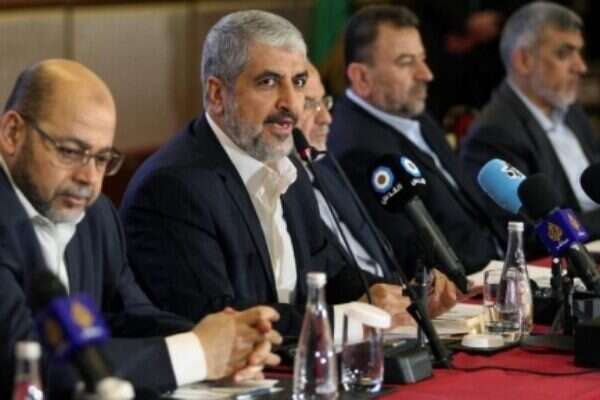
Hamas on Monday dropped its long-standing call for Israel's destruction, but said it still rejected the country's right to exist and backs "armed struggle" against it. In a revised policy document presented in Doha, Qatar, by its leader Khaled Mashaal, Hamas also said it would end its association with the Muslim Brotherhood, a move apparently aimed at improving ties with Gulf Arab states and Egypt, which view the Brotherhood as a terrorist group. Mashaal, however, clarified his position, saying Hamas remained part of the Muslim Brotherhood's "intellectual school" but was "an independent Palestinian organization." He added that Hamas' fight was not against Judaism as a religion but against what he called "aggressor Zionists." Israel responded to the announcement by accusing Hamas of trying to "fool the world," while the group's main Palestinian political rival, the Fatah faction of Palestinian Authority President Mahmoud Abbas, also reacted coolly to the policy shift. Israel said the document aimed to deceive the world that Hamas was becoming more moderate. "When Hamas stops building tunnels and spends its resources on civilian infrastructure and ceases educating toward killing Israelis -- that will be true change. But that hasn't happened," a statement issued by Prime Minister Benjamin Netanyahu's office said. "Hamas is attempting to fool the world but it will not succeed," said David Keyes, a spokesman for Netanyahu. "They dig terror tunnels and have launched thousands upon thousands of missiles at Israeli civilians. This is the real Hamas." The publication of the revised policy document came two days before Abbas was due to visit Washington on Wednesday, and days after U.S. President Donald Trump said he might travel to Israel this month and sees no reason why there should not be peace between Israel and the Palestinians. "We don't want to dilute our principles but we want to be open. We hope this [document] will mark a change in the stance of European states towards us," Mashaal told reporters. He told CNN on Tuesday he believes the Trump administration can alter the nature of the Israeli-Palestinian relations. "The new administration is capable of changing the Arab-Israeli conflict," he said, adding that the organization should not expect different results if it keeps applying the same old methods. Hamas, which has controlled the Gaza Strip since 2007, said in the document it agreed to a transitional Palestinian state within the 1967 borders. "Hamas advocates the liberation of all of Palestine but is ready to support the state on 1967 borders without recognizing Israel or ceding any rights," Mashaal said in Doha. "No part of Palestine will be surrendered, and it does not matter how long it will take." The terrorist organization also reiterated its unchanged position on the so-called right of return for Palestinian refugees to Israel, saying it does not distinguish between pre-1948 and pre-1967 armistice lines. The organization said it recognized the consensus among the Palestinian people for possible negotiations with Israel over pre-1967 borders, the right of return and east Jerusalem, but that it opposes any negotiations that include those issues. Coordinator of Government Activities in the Territories Maj. Gen. Yoav Mordechai responded to the revised Hamas charter on Facebook. "'The Quran is our constitution and death for the sake of Allah is our highest wish' -- this is the true face of the Hamas terrorist organization, not its new covenant or revised charter, which is distortion and deceit pure and simple," Mordechai wrote. Many Western countries classify Hamas as a terrorist group over its failure to renounce violence, recognize Israel's right to exist and accept existing interim Israeli-Palestinian peace agreements. Fatah spokesman Osama al-Qawasme chastised Hamas for taking decades to join Fatah in accepting a Palestinian state within the 1967 borders, a position Hamas used to criticize Fatah for. "Hamas' new document is identical to that taken by Fatah in 1988. Hamas is required to make an apology to Fatah after 30 years of accusing us of treason for that policy," Qawasme said. It remained unclear whether the document replaces Hamas' 1988 charter, which calls for Israel's destruction. Mashaal said the document would "guide Hamas' daily political activity." There was no immediate comment on Monday from Egypt and Persian Gulf Arab states to the Hamas document. On Arab social media, Hamas' revised charter was criticized as "defeatist." Hezbollah, which also lambasted Hamas, said it "will not support any arrangement that leads to the partition of Palestine. There can be no conditions placed on Palestinians returning to their land and if Hamas won't act to liberate Palestine from Jordan to the [Mediterranean] sea -- then its resistance is pointless." Meanwhile, the Izzedine al-Qassam Brigades, Hamas' military wing, delivered an ultimatum to Israel on Tuesday that it had 24 hours to meet the demands of Palestinian hunger strikers in Israeli prisons. "Every day that passes without meeting the prisoners' demands, Hamas will add 30 new names to the list of prisoners the organization demands to be released in any deal with Israel," Izzedine al-Qassam Brigades spokesman Abu Obeida said in a video. Fifteen days into the hunger strike, according to the Israel Prisons Service, the number of striking prisoners has dropped from 1,300 to 870. Abu Obeida also called on Palestinians in Ramallah and other West Bank cities to take to the streets on Wednesday and demonstrate in support on the prisoners. Hezbollah leader Hassan Nasrallah criticized Arab states and leaders, the Arab League and the Arab media for ignoring the prisoners' plight.
Revised Hamas charter an attempt to fool the world, Israel warns
Hamas leader Khaled Mashaal says he hopes revised charter "will mark a change" in Europe's position toward the Gaza-based terrorist group • Israel says document aims to deceive the world into thinking that Hamas has become more moderate.
Load more...