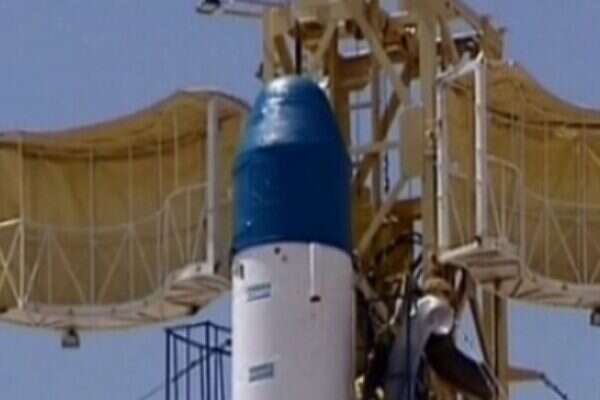
An Iranian satellite has captured images of Israels nuclear reactor in Dimona, Iranian news website Mashregh News reported this week. The Iranian Navid satellite was launched into space about two weeks ago, and according to the report, has snapped high-resolution photos of the Negev Nuclear Research Center in southern Israel. It is widely believed that Israeli produces nuclear weapons at the site, an accusation Israel has never confirmed nor denied. Iran announced earlier this month that it had successfully launched the Navid satellite into orbit, the latest in its ambitious space program. State news agency IRNA said the satellite was designed to collect data on weather conditions and monitor for natural disasters. According to the report, in addition to capturing detailed images of the reactor in Dimona, which serves the Zionist regimes nuclear activities, the satellite photographed critical sites in occupied Palestine, including air force bases and areas of Tel Aviv. At the same time, it appears that the U.S. government is recognizing more than ever the danger that Iran poses for the world. U.S. Defense Intelligence Agency chief Lt. Gen. Ronald Burgess told a Senate Armed Services Committee hearing on Thursday, Iran can close the Strait of Hormuz at least temporarily, and may launch missiles against U.S. forces and our allies in the region if it is attacked. Burgess added that in the event of an attack on its nuclear facilities, Iran would not limit its response only to the Middle East, but could also attempt to employ terrorist surrogates worldwide. However, the agency assesses Iran is unlikely to initiate or intentionally provoke a conflict, he said. Asked bluntly whether intelligence agencies believed Israel had made a decision to attack Iran, Burgess replied, To the best of our knowledge Israel has not decided to attack Iran. On the sanctions, Burgess said Iran was nowhere near giving up its nuclear aspirations. Iran today has the technical, scientific and industrial capability to eventually produce nuclear weapons. While international pressure against Iran has increased, including through sanctions, we assess that Tehran is not close to agreeing to abandoning its nuclear program, Burgess said. Iran proclaimed advances in nuclear know-how on Wednesday, including new centrifuges able to enrich uranium much faster, a move that could hasten what appears to be a steady drift toward confrontation with the West over its nuclear program. Burgess said Iranian ballistic missiles in development could range across the region and central Europe, and a new space launched vehicle demonstrates progress for a potential intercontinental ballistic missile. Israel earlier this month warned that Iran had been working on developing a missile capable of striking the U.S. The work has been occurring at a military base hit by an explosion in November that killed 17 Iranian troops. Also commenting on Iran on Thursday, U.S. Defense Secretary Leon Panetta told the House Appropriations Committees defense subcommittee, We will not allow Iran to develop a nuclear weapon. This isnt just about containment. We will not allow Iran to develop a nuclear weapon ... We will not allow Iran to close the Strait of Hormuz. And in addition to that, obviously, we have expressed serious concerns to Iran about the spread of violence and the fact that they continue to support terrorism and they continue to try to undermine other countries. The Pentagon chief delivered U.S. President Barack Obamas oft-repeated statement that we do keep all options on the table. Panetta, the former CIA director, said U.S. intelligence showed that Iran was continuing its uranium enrichment program. But the intelligence does not show that theyve made the decision to proceed with developing a nuclear weapon. That is the red line that would concern us and that would ensure that the international community, hopefully together, would respond, he said. Also testifying before the Senate Armed Services Committee, Director of National Intelligence James Clapper said the decision on a nuclear weapon would be made by Irans Supreme Leader Ayatollah Ali Khamenei, raising questions about the role of Iranian President Mahmoud Ahmadinejad in the process. He (Khamenei) would base that on a cost-benefit analysis in terms of, I dont think hed want a nuclear weapon at any price, Clapper said. So that I think plays to the value of sanctions, particularly the recent ratcheting up of more sanctions and anticipation that that will induce a change in their policy and behavior. Clapper said it was technically feasible that Tehran could produce a nuclear weapon in one or two years, if its leaders decided to build one, but practically not likely. Meanwhile, the U.S. Treasury on Thursday announced sanctions on Irans Ministry of Intelligence and Security, which it accused of supporting terrorism, abusing the human rights of Iranian citizens and supporting the Syrian governments crackdown. Were reviewing the letter, said White House press secretary Jay Carney. The CNN report on Thursday said the letter was signed by Irans chief negotiator Saeed Jalili on behalf of President Mahmoud Ahmedinejad. It is addressed to European Union foreign policy chief Catherine Ashton and serves as a reply to Ashtons letter from a few months ago. We voice our readiness for dialogue on a spectrum of various issues, which can provide ground for constructive and forward-looking cooperation, reads the letter.
The Obama administration acknowledged Thursday a CNN report that Iran has recently sent a letter to the EU in which it offered to renew talks with the West on the fate of its countrys nuclear program.
Report: Iranian satellite captured images of Dimona nuclear reactor
Iranian website says Navid satellite took high-resolution photos of critical sites in 'occupied Palestine'" including "air force bases and Tel Aviv • U.S. military intelligence: Iran may launch missiles at U.S. forces and allies if attacked.
Load more...