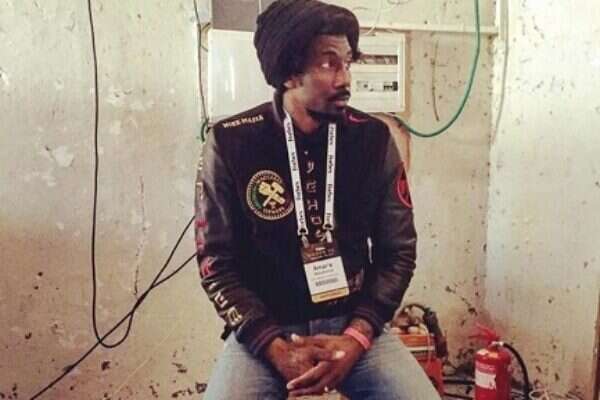
What comes to mind when reviewing Amar'e Stoudemire's biography and career to date -- at age 34 -- particularly at this time of year, is the traditional Passover Seder song "Dayenu" ("It would have been enough"). Like his 6 foot, 10 inch frame, his accomplishments are larger than life. If he had overcome an extremely difficult childhood and not become a spectacular basketball player, it would have been enough -- dayenu. If he had become a spectacular basketball player and not moved to Israel, dayenu. If he had moved to Israel and not authored children's books and cookbooks, dayenu. And so on and so on. Starting a record label, co-designing a clothing line, operating multicultural summer camps, owning a boxing gym, art consulting, winemaking, acting, high-tech investing, farming, documentary filmmaking, promoting interfaith cooperation ... the "dayenus" in Stoudemire's life seem to never end. It's no wonder that Forbes magazine has labeled Stoudemire "the most creative man in the Middle East." It would be hard to imagine a less promising start in life. Stoudemire grew up poor, in central Florida. His parents divorced when he was young. His father, Hazell, died of a heart attack when Amar'e was 12. His mother, Carrie, a migrant agricultural worker, was in and out of jail for petty crimes, and his older brother, Hazell Jr., likewise had serious run-ins with the law. Sports provided a measure of stability in Stoudemire's otherwise chaotic surroundings, but not much. He attended five different high schools, and between the moves and bouts of academic ineligibility, ended up playing only two seasons of high school basketball. But those two seasons, along with summer leagues, were enough to establish Stoudemire as one of the most talented young players in the country. Skipping the usual stage of playing college basketball, Stoudemire went directly from high school into the NBA -- the only high school player chosen in the first round of the 2002 draft. The move directly from high school to professional basketball, winning instant fame and fortune and facing adult responsibilities and distractions, could be treacherous for any young man in the best of circumstances. But not for Stoudemire. He made the difficult adjustment with relative ease and his game just kept improving. He was named NBA Rookie of the Year in 2003 and went on to an impressive 14 seasons in the NBA, playing for the Phoenix Suns, New York Knicks, Dallas Mavericks, and Miami Heat. It was during his NBA career that Stoudemire revealed another source of stability and inspiration in his life: his spiritual side as a self-identified "Hebrew Israelite." He grew up hearing stories from his mother about the family's Jewish roots, and these later fused with an interest in the Black Hebrew Israelite movement -- a mainly African-American group that believes the people taken as slaves from Africa were descended from the ancient Israelites. Stoudemire's spiritual journey brought him to Israel for the first time in 2010. His family made annual visits after that, and in 2016, he announced that he was retiring from the NBA and moving to Jerusalem, where he would purchase a large stake in, and play for, the Hapoel Jerusalem basketball team. I caught up with Stoudemire this week at the Forbes Under 30 Summit in Tel Aviv and spoke with him about his spiritual connection to the country and his life in Israel since joining Hapoel Jerusalem. Q: You've been living here now for eight months. Are you getting acclimated to your new home and learning Hebrew? "I've been studying Hebrew for the past few years, but more so here in Israel. I've been studying seven months, off and on. My acclimatization has been going well." Q: Are your children going to school here? Are they also playing sports? "Absolutely. My son plays baseball; my daughter plays tennis." Q: What do you think about the state of sports for schoolchildren in Israel? "I don't think there are a lot of children that play [sports in Israel]. I think that's an area of space where we can improve -- sports for youth programs -- for sure." Q: When you came for that initial visit to Israel in 2010, what was your first impression of the country? "I loved Israel, my first time coming. [After that,] I made an annual trip here -- started coming every summer with my family. I invited celebrities and athletes here to Israel, and their first impression was the same as mine. They loved it once they got here. From the outside, looking in, sometimes they're not totally sure, but once they travel here, they have a whole new perspective on Israel." Q: Has anyone ever discouraged you from visiting or living here- "I get some comments on my Instagram, but I put that aside, because I have a spiritual connection to Israel." Q: Tell me about that spiritual connection. Where did it come from- "My mother instilled it in us, as youth, about us being Israelites, being from the ancient children of Israel, so, as a family, we started to follow all the laws of Moses, and we just kept growing from there." Q: Who are your role models- "Michael Jordan, which is typical for a basketball player. Tupac Shakur was another one of my role models, and John Lennon." Q: Do you have any Israeli role models -- people you've met here who have inspired you? "There are a lot of great people doing amazing things here in Israel. Now that I live here, I'm learning more and more about it." Q: You grew up overcoming great adversity, which may have pushed you on to where you are today. Meanwhile, your kids are growing up incredibly privileged. How do you keep them grounded so they too will reach their fullest potential- "All the lessons I learned as a youth, growing up, I try to instill in them. I always take them back to my humble beginnings, where my family lives. I take them back there to hang out with the uncles and cousins in Florida. So they get an understanding of what a humble beginning is about. It's a little bit different from my upbringing, but they still get a taste of it." Q: You are a role model for kids here in Israel. What message can you give to them? "For me, I'm just being myself. I'm being who I am, and I think for them, it's really about being who they are. But having some positive affirmations. Taking the positive from certain leaders that they follow, and applying it to themselves, which is the model that I took." Q: Do you have Passover plans- "I've got a family here that we're going to visit. We're going to have a feast for the first day of Passover, and then celebrate the next six or seven days -- it's going to be fun."
The most creative man in the Middle East
With a dazzling NBA career behind him, basketball legend Amar'e Stoudemire is busier than ever, playing for the Jerusalem team he partly owns, connecting with his Hebrew spiritual roots, and engaging in a dozen creative and entrepreneurial pursuits.
Load more...