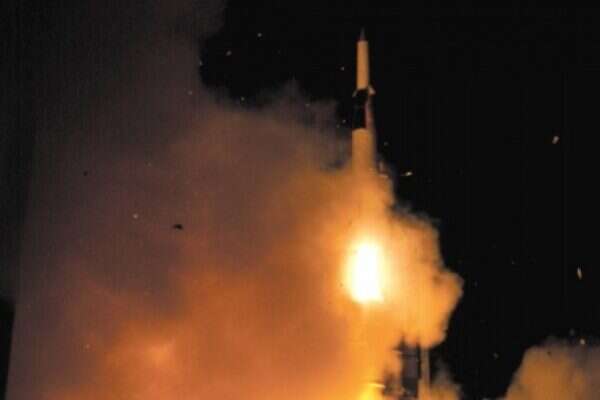
Israel has in recent days successfully tested its Arrow 3 anti-missile interception system, a locally developed system designed to intercept and destroy ballistic missiles while they are still in the earth's atmosphere. The test was revealed by Aryeh Herzog, director of the Defense Ministrys Homa project, which deals with the states missile defenses. Held in an undisclosed location in Israel, an Arrow 3 interceptor missile was launched against an incoming projectile, successfully destroying it after a few hundred meters of flight. The test itself did not involve firing the missile in its full capacity, but aimed only to test its proper separation from the launch container. The guidance and actual capabilities of the missile were not tested, and in the coming months the missile's flight ceiling will be tested. The Arrow 3's precision in shooting down other missiles will be evaluated in the future. The test comes against the backdrop of recent declarations by Iranian Air Force commander Brig. Gen. Amir Ali Hajizadeh, which aired on Iranian TV channels earlier this month. "If the Zionist entity wants to attack us, we will strike at the heart of Tel Aviv before their planes even leave our airspace," Hajizadeh said, according to a translation provided by the Middle East Media Research Institute. "We have planned and conducted calculations and we have reached the conclusion that we do not need a range of more than 2,000 kilometers, because Israel is no further than this from our borders. But in order to feel secure, and for our centers to be secure, we must be prepared and must develop and enlarge our missile bases. "There are 50 American bases surrounding Iran, no more than 200 to 300 km away. If the Americans want to carry out evil deeds against us well, they have brought 150,000 soldiers over, and they have dozens of bases. We can bomb all these targets, including the U.S. Navy in the Persian Gulf. This will happen if the U.S. wants to carry out a criminal operation against us, and the same goes for Israel." Developed by the state-run Israel Aerospace Industries, Arrow 3 is slated to be Israel's next-generation missile interceptor, built to collide "metal-to-metal" with long-range ballistic missiles before they re-enter the Earth's atmosphere. The Arrow 3 was designed as a response to longer range ballistic missile threats. Defense officials speculate that the Arrow 3 will not be operational before 2015. The missile is considered unique, and is planned to provide Israel with the needed defense from unconventional missile bombardment. Israel currently deploys the improved Arrow 2, which can shoot down long-range ballistic missiles. The Magic Wand and Iron Dome anti-missile systems were developed to shoot down shorter range projectiles. Magic Wand is still in production, while Iron Dome has already proven itself in operational incidents and is being deployed countrywide. Once operational, Arrow 3 will become the upper tier of the Israel Defense Force's multi-tiered active air defense concept, which aims to provide a comprehensive shield against a multitude of rocket and missile threats. The Arrow 3 exo-atmospheric interceptor includes a two-stage interceptor based on hit-to-kill technology. Its compact design, outstanding maneuverability, and diverse capability serve to enhance its effectiveness against all types of ballistic missiles and warheads. Herzog is stepping down after serving more than 10 years as director of Homa and will make way for Yair Ramati, the current corporate vice-president of Israel Aerospace Industries. Israel is no stranger to missile bombardment;. In 1991, former Iraqi president Saddam Hussein launched Scud missiles at Israel to provoke an Israeli response and break the U.N. led coalition against him. Scuds had a range of more than 400 km and were launched from within Iraq. Missile batteries were deployed through Israel to shoot down the incoming Scuds, with partial success. Two people were killed and 230 were injured in that conflict. In 2001, residents inside a 10 km radius from the Gaza Strip began being hit by Kassam rockets, improvised unguided rockets that have killed more than 20 people and injured hundreds and have tormented residents in the area for years. In the summer of 2006, during the war between Hezbollah and Israel, Israel was hit by nearly 4,000 Katyusha rockets within 34 days, killing 43 civilians and wounding 1,489. Israel's history has led to extensive efforts to develop counter-missile batteries.
As rocket threat looms, Israel successfully tests Arrow 3
Progress in multi-layered anti-rocket defenses • Test comes amid recent declarations by Iranian Air Force chief Ali Hajizadeh: If the Zionist entity wants to attack us, we will strike at the heart of Tel Aviv.
Load more...