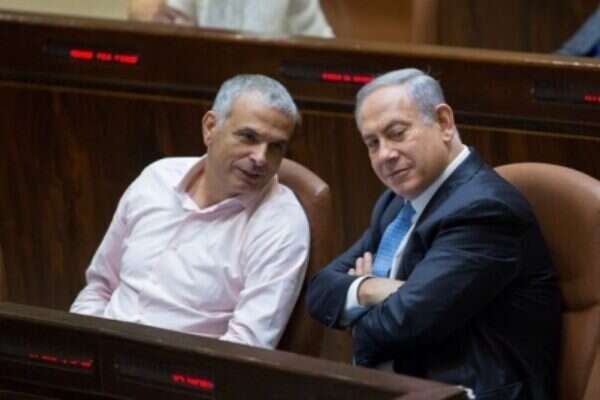
Prime Minister Benjamin Netanyahu announced Saturday that he would not hesitate to call an early election to prevent the launch of the Israeli Public Broadcasting Corporation, saying he has changed his mind about a deal he had struck with Finance Minister Moshe Kahlon to let the new body start broadcasting in late April. Netanyahu said it makes no economic sense to create a new body to supplant the existing Israel Broadcasting Authority, and said that if Kahlon insists on implementing the deal, he would move to dissolve the Knesset and call elections. "I changed my mind [about the deal] after a meeting with employees of the Israel Broadcasting Authority," Netanyahu wrote in a Facebook post. "I heard heart-wrenching stories about experienced employees who were being let go because of the IPBC. I also realized that contrary to what has been reported by the Finance Ministry, keeping the IBA would save tens of millions of shekels. So what is the point of having the IPBC-" Netanyahu asked. In a separate post, Netanyahu said that IBA expenses were 670 million shekels ($185 million) in 2016, whereas the IPBC would require a annual budget of about 730 million shekels ($200 million). "Over the past few years, the IBA has become more streamlined and has managed to save more than NIS 300 million [$83 million], and they told me they were willing to carry out drastic measures to save more and meet all their budgetary goals," Netanyahu wrote, and repeated, "So what is the point of having the IPBC-" The meeting between Netanyahu and the IBA employees took place on Friday. The following day, Likud ministers Miri Regev, Tzachi Hanegbi and Yariv Levin, as well as Coalition Chairman David Bitan (Likud), arrived at the Prime Minister's Residence to meet with him. Netanyahu told them his disagreement with Kahlon over the new body was also a battle over the government's ability to pursue its policies. He said a finance minister must not intervene in matters beyond his purview, and while it was within the prerogative of a finance minister to object to something because of budgetary concerns, objections not based on budgetary matters were out of line. "We either merge the IPBC with the IBA or hold an election," Netanyahu said. He also cited the coalition agreements he signed with Kahlon's Kulanu party, which give the Likud veto power over issues pertaining to media regulation. Speaking on Saturday night ahead of his departure for a state visit to China, Netanyahu said, "The government was founded upon coalition agreements that clearly stipulate that all parties must abide by the decisions made by Likud, by us, over media matters, and this extends to the closure of the IPBC." Ultra-Orthodox parties expressed outrage after the reports of the Saturday meeting emerged. "This amounts to a major desecration of Shabbat and a severe breach of the status quo," Health Minister Yakov Litzman said. "For years, the tradition has been that no official functions are carried out on Shabbat." Late Saturday, Regev echoed Netanyahu and endorsed his plan. "A government and a prime minister must revisit things occasionally, and this is what happened with the IBA," she said. "Rather than throwing away tens of millions of shekels on a bloated corporation run like an exclusive club, we must rehabilitate the IBA. I hope the sense of public responsibility will prevail among the coalition partners and that they will respect the coalition agreement rather than force us to go through a pointless election campaign." On Sunday, Regev continued, telling Army Radio that "this is a matter of principle -- coalition agreements must be upheld." In contrast to Regev, Transportation and Road Safety Minister Yisrael Katz told Army Radio on Sunday that "media-related disagreements are not sufficient grounds to hold an early election." People close to Kahlon said they were surprised by Netanyahu's about-face, just days after the two agreed on a framework to let the IPBC start broadcasting in late April. According to a senior Kulanu party official, "Kahlon has no misgivings about the deal he struck with Netanyahu on Thursday, under which the IPBC will be launched in April and Kulanu will support the new communications bill. He usually does not get overly concerned about ultimatums and he expects the IPBC to be launched on time and the communications bill to pass as well, as agreed upon." Things may become complicated legally if an election is called. It is virtually impossible to amend laws between the time a Knesset dissolves and the swearing-in of a new government. Therefore, the current law, which stipulates that the IPBC will start broadcasting in late April, will have already taken effect by the time of the election. Meanwhile, Habayit Hayehudi Chairman Naftali Bennett said Saturday that there is no need for an election. "I call on everyone to act responsibly and avert a costly march to the polls that would hurt Israel's economy and its people," he said. "The IPBC crisis can be solved with a little bit of good will." Opposition figures seemed more enthused about going to the polls. Opposition Leader and Labor party head Isaac Herzog said, "The Zionist Union I head will join forces with others in a moderate, socially minded and responsible Zionist bloc in an effort unseat the prime minister." Meretz leader Zehava Galon said she was in favor of an early election and she would introduce legislation to dissolve the Knesset this week. MK Shelly Yachimovich (Zionist Union) told Israel Radio Sunday that she was also in favor of calling an early election but said she would not support scrapping the IPBC. Others in the opposition suggested Netanyahu's move was related to the ongoing police investigations into him. MK Yoel Hasson (Zionist Union) said, "Netanyahu, who has had to deal with one investigation after another, does what he knows best: He is taking the country toward an early election to get out of the ditch he is in. We are not going to let this happen this time, and we are not going to cooperate with him in dissolving the Knesset because there is no real gain for the state in doing so." Meanwhile, a poll published on Channel 10 on Friday shows that, unlike the results of two previous polls, a new party led by former Defense Minister Moshe Ya'alon would not win enough votes to cross the electoral threshold. The latest poll shows Likud maintaining the largest bloc of seats -- 26 -- with Yair Lapid's Yesh Atid party second with 25 seats, and Habayit Hayehudi and the Joint Arab List with 13 seats each.
Row over broadcast regulation fuels talk of early elections
PM Benjamin Netanyahu says new public broadcasting body due to launch in April would be a heavier burden on taxpayers than keeping reformed Israel Broadcasting Authority • If Finance Minister Moshe Kahlon does not cooperate, we will go to polls, he says.
Load more...