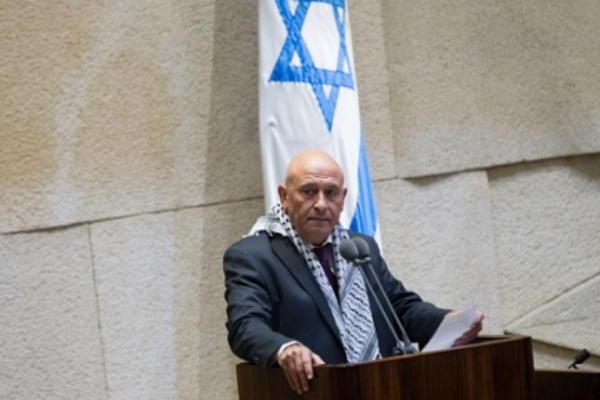
The case of Joint Arab List MK Basel Ghattas, who is under police investigation for allegedly compromising national security by smuggling cellular phones, SIM cards, and coded messages to Fatah security prisoners in Ketziot Prison, is infuriating. But I found myself conflicted by it. Leaving the doctor's office this week, I recalled that the nurse was an Israeli Arab, and none of her patients seemed to have thought twice about it. It was equally natural when an Arab cable technician arrived at my home, or when an Arab family sat next to me in a cafe. Last Ramadan, I invited an Arab diplomat for dinner. I was proud that a large group of Israeli Arabs had chosen to eat at a Tel Aviv restaurant, where they spoke Arabic freely, even if it was laced with quite a bit of Hebrew. When I turned the diplomat's attention to this, noting that Israel was the safest place for Arabs in the Middle East, he nodded. He got the hint. The present offers us an opportunity to take a significant step forward in encouraging Israeli Arabs to further pursue their integration in Israeli society. Their national awareness is unlikely to fade, nor should we aspire for it to do so -- they are and forever will be Palestinian -- but we can still aspire to make them feel far more Israeli than they do now. The assumption that progress can be made is based on the fact that the Middle East is changing, and not for the better, making Israel look far more appealing. Another encouraging fact is that the wave of terrorism that began over a year ago, the "year of the knife," has involved only two incidents perpetrated by Israeli Arabs. This creates a significant difference between them and the Palestinians across Judea and Samaria -- in their self-perception, if nothing else. True, some Israeli Arabs have been implicated in setting the wildfires that raged across Israel in November, but on the other hand, there were Arabs who invited fire victims into their homes. Israeli Arabs are not one cohesive group, and they differ in their perceptions of Israel. But it seems that Israel is the one to push them to support radical Arab politicians. A recent survey by the Israel Democracy Institute's Guttman Center found that 61% of Israeli Arabs believe their elected officials are more preoccupied with the Palestinian issue than with the issues of their constituency. Seeking to "rid" itself of Arab lawmakers, the Right promoted raising the electoral threshold from 2% to 3.25%. This caused the Arab parties -- Balad, Ra'am-Ta'al and Hadash -- to join forces and form the Joint Arab List, which won 13 seats in the 2015 elections, becoming the third largest faction in the 20th Knesset. There is nothing wrong with that, of course, but true to the form of factions bringing together several political forces, the radicals are the one setting the tone. Moreover, the chances of another political faction being formed to express the will of moderate Israeli Arabs are slim. Why? Because its chances of passing the new electoral threshold are even slimmer. This does not have to be the case. The Guttman Center's survey also found that 55% of Israeli Arabs are proud of the fact they are Israeli, and 42% believe Israelis can rely on each other in times of need. This data could serve as a solid base on which relations between the Arab minority and Jewish majority in Israel could be improved. To promote a positive chance on this issue, the Israeli government should invest in three main avenues: First, it must live up to past financial pledges. This means investing far more than ever before in the Arab sector's infrastructure, but also in education, which is the key to integration in the workforce and as a result, improving the quality of life. Second, it must regulate the Bedouin settlements in the Negev. The majority of Bedouins live on land they do not own, which is devoid any infrastructure. This has led to serious problems that must be addressed without delay, as every year that goes by without resolving these issues only makes them more complex. Third, law enforcement in the Arab sector must be improved. A special budget should be allocated to the Israel Police, and the police should come up with a plan that has clear objectives and indices to show law enforcement has actually improved. Increasing law enforcement in the Arab sector is not a "punishment" -- it is an interest the state and the Israeli Arab population share, as it is the public that is most affected by residential crime rates. There is no need to pander to the Arab sector. In a case such as that of Ghattas, if convicted, offenders must be punished to the full extent of the law. At the same time, however, we have to be careful not to pursue legislation that targets the Arab sector. During the British mandate in Palestine, whenever the Arabs would riot, they would trumpet the fact that the British government was on their side. The fact that Israel is now ruled by a Jewish government is clear, solid and indisputable, and there is no need to flaunt it. Many Arabs find it difficult to reconcile their living in Israel, where the language, flag, national anthem, and Law of Return are so glaringly Jewish. That, of course, is how it should be in the Jewish state, but that is also exactly why the government has to be sensitive and avoid passing laws that appear to be targeting a minority group. The controversial mosque loudspeaker bill, for example, ignores such sensitivities. Had any European country tried to pass a similar law over, say, kosher slaughter practices, with ministers arguing that it had nothing to do with Judaism and everything to do with animal rights, we would be hard-pressed to believe them. This is what the arguments excusing the mosque loudspeaker bill sound like to Muslim ears. If some areas suffer from noise pollution -- and some apparently do -- the matter should be dealt with by the specific neighboring Arab and Jewish communities. If they fail to resolve the issue, local law enforcement should step in. The Jewish state, however, should refrain from interfering in the religious practices of the minorities living among it unless unusual circumstances present themselves. A muezzin's call to prayer cannot be seen as warranting state interference. Zeev Jabotinsky once wrote, "There they shall be satiated with abundance and happiness, the son of Arabia, the son of Nazareth and my son / For my flag is a flag of purity and honesty / It shall purify both banks of my Jordan River." He may have been writing about both sides of the Jordan River, but we would be wise to adopt this sentiment even when it comes to the small State of Israel.
The lessons of the Ghattas affair
Israeli Arabs are not a cohesive group, even if the radicals among them are able to drown out moderate voices • Israel has the opportunity to take a significant step toward integrating Israeli Arabs in society, but it must show the proper sensitivities.
Load more...