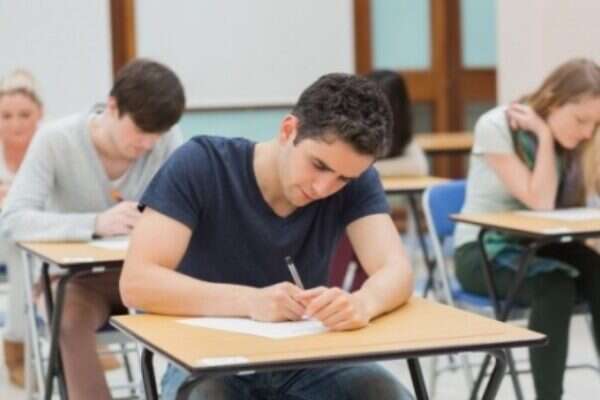
1. The weekly scandals pull us into dealing with minor matters and neglecting things that are truly important. Let us make education our top priority for a change. This week, the international PISA -- Program for International Student Assessment -- scores were released. Conducted by the Organization for Economic Cooperation and Development, these tests evaluate the 'literacy" of high school students in three main subjects: reading comprehension, math and science. Out of the 70 countries tested, Israel was ranked 40th. Not too great. Definitely could be improved. But have we declined? On social media, I read laments: What happened to the Jewish people who once excelled and are now below average? But when you look at the numbers, you discover that the overall result is misleading. There is a huge gap between Hebrew-speaking and Arabic-speaking students, and a big gap between Arabic-speaking Muslims and Arabic-speaking Christians and Druze. The Druze town of Beit Jann in the Galilee, for example, is home to the best school system in Israel in terms of test results. In the latest PISA tests (conducted in March 2015), Israel came in 37th for reading comprehension. But if we consider only Hebrew-speaking students, Israel would be ranked 12th. The scores of the Arabic-speaking students alone, on the other hand, would put Israel in 64th place. The same holds true for the math scores: Israeli Jewish students would have placed 20th, and the Arab students 61st. In the scores of Arab students, I found no difference between city residents and rural or nomadic populations. It could be that there is a notable gap in favor of the urban residents. But the solution to this problem cannot rest solely on the government and the school system. The attitude toward education in the home is a deciding factor in the education of children. 2. The science section of the PISA tests is very strange, and features general questions about knowledge and understanding that change from test to test, so it's hard to study for them. Last year, students were asked about bird migrations, running in hot weather, meteoroids, fish farms, and so on. Some experts think these questions teach us something about the students. Others think the subject is superfluous. In my opinion, the other two sections of the test are immeasurably more important than the bizarre science questions. The right approach to math demonstrates an ability to deal with abstract, precise problems. It also guarantees that more high school graduates will go on to work in the exact sciences later in life. Unlike the amorphous "science," math can definitely be studied. Apparently, it isn't studied enough. It's good that Education Minister Naftali Bennett is promoting the subject. More than the previous two subjects mentioned here, I believe reading comprehension is the most important part of the test, because it is the key to education, to expanding knowledge and understanding. It is not just understanding a text. How we get a grip on a text teaches us to read the world, to develop a reasonable gauge of reality and even perspective. Reading comprehension is important to our development into influential citizens. Reading is also responsible for depth of thought. A lack of vocabulary because of insufficient reading leads to a lack of breadth of thought and a lack of ability to express oneself. The matter takes on special importance when it comes to the historic Hebrew language, which is a more condensed language with much fewer words than English. A Hebrew word can have many meanings that stem from the long history of the language. A lack of vocabulary leads to the loss of understanding of a great many meanings. It can also lead to violence. Those with no ability to vent about the problems in their lives may resort to verbal insults or physical expressions -- punches and pushes and worse. It is not schools that bear the main responsibility for reading comprehension, but rather homes, through books, or, in other words, through reading. Do our children read enough, do we prod them to read, do they see their parents reading? One of the "foundational sights" I grew up with, as the poet Hayim Nahman Bialik put it, was my late father reading, continually. Even today I hear my late mother's voice reading me "Little Red Riding Hood," "The Flower with the Golden Heart," or other stories in her broken Hebrew. 3. I learned that from the seventh to the 10th grade, the school system allocates a total of 18 weekly hours to preparing for the test. Shouldn't we invest more hours in humanities subjects like Bible, history and literature, and in exact sciences like math and physics? This is how the PISA research defines the "literacy" it demands from the students who take the test: "Students' ability to apply knowledge and skills and to analyze, reason and communicate effectively as they examine, interpret and solve problems." Many of us acquired that literacy both formally and informally. At school, but also at home, in the youth movement, in the army, in yeshiva, from a hunger to succeed, and more. We also need to take the comparison to other countries with a grain of salt. Every country has its own history, population makeup, and tradition. Israel is constantly among the top nations in the world in terms of registering for patents, both in terms of GDP and size of population. This is not a figure expressed in the PISA test results. Over 300 leading international companies operate in Israel today. Firms including Facebook, Google, Intel, Apple and IBM have chosen to build research and development centers in Israel. Israel is a testing ground where services and products are developed for the whole world. Have these companies not seen the PISA scores? And what if the comparison to other nations isn't the only measurement? Is it possible that discipline problems and busting frameworks and the disorganized manner of acquiring knowledge, combined with endless curiosity, are actually what cause Israelis to break into new areas of knowledge? If a page of Talmud can teach us something about how our people learn, it could be described as "organized noise" -- there is no conclusion that is not challenged, and after that's been worked to death, we go back and around again. This dialectic of thought, the back and forth between a conclusion and a challenge to it and between thesis and anti-thesis, lies at the heart of our scholarly tradition. We can assume that many of the young students who didn't know the answers to the PISA test questions will develop their own intellectual and investigative personalities later on, and fill in the gaps, even about the migration of birds.
On tests and reality checks
Although the international PISA test results seem to show Israel in a poor light, a close look at them shows they are misleading • Good reading habits come not just from the government and the school system, but from the home.
Load more...