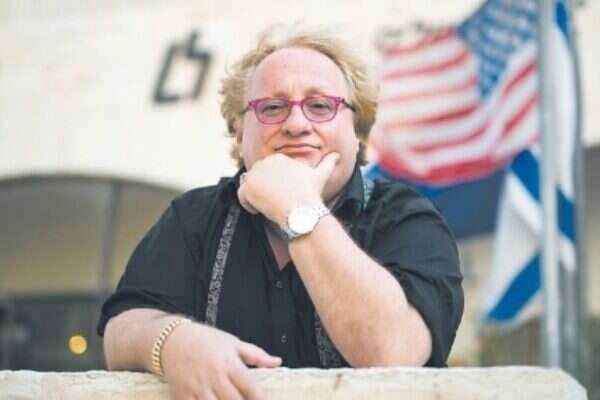
Tuvia Tenenbom is a funny man. I am not the first to describe him as such. Behind the jokes and sarcasm, however, is an undercurrent of anxiety. Anyone who has read his recent travelogues knows he has taken a thankless task upon himself: village idiot, court jester, who in his profound wisdom deploys humor to reveal the existential truth cloaked by daily life. "I'm the foreign observer," he tells me, "and like the classic Jew I am a nomad, living here and there and everywhere. I am a resident of Germany, and I have Israeli and American citizenship. But I am a Jew who cares about Jews and I am not ashamed of that." He is currently releasing a new book, "The Lies They Tell" (Sela-Meir Publishing). Following his accounts of Germany and Israel (and the Palestinian Authority), it is now the United States' turn. For seven months, Tenenbom traversed that vast country, "the land of the free and home of the brave," speaking to thousands of people on his path, from the most far-flung rural areas to the cosmopolitan centers of the universe. The result: a jarring, disconcerting testimony. Not to worry, Tenenbom knows how to serve his dishes in an easy, palatable manner, which won't allow you to put the book down until it's finished. The soul-searching and pondering will come later. The United States exposed in this book is not the idyllic dream many Israelis picture in their minds. At a cafe adjacent to Rehovot's Beit Haam community center, built in 1913 by the pioneers of the First Aliyah, we sat down for a contemplative discussion. Were you surprised- "Yes. I thought America was much better. When you write a book, you need to dig deep. When you live in New York, for example, you automatically make connections and bring people closer. It's something psychological that has to do with the brain's immune system; you collect people who love and respect you around you. Before I wrote the book ('I Sleep in Hitler's Room'), I didn't think anti-Semitism was common in Germany. But when you start asking pointed questions, and use humor ... you understand, I try not to be 'heavy,' we have drinks together, share a smoke, and only afterward do I ask, 'What do you think of Jews-' And things come out. I didn't think racism in America was so harsh. I didn't think there were places in the Unites States where refugee camps in Jordan and Iraq are heaven in comparison. I spent countless hours in these places, and I discovered a world that is hard to believe exists." One of the fascinating parts of the book is the trip to Chicago's South Side, where Barack Obama became as a social activist. In 1996, he was elected on behalf of this area to the Illinois State Senate, representing Illinois' 13th state senate district. "The idea of America is 'we are the people.' Don't interview the leaders in politics but the 'common folk.' For me, those common folk even include the rector of the University of California, Berkeley. That is why I decided to learn about Obama the American way: We'd go to the people who voted for him, who first made him their representative in the Illinois Senate. Before that he was just a social activist. On occasion I receive a mass email message from him -- 'Tuvia, this is Barack' -- about how he started in Chicago and looked after his people. "I worked a long time to find out who these people were. When I found where they lived, people tried dissuading me from going there. It's too dangerous. I insisted. And then I saw something I never believed existed: neighborhoods where homicide is part of everyday life, immense neglect. When I went there by bus, at the last stop the driver -- a black person -- looked at me and said: 'You're not getting off here. Hey man, don't do it.' As soon as I got off , a car pulled up next to me with two white people inside with bulletproof vests and weapons, who instructed me: 'Sir, leave this area!'" What did you see- "That the people in whose name Obama is still speaking today live in a scary place of routine murder and horrific poverty, and that nobody cares, not even him. I asked the residents if things have gotten better since he was elected, and they answered no; there were those who said it's gotten worse. Only one small boy said, 'Better, because I get food stamps.' That's how they live there. It can't be any worse." What did you expect, that the moment he entered office he would say, "This is my project, this is my place, I am turning it into a palace-" "Precisely that. At least that neighborhood you were speaking for. You've been in the White House seven years already, and spent years in the Senate, do something for these people. Nothing. Zero. The cynicism with which he uses 'his neighborhood,' made me feel he was much smaller. It's not about politics anymore; it's cynicism. And the amazing thing is, where is the press-" The press is covering for him- "Of course. All the time. Even the press that doesn't cover for him, why haven't they written about it? Why should this schmendrick [pointing to himself] need to go to these places-" Is that why you've had a hard time finding a publisher for your book over there- "Yes, because you understand that America is just one giant camouflage net, and that Americans are afraid to talk about the actual reality." In the book, you deal a lot with political correctness. It's a mechanism that uses language to regiment thought. What can and can't be said, until you are scared to even think differently, because you will be singled out from the crowd. "At the end of the day this mechanism changes reality. I think this is a huge danger for the United States, because people don't speak the truth and are scared to say what they think. At one point or another it has to explode." Why can't things go on as they have up to now- "Because it goes against human nature! Why is Donald Trump doing well? After all, 10 or even four years ago he would never have been able to penetrate the establishment's outer defenses. He says things that Americans don't hear. In other words, they think it, but don't hear it. That is why the press has rallied, almost in its entirety, against him. Even the Republicans. Because everyone is afraid it will blow up." What you saw on your long journey was that the mechanism protecting this fictitious unity is a phony mechanism, which is why, quite ironically, Donald Trump appears like someone who can save America from this quandary... "That's it exactly. He will save America by placing a 'this is what we think' mirror in front of it. It's very important. On a personal level, I am not in favor of Trump and am not involved in the elections. I am keeping a distance, without voting. But I think it would be really good for America, on all fronts, if he is elected. Because then they will have to confront their problems." *** Seven months is a lot of experiences. What do you remember the most- "The racism -- blacks and whites, Indians, Hispanics, everyone against everyone. And a blossoming of anti-Semitism. It is beginning to reach the United States, where you hear more and more people speak against Israel. It's in the streets, too, in red states you hear 'Free Palestine.' People tell me freely they are certain the Jews will go to hell, things of that sort. The idea of 'replacement theology,' that the chosen people were the Jews, but now it's us [the Christians]. This has caused anti-Semitism to spread for 2,000 years. I met a wealthy Christian supporter of Israel who opposes Obama. Ultimately what I hear from him is that oil prices have changed because of a few Jews in New York. It's frightening." I know a few prominent Israelis (including in the media) who talk about Jewish financial control in America... "What I found surprising was that in the places I saw anti-Semitism, I found Jews in the background. The greatest anti-Semites are Jews. In America as well. I found a pretty troubling self-hating Judaism, which talks about how Jews are so bad, so racist, and how much Israel is like that. Unfathomable self-loathing." Why? Israel is an obstacle to completely assimilating into American society- "It's not just Israel, but even American Jewry. Jews are happy to accuse their own brethren of racism. Where did they find that, are they any more racist than the Irish Americans? I wrote for years for the liberal Jewish [magazine] The Forward. But when I reported what I saw in a liberal Jewish temple, they refused to publish. Members of the synagogue gathered to discuss racism. It became apparent that the issue wasn't racism between whites and blacks, but racism by Jews against blacks and Israel's racism toward Ethiopian Jews. Here is where I touched upon the soul of this hidden Judaism, the stupid Judaism, the self-hating, which applauds those who deride it." You had a similar experience at the Haaretz Conference on Peace in New York. "Most of the audience was comprised of American Jews. When Samantha Power, the U.S. ambassador to the United Nations and Obama's representative [at the conference], said ties between the United States and Israel were strong, and that the U.S. would fight anti-Semitism -- there were a few claps. When [Joint Arab List Chairman, MK] Ayman Odeh got up and spoke about the Nakba and genocide of the Palestinian people at the hands of the Jews, not only did they applaud -- the crowd responded with a standing ovation and cheers as if he were a rock star. You need to be crazy to do that. [Haaretz reporter] Amira Hass told them that if they are thinking of moving to Israel, they should know they are committing a crime. And they clapped their hands. The point is that these American Jews cleared their schedules for the day to come and cheer for these comments. It wasn't just a few but rather an entire audience cheering for Israel-haters." Toward the end of the book you describe meeting Chase Untermeyer, who was the former U.S. ambassador to Qatar, and he told you some pretty amazing things. "I came to him by chance, because former President George W. Bush wasn't available that day, and Untermeyer is his neighbor. I was surprised to learn that he knows little about the Arab world. I asked, did no one at the State Department tell him anything about what I was telling him from my experience in the Arab world. His answer was: 'The nature of politicians and policymakers is to try to make reality fit the theory, or to the policy, instead of the other way around. In the U.S. government there is always the tendency to make facts fit the philosophical precept, and the facts to the policy, and that's to justify the policy or its alteration.' I asked, why do they work like that, because changing the facts is, after all, impossible, and he replied: 'Because it serves their interests.' What's interesting is that this line of thinking is shared by the American Left and Right. The facts are not of interest." What is your insight from all this- "In the long term, the United States can't be trusted. The Jews in Israel and the world -- who hold the fate of Judaism and their people dear -- need to know that success depends on them." What are you talking about? People here get worked up over a little tension between us and the White House... "That's nonsense." A common thread in your book is the connection between the Left and the Palestinian story. One gets the impression that this is the raison d'etre of this group. "I found that there are two questions related to one another: If you believe in climate change the way Obama, for example, describes it, you are also pro-Palestinian. It's true the Palestinians give the world an excuse why not to like us, but even before we heard about them [the Palestinians], many nations came together to kill Jews." Why would the Americans care about the Palestinians? "It has to do with globalization. The Americans influence and are influenced. On the Palestinian matter, the Europeans influence the Americans. They don't really care about the Palestinians, but they help ease their conscience regarding the Jewish people. On the other hand, I think there is one nation that has been persecuted by everyone for 2,000 years, and if you are really a human rights activist, you need to first and foremost care for this nation." You have a lot of experience with America and Europe. Where do you see the difference between the Europeans and the Americans- "As a fat person I can say the food in Europe is better. American coffee tastes like asphalt, and apparently in the wealthiest country in the world they don't know how to make bread. Secondly, the European racist will say things outright. The American racist will wait. At first he will say he loves everyone. That's one of the interesting things about the [average] American: Ask him about his salary or relationship with his wife, and he's willing to answer you. But the moment you ask him whom he voted for president, he'll pause and say that's private. I met couples where the husband didn't know whom his wife voted for, and vice versa." What do you derive from this behavior- "The American's fear is that his truth will come out. That he'll mistakenly say what he really thinks. 'In the land of the free and the home of the brave,' I didn't meet a lot of free people, and I couldn't find many brave ones either. Speaking of brave, last week the iPhone 7 was launched, and I heard [senior vice president of worldwide marketing] Phil Schiller from Apple say they were brave to abolish the headphone jack! So, you understand-"
The dark side of America
Tuvia Tenenbom, author of "Catch the Jew!" and "I Sleep in Hitler's Room" sits down for a frank chat with Israel Hayom • His new book, "The Lies They Tell," exposes the real America, the one where racism and anti-Semitism lurk just beneath the surface.
Load more...