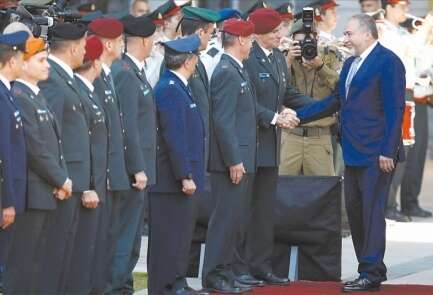
Sooner or later -- probably sooner -- Defense Minister Avigdor Lieberman will fall in love with his new role. It happened to all of his predecessors: the power, the excellence, the access to information and the secrecy are addictive, intoxicating. No other ministry in Israel involves so much power: physical, economic, intelligence. There is also no other ministry in Israel that enjoys so much independence: operational, planning, political. Only the prime minister is stronger than the defense minister, but he lives in a glass house, while the defense minister lives in a bunker, surrounded by a loyal and secretive environment. Lieberman will learn to appreciate all this. From the small perks of the job -- the helicopters at his service, the honor marches, the army of officers and soldiers ready for duty at all hours, for all purposes -- to the greatest one, the near-exclusive knowledge the defense minister has when it comes to information and operations. Each morning, his military secretary will present him with an intelligence briefing and an operational briefing. The first will tell him who said what and who did what on the enemy's side, down to the finest, occasionally embarrassing, details; the second will update him on what our side is doing. A significant portion of what he will hear, of what he is responsible for, will be new to him. Despite years of being in the cabinet and being exposed to classified materials, Lieberman will soon find out how much he doesn't know -- about units, about operations, about projects and measures. It is with his approval, and his approval only, that troops are sent out on operations that deal not only with human life, but the life of the state. All it takes is a single sleepless night, a single nerve-wracking wait for an operational report, to understand the weight of the responsibility and the miniscule distance between failure and success, between life and death. Lieberman's predecessor, former Defense Minister Moshe Ya'alon, did these things with his eyes closed. His path -- from elite reconnaissance unit Sayeret Matkal, to Military Intelligence Directorate chief, to head of the Central Command, to IDF chief of staff -- gave him not only broad professional knowledge, intimate familiarity with the material, and confidence in the military (and the military in him), but also, and most importantly, an understanding of the limitations of power. He learned what not to do, where not to go, what not to get involved in. There is a dramatic difference between a cabinet minister who proposes to "assassinate [Hamas leader] Ismail Haniyeh," and a defense minister who knows that the result of a move like that would be another 50-day war; and there is a difference between someone who suggests "attacking Hezbollah's storehouses" and someone who signed the operational plans and understands their value. As of this week, Lieberman is in charge. When a home in Hebron is overtaken illegally, he will be the one who has to order it evacuated in accordance with the law, and when a strike in Syria becomes complicated and leads to a counterattack and to injuries, he will be the one who has to deal with the outcome. In good and bad, actions and omissions, the responsibility will be his; he is no longer an unsatisfied diner, but the chef himself. The key man: IDF Chief of Staff Lt. Gen. Gadi Eizenkot If we judge by what Lieberman said at his swearing-in ceremony at the Knesset and at his short introductory meeting with the General Staff Forum, he plans to dedicate the next period to action, rather than words. In meetings he held with several senior reserves officers (former Deputy Chief of Staff David Ivry, former Israeli Navy Commander Eliezer Marom, former Coordinator of Government Activities in the Territories Commander Eitan Dagnot, former security chief for the defense establishment Yehiel Horev and others), he said he knows how much he doesn't know. He intends, he said, to work hard and learn a lot. He told the generals that he is coming to do good, not bad; that he is not the angry MK who came to the military court to show his support for the soldier who shot a neutralized terrorist in Hebron, but a moderate and responsible minister who has come "to work in full cooperation with the chief of staff." It's likely that this is not all politesse. As an experienced and sharp politician, Lieberman understands that he is entering the Defense Ministry with a learner's permit: a rookie who has to prove himself. He needs top IDF and Defense Ministry officials around him to offer guidance, or he will stumble and fall. This is true for the small things -- what to speak about with the chief of staff in a work meeting versus a personal meeting -- and certainly for the big things -- what is up to the defense minister to decide exclusively, what requires approval from the prime minister and what should be brought before the cabinet. It will be his responsibility to learn about the procedures, the order of discussions, the reporting guidelines, the tours and situational assessments and the discussions on operations and missions each Thursday. He will learn about what requires a midnight wakeup call and what can wait until morning. Very soon, he will be required to establish his work environment -- the intimate circle inside his office, and the wider circle of informal advisers. While the General Staff and those at the Defense Ministry won't like it, Lieberman will have to be accompanied by someone who tells him what to ask and where to tread lightly. In a way, it is good for the IDF, as it will help to avoid the pitfalls of an inexperienced defense minister. At the same time, Lieberman will learn to trust the professionals. He is surrounded by a group of high-quality, serious, experienced and level-headed officials to a degree that he has not yet encountered. When COGAT advises him to ease restrictions on the Palestinians ahead of Ramadan, it won't be because the commander is a leftist, but because it is an effective way to regulate the pressure among the population and in doing so, to reduce the number of terrorist attacks. And when an Air Force commander recommends acquiring a new fighter jet, it will only be after a thorough and unbiased examination of the matter. The vast majority of what he will hear will be matter of fact and free from outside interests, certainly political ones. Lieberman may be able to disagree with the logic, but not with the fairness. For him, the key man will be Chief of General Staff Lt. Gen. Gadi Eizenkot (and to a lesser extent, Defense Ministry Director-General Udi Adam, who also began his new job in the last week). On the one hand, Eizenkot will be his mentor, and on the other hand, he will be like the mirror on the wall from the story of Snow White: Like the mirror, Eizenkot always tells the truth, even if it's uncomfortable to hear. If Lieberman thinks he can bend the rules with Eizenkot, pull one over on him or drag him along on adventures -- he has the wrong man. Eizenkot will be very loyal, devoid of the trappings of power and certainly without any political aspirations, but he will insist on going with his professional truth until the very end, even if it means a conflict with the defense minister. From this point of view, Eizenkot is a sort of anti-anxiety pill for all those who fear that Lieberman will "run wild" as defense minister and set the region on fire. It is in any case unlikely that such a thing would happen. From the few things he has said since beginning his new job, we can see that his intentions are just the opposite: Starting with his comments about a two-state solution, which were meant to calm the Palestinian and international arenas, and continuing on to his meeting Wednesday -- his second day on the job -- with the American ambassador to Tel Aviv, which was meant to put to rest any fears that his close relationship with Moscow would harm Israel's strategic alliance with Washington. Additionally, Lieberman is planning a short visit to the United States in the middle of June. Likely, if he were able to choose the timing, he would have preferred to gain a little more experience in his role before leaving the country. But this is an important trip that will focus on the extent of American aid to Israel over the coming years (and it will include his participation in a ceremony for the first F-35 fighter jet to be sent to the Israeli Air Force). It's safe to assume that the administration in Washington will shower the new minister with love, as it does, as a counterweight to its shaky relationship with Prime Minister Benjamin Netanyahu and as testimony to the intimate relationship between the defense establishments in each country. Lieberman would do well to take advantage of the visit to form personal relationships that will serve him (and Israel) when an unusual decision must be made or action taken. Even before his trip to the United States, Lieberman will begin to get some experience in the field: introductory visits with IDF units, exercises, tours along the borders. Ramadan begins this coming Monday, and the defense minister will be asked to decide on the easing of restrictions, including whether to fulfill the Palestinian expectation to free prisoners as a gesture for the holiday. Surprisingly, the Palestinians' hopes for him are soaring, since they see him as a cynical pragmatist; unsurprisingly, the settlers' hopes for him are also soaring, certainly because of the fact that he also lives in the area. Just as Ya'alon did, Lieberman will also have to stand up to difficult tests: He will be required to approve the demolition of an illegally built house, to sign on Shin Bet security agency recommendations to subject extremist right-wing activists to administrative detention, and to support the IDF, its officers and its values, in the face of public, political and religious pressures. He will discover very quickly that the defense establishment is very sensitive in these contexts. The same is true if suddenly there is a great deal of requests for entrance permits to the IDF headquarters in Tel Aviv for all kinds of unfamiliar people who may try to take advantage of their proximity to the new minister to maximize their profits. Lieberman, who vehemently insists that all the investigations into those close to him were due to political considerations, will now have a chance to prove himself. The Defense Ministry provides infinite opportunities to profit (some of them kosher, and others less so) in brokering and advancing defense deals. It will be interesting to see who requests defense export permits and what will be decided by the professionals heading the various branches of the ministry. When Ehud Barak was defense minister, there were rumors flying around -- none of which were proved, and some of which were even investigated by the police -- about improper transactions and significant profits made. The last thing that Lieberman needs as he begins his new role is similar rumors spread about him. Safe harbor- Lieberman's main advantage, alongside a healthy mind and significant experience in senior government positions and in public life, is his image: Israel now has a defense minister who is at least supposed to serve as a deterrent -- no nonsense, no doublespeak and unafraid to act when necessary. This image in and of itself should do the trick. Just the fact that the enemy knows that Israel has a "crazy" defense minister will make it fear launching a war. On the other hand, this image also comes at a price. Sooner or later, the time will come for Lieberman to prove that his image is not hollow. Ten years ago, the prime minister and defense minister made a rookie attempt to fight their image and dragged Israel into a failed adventure in Lebanon. Lieberman would do well to read the debriefing of that war as homework to learn what not to do and how not to make decisions. Later, he will certainly learn that words spoken, even by him, have limited value and are absolutely not a binding plan of action: not with the Aswan Dam, not in Lebanon, and not in Gaza. He will only discover the limits of power, and its price, when he visits a bereaved family for the first time, a family that he is responsible for protecting with his decisions. When he has to look into the eyes of parents whose world has collapsed around them and to explain, he will see the other side of the powerful airplanes, intelligence and cyber-security, and he will see in practice his comments this week, in which he said that "Israeli society cannot afford to wage elective wars." The other side of this equation -- according to which, if Israel does have to go to war, it must win -- is certainly true, but it is now in Lieberman's hands to decide and to prevent. Gaza, for example, is at a critical juncture: Its infrastructure is collapsing; its population is in distress; and Hamas is in the midst of a crisis. On the one hand, Gaza does not want to fight again, but on the other hand, there is no bright future on the horizon. The IDF has suggested building a port in the Gaza Strip to break through this impasse. It would allow for years of calm during the construction and would also pay in dividends towards the complete rehabilitation of relations with Turkey and towards the moderation of efforts to delegitimize Israel. Concerns that the port may be used for smuggling are dismissed by the military as follows: "What took them 10 years to build will take us 10 minutes to destroy." The discussion, of course, is more complicated, and opinions are split. The majority of the IDF is supportive (as are about half of the cabinet ministers), the Shin Bet is against it (and Ya'alon sided with them). Lieberman will soon be asked to weigh in and he may surprise us. His decision will be crucial and will also determine whether there is an escalation of violence in the south, or whether there will be years of calm during which Israel will completely disconnect from Gaza and allow it to rehabilitate (and, God forbid, to grow stronger as well). In other areas, Lieberman will obviously maintain the status quo: Israel now enjoys impressive calm security-wise and has no threats to its existence, which allows it to use proportional force and to take calculated risks. This will give Lieberman time to learn the system not just with regard to the operational issues, but also the less attractive but equally crucial matters: the budget, human resources, projects and a host of other words that Lieberman will now be required to memorize as part of his duties. Those who have met with Lieberman before and since he began his new position were left with impression that he is determined to succeed and that he intends to surprise all those who claimed that the security portfolio had not been entrusted to him, but abandoned to him. The burden of proof is, of course, on his shoulders. The Defense Ministry is an expensive, complex and volatile toy, and if it is used without supervision, the consequences could be disastrous. As a man who has built up an image of power and has now received it, we must hope that Lieberman will also learn the limitations of power.