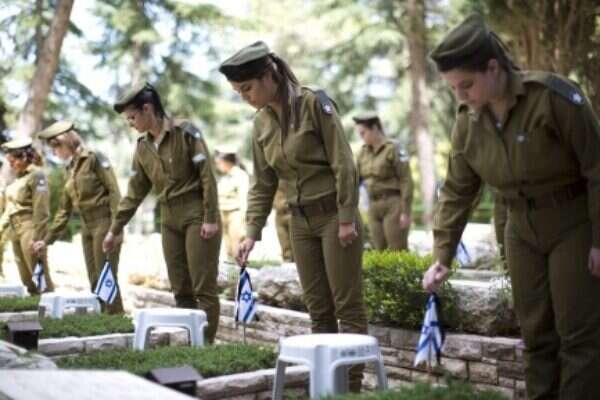
This week, as Memorial Day for Fallen Soldiers and Victims of Terrorism approaches on Wednesday, the entire nation will bow its head in solidarity with the many Israeli families who have lost loved ones in battle or in terrorist attacks. Memorial events begun on Sunday afternoon, with the traditional Flag for the Fallen ceremony at the Mount Herzl military cemetery in Jerusalem. In attendance at the annual ceremony were IDF Chief of Staff Lt. Gen. Gadi Eizenkot, Police Commissioner Roni Alsheikh, Israel Prison Service Commissioner Ofra Klinger, Defense Ministry Deputy Director General and Family and Commemoration Division head Aryeh Mualem, Yad Lebanim Chairman Eli Ben Shem and IDF Widows and Orphans Organization head Nava Shoham Solan. During the event, IDF soldiers placed small Israeli flags on each of the graves in the military section of the cemetery, and Eizenkot saluted the fallen buried there and all other fallen IDF soldiers. This is the 15th year the Flag for the Fallen ceremony has been held to honor and recognize IDF soldiers who defended the country with their lives. Initially, the chief of staff would place a flag by the grave of the last soldier buried at Mount Herzl. However, this part of the ceremony was changed after a bereaved family got upset that the IDF chief did not place a flag by their son's grave because he was not buried in the cemetery's central area due to doubts as to whether or not he was Jewish. Flags will be placed by the graves of each fallen soldier at all the military cemeteries and military plots across the country by Wednesday. "This evening, flags will be placed on the graves of all fallen soldiers, along with a black ribbon, a symbol of the loss and pain bound up in the revival of our nation," Eizenkot said on Sunday. "In the name of the entire people of Israel, IDF soldiers and youth group members will pass among the gravestones and place a flag by each name in memory of the fallen. This is our way of saluting our sons and daughters who set out on their missions, acted in accordance with the values of those missions, [values of] friendship and love of their country, and they gave their lives for that purpose -- to protect the country and its people." Eizenkot made a commitment to those present that the military "Will continue to be there for you and to embrace you, to carry forward the memory of your loved ones, to walk in their path and to come back here year after year to reverently salute each and every one of them. "Today, we will also remember the missing IDF soldiers and those whose burial places are unknown, and we promise that we will not rest until we return everyone to our borders." Mualem also spoke at the ceremony, saying he would continue in his moral duty "to safekeep the memory of your loved ones -- even when the [memorial] siren is not heard, when the nation's flags return to full mast, when the memorial candles burn out, when the days go from sacred to regular. This is our commitment, this is the path we walk." Also on Mount Herzl on Sunday was a flag-laying ceremony in memory of Israel's 1,450 fallen police officers. The event was attended by Israel Police and Israel Prison Service representatives, as well as by bereaved family members. 'Terrorism aimed at the heart' An equally moving ceremony in memory of terror victims was held Sunday at a memorial park in Tel Aviv. The ceremony was attended by Tel Aviv Mayor Ron Huldai, Terror Victims Association Chairman Yehoshua Cohen and bereaved families. Dudu Bakal, the father of Alon Bakal who was murdered in January's Tel Aviv shooting attack, spoke at the event on behalf of the bereaved families. "My life and the lives of my family have been forever changed," he said. "My son was murdered in a terrorist attack at the Simta pub. Because he was Jewish. His mother cries all day long. The cemetery where our treasure is buried has become the center of her life. When terrorism enters your private circle, every day is memorial day. God takes the good ones. And Alon was exactly that -- the salt of the earth, he loved life, he worked hard and always gave to others." Huldai said that in the last year, terrorism has struck the Tel Aviv-Jaffa municipality three times, "took the lives of six people, and injured 20. It is specifically because of Tel Aviv-Jaffa's centrality in this country that terrorism insists on coming back to strike it. An attack on Tel Aviv-Jaffa is an attack on the heart of Israel. A heart that terrorism tries to stop repeatedly, using knives and bullets -- but without success. 'Military service is an honor' Each memorial day, Miriam Peretz, who lost two of her sons in their military service, shares her story. On Sunday, at a conference at the Menachem Begin Heritage Center in Jerusalem, the English version of the book on her life, "Miriam's Song," was launched. The book, released by Gefen Publishing House, was translated with the help of Orthodox Union Israel after it won the Platinum Book Prize. "My story is the story of all of Israel," Peretz said. "It is a story of darkness, light, hope and sadness. It was difficult, but I chose life. That is what I teach our soldiers: Service is an honor, not a duty." Executive Director of OU Israel Rabbi Avi Berman said, "Miriam has succeeded in convincing people to move to Israel within a few minutes. She is a constitutive character. God gave her this role, she did not choose it -- but she accepted it with love for the people of Israel."
IDF chief to bereaved families: We will be there for you
Dudu Bakal, father of Tel Aviv terror victim Alon Bakal: "When terrorism enters your private circle, every day is memorial day" • Soldiers, youth group members lay flags by the graves of each fallen soldier at military cemeteries across the country.
Load more...