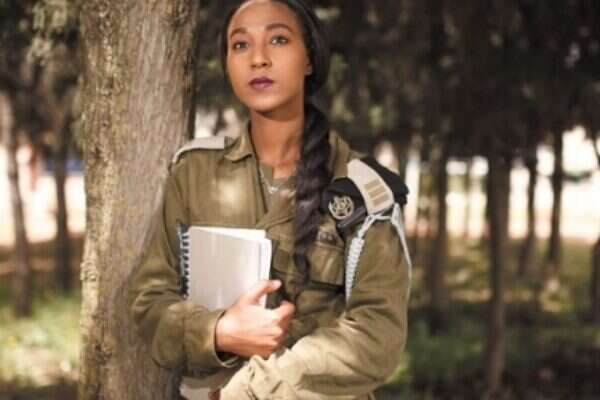
Back in 1488-1486, when he traveled from Italy to Jerusalem, Rabbi Ovadia of Bartenura wrote in his travel journal: "By one of the borders of Abyssinia [the Ethiopian Empire], past the Sambatyon River, in a very hilly land, are the lost People of Israel." Five hundred years later, Ethiopia experienced a severe drought that led to a major famine and a bloody civil war. The ruler, Mengistu Haile Mariam, would soon flee to Zimbabwe. Ethiopians were facing real danger. In the midst of all the chaos was the Elias family, who joined thousands of other "lost People of Israel" on a difficult journey by foot, beginning in early 1991: from the Semien Mountains in the Ethiopian highlands northeast of Gondar all the way to Addis Ababa, Ethiopia's capital city. There, the family whispered among themselves the rumor that had spread through their entire community: They would be brought to Israel like their brothers before them in Operation Moses of 1984. The father, Ergau, a Jewish community leader, and the pregnant mother, Deveritu, led their 11 children toward their millennia-long dream. After months of walking, the family arrived at the improvised camps set up outside the Israeli Embassy in Addis Ababa. Two of the children died during the harsh journey. Within a few days, moments before the words "Operation Solomon" would spread through Israel, an Israel Air Force plane took off, carrying them to the Promised Land. But there was also a new ray of light for the family: a girl was born, baby Zehava. More than a slogan Nearly 25 years have passed since the 40 dramatic hours at the airport in Addis Ababa, and the baby is now Capt. Zehava Elias, a noble, ambitious and proud officer in the Education Corps, who has come a long way and has a bright future ahead of her. "I was a month old when we got to Israel," she says. "At first, we lived in a hotel in Safed, and my parents told me that was a soft landing compared to the difficult months before we made aliyah. After a month, we went to an immigrant absorption center in Lod, where we lived until I began first grade. From there, we moved to an apartment in Lod, where we still live today. My younger twin brothers were born in Israel." Q: What has your family told you about life in Ethiopia- "It was a different culture, one with much more room for tradition. They lived a life that I would call 'biblical.' For example, when my mother observed the niddah laws [the Jewish ritual purity laws that mandate separation between a menstruating woman and her husband], she would go 700 meters [about 2,300 feet] away from the village. There was strict observance of the religion and a strong desire to come to Israel, though this may sound like just a slogan today. Think about how they left everything and set out on a journey to some faraway dream. Today, I have a map of Ethiopia in my office." Q: What kind of child were you- "Just like everyone else. In the ninth grade, I transferred to the Ramla-Lod high school where I completed my matriculation exams, with a specialization in Bible studies and biology. I was the only Ethiopian in my class, and my eyes were opened to the possibilities that the world has to offer and to what I think and what I want for myself. When I was 14, I worked as a cleaner. I wanted to be able to pay for the name-brand jeans that everyone wore at school, and I couldn't ask my parents to buy them for me." Q: Did you feel different as the only Ethiopian in your class? Did you experience racism- "Almost never. I remember once, when we were learning about the Holocaust, the teacher said that 'colored people' were also murdered, and everyone looked at me as if to say, 'Oh no! How could she say that-' "I also remember that I would constantly have to translate everything for my mom, and I wanted her to hear what the teacher had to say about me without me translating. Even now, I want to be able to tell her about my experiences in the army and to have her understand everything. Maybe that's where my drive to excel comes from -- because if you're the best, it translates to every language." In 2007, as she was about to complete her studies, her older sister died of cancer. "Until that point, I hadn't thought about my military career," Elias says. "I knew that I would enlist, but I didn't know what I wanted to do in the army. Shortly before my sister died, she told me, 'Zehava, I expect you to have a meaningful service.' Her words guide me even now." She was drafted to the IDF's Amir course for the integration of Ethiopian men and women into the military, which was held on the Education Corps' Michve Alon base. She completed the course with distinction. "It's a course that opens the door for people who feel they have the potential to take on high-quality positions," Elias says. "After the course, I was assigned to a training and command course for special populations. After that course, I was placed at Havat Hashomer [an Education Corps base that specializes in training soldiers from disadvantaged communities], as a commander for special populations. It was a very empowering experience. My neighbors were there. There were many people from the population that I came from." Q: How did you deal with that- "It was very important to me to express the significance of the requirements for the soldiers alongside faith in them, to tell a soldier, 'Yes, I expect you to be able to do the following things in 40 seconds, and I believe that you can do it.'" Q: You must have seen many crises there. "I had soldiers who just crashed and wanted to go home, some of them because they had to help earn money for the household. There were parents who called and threatened to commit suicide if their son didn't come back home, and I had to deal with soldiers who had made it through tough times themselves. I helped them change. I told them, 'When it comes to the things that you can control, do the best you can.'" From there, Elias went on to an officers' course at the Bahad 1 officers' training base, which she also completed as an exemplary cadet. After completing Education Corps training, she was stationed as a commander for teacher soldiers, who prepare pre-military youth for the army and carry out other educational duties, and for Garin Nahal (a pre-military program) participants in Kiryat Gat. Her next role was presiding over the pre-discharge courses for soon-to-be-released soldiers. In 2013, she received a certificate of excellence from then-head of the IDF Personnel Directorate Maj. Gen. Orna Barbivai, the first female major general in the IDF. Elias then went on to serve as a division head MAKAM, the IDF Center for Promoting Special Populations. "In each division, there is an NCO who accompanies the soldiers from special populations. Her job is essentially to mediate between the soldier and his commander, to remind the commander that the soldier has special needs beyond his tasks in the military. This job is sort of like being a mini-social worker. I also did a lot of home visits." Q: Impressive. What is your job now- "Today I am deputy education officer in the Northern Command. I am the commander for NCOs and education officers, and we deal with everything related to education in the command. The majority of the work is leading educational programming and adapting it uniquely for different units, especially regarding the populations that serve in them. We deal with a wide range of programming, including [content on] mutual responsibility, human dignity, integration in society, democracy, current events, opportunities for higher education for soldiers, including courses to complete matriculation exams and academic studies, and much more. The cherry on top is the Northern Command Military Band, the most amazing tool out there. When I approach the commanders with a request to hold an education day or cultural event, many doors are opened the moment I mention that we will also include the band." 'I understood the meaning of life' Just like many others from the Ethiopian community who have become Knesset members, lawyers, artists and athletes, Elias -- who is completing a bachelor's degree in business administration and marketing while serving in the military -- is a "success story." At the same time, we cannot ignore the repeated claims from members of the Ethiopian community of racist treatment from Israeli society, as well as police discrimination and brutality. It was only a year ago, after a video was released showing police officers beating up Ethiopian-Israeli soldier Damas Pakada, that members of the community took to the streets of Tel Aviv, Jerusalem and other cities in protests that ended with violence and arrests. At those same protests, as in the media, the name Yosef Salmasa was repeated. Salmasa committed suicide two years ago, after an apparently violent arrest in which police used a Taser gun. His family filed a complaint against the police officers with the Police Investigation Unit, but the case was closed for lack of evidence. Police Commissioner Roni Alsheikh decided that there was no justification to take administrative or command steps against the police officers, but the name Yosef Salmasa has become a symbol for the struggle of the Ethiopian community. "The state provides us with tools to succeed, but there is some kind of psychological roadblock that is difficult to overcome for people from the community," Elias says. "In the neighborhood where I grew up, people sometimes told me that I am 'becoming Ashkenazi' or said, 'Where are you living? Get out of your bubble,' but I am proud of who I am, and I know that there are also people who see me as an example. Two girls who were a grade younger than me at school recently enrolled in an officers' course. By the way, I was the first officer in my family, and my siblings followed afterwards. We do need to fight harder for what we deserve, but those who choose to work hard for what they want will succeed." Q: How do you do that- "I believe that strength comes from education. After I lost my sister, I understood the meaning of life, for better or for worse, and we can choose the path we walk in life. I have also failed; I didn't get every position that I wanted, but I never thought it was because of my background or my inability. I knew that I was good enough. I fought and continue to fight for what I want." Q: And what do you want to be when you grow up- "My dream is to continue working in education, to establish a boarding school or an orphanage, and to manage it."
Capt. Zehava's exodus from Ethiopia
Capt. Zehava Elias was a month old when her family arrived in Israel from Ethiopia • Now a proud officer in the Education Corps, she says: "We do need to fight harder for what we deserve, but those who choose to work hard for what they want will succeed."
Load more...