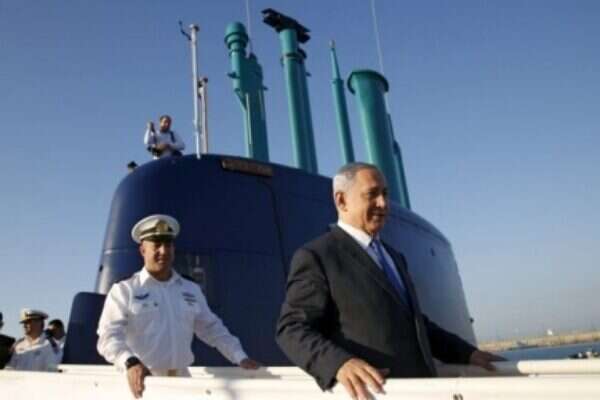
After three weeks at sea, Israel's fifth submarine, the INS Rahav, docked at the Israeli Navy base in Haifa and was welcomed in a state ceremony attended by Prime Minister Benjamin Netanyahu, President Reuven Rivlin, Defense Minister Moshe Ya'alon, IDF Chief of Staff Lt. Gen. Gadi Eizenkot, and Israeli Navy Commander Vice Adm. Ram Rothberg. The INS Rahav, which Israel acquired for 1.6 billion shekels ($406.3 billion), was accompanied on its journey by another submarine, a missile ship, small boats belonging to the security forces, and Israeli Navy commando vessels. Adm. Oded Gur-Lavie, former commander of the nation's submarine fleet, was aboard the new sub for the trip to Israel. As the ceremony began, all the Navy personnel on board the submarine emerged to great applause. The last sailor to disembark was the commander of the INS Rahav, Cmdr. S., who saluted the senior commanders and asked Rivlin's permission to "attach the INS Rahav to Israel's naval command." Netanyahu took the podium, thanking German Chancellor Angela Merkel for funding a considerable part of the cost of the submarine, and hinted at the vessel's second-strike capability. "Above all, our submarine fleet serves to deter the enemies who seek to destroy us. They will not have their way. They need to know that Israel can strike with great force anyone who tries to harm it," the prime minister said. "The citizens of Israel must know that Israel is a very strong country, and we are doing and will do everything to protect them, in every place and in every arena, in the kinetic and the cyber worlds, with the cyber program we're building. In the air and over the air, in space. On the ground and underground, against the tunnel threat. At sea and under the sea, with our submarine fleet," Netanyahu said. The INS Rahav is the second Dolphin AIP class submarine the Israeli Navy has acquired. The air-independent propulsion technology allows the submarine to remain submerged for longer periods than earlier models. The submarine was based on the first-generation Dolphin submarine, and includes innovative systems that significantly extend the submarine's attack, discovery and defense capabilities, as well as its operating range, length of missions and stealth. The new Dolphin is also about 20 meters (65 feet) longer than Israel's three older submarines, which each measure about 68 meters (223 feet.) In the coming months, the Rahav will undergo a series of tests in Israel and be fitted with Israeli systems. Only after the process is complete will the sub be declared operational and join IDF operations. Ya'alon addressed the new submarine's capabilities, saying, "Israel will know how to reach every place in the Middle East and beyond it, to get its hands on terrorist operatives, their commanders and handlers, and if necessary, also attack the weapons they are seeking to amass to use against us." Rivlin also spoke, telling those present that "in the coming decades, the INS Rahav will take an active part in the defense of Israel and its maritime territory, while submerged deeper, farther and for longer periods. But the machine of war alone cannot win the battle. The crew of the submarine is its real qualitative edge -- the crew of the submarine will win." Eizenkot said that "this year, we'll begin to implement the Gideon multi-year work plan that we recently put together. The plan is designed to ensure that the IDF is equipped to meet the battlefields of the future and become an advanced, sophisticated army -- a precise and powerful army. "The naval command has an important role to play in our success against various threats and in protecting the security of our citizens and Israel's strategic assets. In every future conflict, the naval command will operate in conjunction with the rest of the [IDF] commands and continue to be an attack, defense and intelligence power that is both efficient and vital. [To] the submarine crew: Many challenges lie ahead, and you can meet them. I know that behind the most powerful machine stand the people who are responsible for the security of the country and our success," Eizenkot said. The last person to speak at the ceremony was Rothberg, the outgoing commander of the Israeli Navy, who informed the attendees that Israel's sixth submarine -- due to be delivered in 2019 -- will be named the INS Dakar, after the submarine that sank in 1968, along with 69 crew members. Some of the Dakar crew's relatives were at the ceremony, and they were touched by the news. "The Dakar and its combat crew, who set out for a mission and didn't complete it; the Dakar -- whose crew were the spearhead of the submarine fleet and the Israeli Navy in those days --- has become a symbol," Rothberg said. "Children and streets were named after it; submariners have been trained in its legacy. The Dakar -- [whose disappearance] was the biggest mystery we've known -- will achieve its goal, will set out in the future and fight once again for Israel. The new, more advanced submarine carrying the name Dakar will be a living, dynamic legacy, brave and victorious. The [new] Dakar will be a living, daily commemoration of the names and faces of the people who set out full of spirit to reach the Haifa Port and fight from the depths for the State of Israel." When the INS Dakar arrives in Israel, the Israeli navy will bid farewell to one of its older submarines and leave five in operation.
Netanyahu: Our submarine fleet deters the enemies who seek to destroy us
Israel's latest submarine, the INS Rahav, welcomed in a state ceremony in Haifa • Prime Minister Benjamin Netanyahu: Israel's citizens must know that we are a very strong country • President Reuven Rivlin: The submarine crew is its real qualitative edge.
Load more...