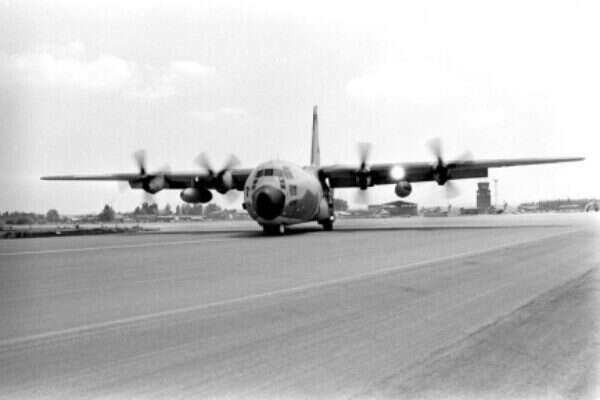
The late Ninette Moreno was one of the passengers on the Air France plane hijacked in Athens on June 27, 1976. The hijackers released those who were not Israeli or Jewish, and because Moreno was a Canadian citizen and they did not suspect she was Jewish, she was given the same treatment. Moreno landed in Paris and was questioned by two Mossad agents for six hours. The information she supplied was detailed and accurate, and based on what she told them, they were able to sketch a precise map of the terminal at Entebbe, Uganda, that included the terrorists' location, the space where the hostages were being held, the rest rooms, the entrances and exits, and obstacles and weak points. The sketch also shows the line of crates that the hijackers set up in the room and told the passengers not to cross. The crates, the terrorists claimed, were full of explosives. But Moreno, who had carefully written down details she had noticed from the moment of the kidnapping until she was released, noticed something interesting. She told the Mossad agents that when one of the crates fell and broke open, a hostage lifted it and put it back without any difficulty. She later checked another crate and realized they were all empty. This information, which was sent to Israel by telegram, conversations in code and envelopes sent priority mail, was later integrated with more information and encouraged then-Prime Minister Yitzhak Rabin to take the decision to launch a military operation without concern that it could fail. And thus Operation Entebbe (also known as "Operation Thunderbolt") -- considered one of the most daring in Israel's history -- got underway. Later, the name was changed to Operation Yonatan, after Sayeret Matkal commander Yoni Netanyahu, a casualty of the mission and the older brother of Prime Minister Benjamin Netanyahu. The action has inspired books, a movie, and countless written words -- and now an exhibit devoted to Operation Entebbe has opened. A permanent exhibit devoted to the operation has, in fact, existed for years, but it was on display in a classified department at Mossad headquarters, so only a few people, mainly members of the spy agency, were able to see it. This week, Netanyahu and Mossad head Tamir Pardo visited the exhibit, which opens to the general public on Friday at the Yitzhak Rabin Center in Tel Aviv. The curator of the exhibit is Avner Avraham, a retired Mossad agent. Avraham refurbished the display content, including the map based on the information supplied by Moreno; Yonatan Netanyahu's tactical vest; a letter from the head of the Iranian military praising the operation's success; a plastic bag with the words "Uganda Duty Free" written on it; and the tefillin (phylacteries) of Akiva Lexer, who had been on his way to watch the Montreal Olympics and four years earlier had witnessed the slaughter of Israeli athletes in Munich. 'Like a James Bond movie' But the family of Moreno, who died seven years ago, doesn't need any exhibit to study the Entebbe operation. That action, which took place on a battlefield 3,800 kilometers (2,361 miles) from Israel, left an indelible impression, especially on Moreno's grandson, Lt. Col. Emmanuel Moreno, a Sayeret Matkal commander who was the most senior officer killed in the Second Lebanon War in 2006. "The hijacking was a formative event in the family," said Yossi Moreno, one of Emmanuel's brothers. "I was six, and Emmanuel was a year younger than me. Grandma came to visit us in Israel from Canada and was hijacked on the way back. Later, she told us that during the abduction she felt as if she was in a James Bond movie, and from there, she collected all the details that helped in the sketch." It is clear to Yossi that the resourcefulness and fighting spirit she showed trickled down to her grandchildren. "There's no doubt that Grandma's stories influenced Emmanuel," Yossi continued. "He was really interested in the story of Yonatan Netanyahu and the entire story of the hijacking." Indeed, it appears that abductions and prisoners were always a part of Emmanuel, whose image is still shrouded in secrecy (his picture is not allowed to be published). He served in Sayeret Matkal, the same unit that conducted the Entebbe operation and took part in the kidnapping of senior Hezbollah terrorist Mustafa Dirani from his home in Lebanon. He was supposed to have commanded the operation to free captive Israeli soldier Nahshon Waxman, but was replaced at the last minute. Emmanuel commanded the mission to rescue taxi driver Eliyahu Gurel, who was abducted in 2003 and held captive in a basement near Ramallah. He was also involved in a series of still-classified covert actions, and was eventually killed in a war that started with the kidnapping of two soldiers, Ehud Goldwasser and Eldad Regev, on the northern border. Another Entebbe hostage who kept a diary while imprisoned was Sarah Davidson, who documented what was happening in the airport. "It was my husband Uzi's and my first family trip with our boys, Benny and Ron," she said in an interview this week. "We went to celebrate the younger one's bar mitzvah. My mother took us to the flight and said, 'When the kids used to stay with me, you would sent postcards and I would read them, and that's how we kept up to date. Now, take a notebook, write down what happens and I'll read it when you get back.' "My mother gave me the notebook after we had already checked in our suitcases, so I shoved it into my carry-on. She also gave me a box of sedatives and a hamsa necklace, which helped a lot later during the stay in the packed hall with the hostages. It was there that I started to write, because I thought we had to leave something behind. I didn't think we would get out of there alive. I started to describe what was happening, and I wrote a little at a time." After they were freed, Sarah thought of a way to overcome the nightmares and the hard memories: another vacation trip. That was the inception of the book "A Personal Diary -- Entebbe 1976," in which she fleshed out her descriptions. It was published a year after the operation. This week, at her initiative, a new edition of the book, titled "My Entebbe," was released. "I thought that today not everyone knows the details of the operation, and it would be right to review things, both the book and the exhibit," she said. For the past 20 years, she has volunteered at the Rabin Center and searched for original material related to the operation. In the end, Dalia Rabin, daughter of Yitzhak Rabin, reached out to Pardo -- who was part of the mission -- and a decision was made to open the exhibit to the public. Just a little more responsibility The director of the Education Department at the Rabin Center, Dr. Nurit Cohen-Levinovsky, said it had been decided to "devote a wing of the museum ... to an operation that even today is considered glorious in the history of the IDF. We built a comprehensive new exhibit, the first one on the subject." According to Cohen-Levinovsky, the Rabin Center is the natural home for such an exhibit: "Menachem Begin said after the operation that everyone deserved thanks and congratulations, but that the captain of the ship deserved a special thank you, because he had a little -- just a tiny drop -- more responsibility. And who knows how much that drop weighed, he asked. Rabin was the man who navigated the ship at the critical moment, knew how to ask the right questions, request adjustments and finally make the decision." Cohen-Levinovsky describes the three different aspects of the exhibit: from the perspective of the hostages, the perspective of those who planned the rescue and the soldiers, and the perspective of the decision-makers -- the Israeli government, led by Rabin. The exhibit features, for example, the original government document approving the rescue action. The word "secret" appears at the top of the letter, firing up the imagination. It states: "It has been decided to approve a rescue action for the hostages in Uganda by the IDF, according to the action plan presented by the defense minister and the IDF chief of staff." Last week, the IDF archives authorized the publication of rare photos and documents from the preparations for the mission, such as the operational log book and notes that Rabin and then-Defense Minister Shimon Peres exchanged. Anyone whose curiosity is still unsatisfied will be excited to see that the new exhibit includes hitherto-unheard recordings of communications in which Brig. Gen. Dan Shomron, the operation's commander, is looking for Yoni Netanyahu, who does not answer. More testimony about the nerve-wracking moments comes from Amos Eran, director general of the Prime Minister's Office during the operation. This week, Eran described the immense tension at the upper echelon. "We were sleeping an hour a night," he said. "I remember how we were notified about the hijacking: During a cabinet meeting, a note was delivered to the prime minister. He showed it to me and asked me to convene a limited forum with the defense, justice and transportation ministers, as well as the [IDF] chief of staff, immediately. Information started to flow. "It was decided to develop two parallel moves: diplomatic and military. At the diplomatic level, talks started over the hijackers' demand to release 60 terrorists, some of whom weren't even held by Israel. We offered a similar number, but different prisoners. At the same time, the military option was moving forward: a plan was submitted to Rabin that he rejected. He demanded that a military operation be executed no more than three minutes after landing at the airport, so then work started on a new military operation. When the hijackers rejected the alternative list we had proposed, we moved into gear for the military option." The pilots drilled on landing at a dark airport, and the Mossad took care of precise coordination: an attempt to give the plane carrying the Sayeret Matkal soldiers the exterior of a passenger aircraft and slipping it into the airport's flight schedule in place of one of the two civilian flights scheduled to land at the same time. In Israel, people began collecting information on the terminal. They discovered that the place had been built by the Israeli construction firm Solel Boneh, and that plans of the building were available in Israel. But that wasn't enough: Updated information was also necessary, and the Mossad sent someone to take photos. "A light aircraft was flown over the area, and photos were taken from the air of the airport and the compound itself, including the hijacked plane," Eran said. "The man who took pictures was a Kenyan who rented a small plane. He claimed that he had a problem landing and managed to circle over the airport a few times, record, and pass us the most important, up-to-date information. The information he gave us arrived minutes before the planes were about to take off. The forces that left got the pictures minutes before boarding. In the end, [the Kenyan man] paid with his life. A few months later he was targeted and killed. "The morning of the Saturday it was decided to go ahead with the mission, an air force commander came to me and said that to meet the schedule, he needed to get to work before the cabinet approved [the operation]. A final drill had taken place the night before near Sharm el-Sheikh [in Sinai]. Rabin decided that the teams would leave two hours before the cabinet meeting. 'I want every minister to speak and say what he feels, without exception, but no more than five minutes,' he told me. "One of the ministers was Haim Bar-Lev, whose son Omer (now a Zionist Union MK) took part in the operation. One of the main deliberations was how to guarantee that the terminal wouldn't be booby-trapped. The concern was that if the forces were detected, the terminal would be blown up and the results would be catastrophic. We held direct talks with Ugandan leader Idi Amin. We told him that we saw him as responsible for the hostages, who were in his country and under his protection. At one point, he blew up and said, 'What do you want? My soldiers are with them in the terminal and giving them drinks and mattresses.' From that, we concluded that the terminal wasn't rigged to explode. That was sent on to the minister, and everyone voted for it," Eran said. Eran had another conversation with Rabin, in which the prime minister gave him a dramatic order: If the operation did not succeed, Rabin said, "I'll resign the next day. Prepare a letter now that expresses everything I've told you." "I was surprised," Eran recalled. "I asked him what the parameters for success and failure were. He answered: a large number of wounded. That letter isn't in the exhibit ... because it was never written. Luckily for us, there was no need."
The spirit of Entebbe is coming to Tel Aviv
Visitors to a new exhibit on Operation Entebbe, at the Yitzhak Rabin Center in Tel Aviv, will be able to view photographs, documents and items from the daring hostage rescue that until now were shut away in the halls of Mossad headquarters.
Load more...