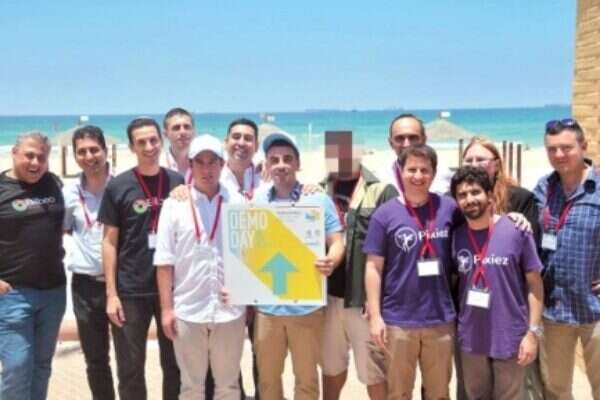
Israel is known as the startup nation, so much so that nearly everyone of us knows a success story about someone who made it big. Many Israelis believe, or are even convinced, that we have an idea that will become the next big thing. Whether it remains a secret or is discussed with friends, the sense is that we can start out on the path that will lead to an impressive exit and glory, allowing us to stop clocking in at our day jobs. In actuality, most of us merely dream while sitting in traffic, waiting for the light to change. But there are those who are taking care to bolster Israel's status in the startup world. These people are tenacious, unafraid to take risks, imbued with true belief in their ideas and ready to take them all the way. As it happens, they are also new immigrants who are here to change our reality. They all belong to the new generation of immigrants who broke through the cultural ghetto and -- with a little help -- are on the rise in the heart of the Israeli high-tech scene. All this is happening thanks to TheHive, a startup accelerator that operates under the auspices of the Rashi Foundation's Gvahim Association. For the past nine years, the project has been working to put new and veteran immigrant entrepreneurs in touch with each other for the purpose of establishing new technological initiatives. Gvahim is the first and only group in Israel that has made it its mission to integrate college-educated immigrants into this niche market, helping them realize their business and financial potential, something that often falls between the cracks due to the difficulties of acclimating to life in Israel. Thousands of people like these arrive every year, some having been educated at elite academic institutions and possessing international contacts and knowledge of international markets. Such potential shouldn't go to waste. Most of Gvahim's staff are also new immigrants or returning Israelis, the guiding principle being that someone who has personally experienced the challenges and unemployment facing new immigrants knows best how to overcome the obstacles they face on their path into the local employment market. "We give new immigrant entrepreneurs who don't have contacts in or really know the Israeli startup world, a chance to realize their technological potential," says Gvahim CEO Gali Shachar, 40. "We do this through [supplying] close professional mentoring, shared work spaces and connections to leading Israeli entrepreneurs and investors. The program gives immigrants the tools that let them make their startup nation dream a reality, while at the same time achieving a top-priority social goal, absorbing new immigrants into Israeli society." Since it opened its doors in 2006, Gvahim has racked up many achievements. Over 1,500 college-educated immigrants have received direct assistance, and another 7,000 have had contact of one kind or another with the group. Nearly 90% of the immigrants mentored by the group found work within a single year, and thus far it has launched 73 startups, 33% of which have raised effective venture capital and 50% of which are self-supporting businesses. As a result, dozens of jobs have been created. It should be noted that 25% of the immigrants moved to Israel after taking part in Gvahim's internship program, which operates a network of 500 mentors from the Israeli business community who have come on board and are personally helping the newcomers integrate into the workforce. A family business One of the project's notable successes is the Dogiz initiative, the brainchild of Alon Zlatkin, a veteran immigrant from the former Soviet Union, and Daniel Djanogly, freshly arrived from Britain. Three months ago, Dogiz won $100,000 in seed money in an international competition sponsored by Google. Dogiz is an application that allows dog owners to stay in touch with the dog-lover community and suppliers of dog-related services in cities all over the world, letting people know who is at the dog park when, who is available to give advice if a problem arises, offer dog sitting or dog walking services, seek friends for one's pet, and more. Another successful venture is Tevatronic, an agricultural business started by two immigrants from the former Soviet Union, Oleg Korol and George Veitsman. The two have raised $500,000 for their startup, which ensures that crops are watered exactly as needed. Another noteworthy project is WeKast, which Google selected from among thousands of startups to participate in its prestigious Blackbox program. WeKast, which lets users broadcast computer presentations from their mobile phones, was founded by Noemie Alliel, an entrepreneur who made aliyah from France, and Igor Korol, the father of Tevatronic's Oleg. Another family success story to come out of Gvahim is Bilbeo, a startup belonging to David Toledano, 46, and his nephew Roni Toledano, 28, respectively a returning Israeli and a new immigrant from France. Bilbeo impressed the judges at a startup competition recently held in Ashdod, offering company managers a smart dashboard that analyzes a firm's performance. Bilbeo had its inception in the family's holiday sukkah, when David, then vice president of exports at Ness Technologies, discussed with Roni his frustration at the lack of requisite management tools. Roni's creative solution sparked the familial partnership. "I had a need ... to build a company in Israel," says David Toledano. "I feel that for me, this is kind of coming full circle, because today I'm closer to the end of my career than the beginning, and [having] the ability to employ people is a dream for me." Married and a father of four who lives in Kfar Saba, he also says that "thanks to our development, we give directors a solution to problems that I encountered myself in the past. Moreover, I see working with family as something magical in and of itself." Roni Toledano adds, "In my former job at Strauss, I had the same kind of management position as David, so when he laid out his professional difficulties, I had a connection to the subject. That's how the idea to develop the product came about." David and Roni Toledano's cooperative venture is considered relatively advanced compared to others in TheHive. They could allow themselves to leave their jobs and now head a staff of five employees based in offices in the Rehovot Science Park. They already sell their work to companies throughout Europe. Despite the age gap, David lets his nephew -- whom he taught to ride a bike when he was a child -- take the wheel and manage the firm. "I listen to Roni like my dad," David says. "He's a very smart kid. It makes me very proud to see him growing and leaving me free for more comfortable business." Roni sums up: "It was charming to me that TheHive's startup accelerator is a nonprofit association. In Israel, a vibrant startup world, thousands are born all the time. But whether you're a tzabar [a native-born Israeli] or a new immigrant, in the end we're talking about the Jewish mind. Other than that, there is a contribution to industry as well as to us as developers." Engineers and champions Success in the local high-tech market seems to require the qualities of a winner, just like those Peter Chermensky, 30, and Eddi Ochakovsky, 29, immigrants from the Ukraine and Belarus, brought with them from the world of sports. The two are mechanical and electronic engineers with a championship record: Ochakovsky was a member of Israel's national karate team and former Israeli youth champion, while Chermensky was an outstanding ice hockey player who transitioned to field hockey in Israel. The two athletes-turned-innovators developed SVD (Safe View Design), a startup that directly corresponds to the rapid pace of the business they are developing. The product is designed to prevent motorcycle accidents through the use of a mechanism that provides alerts about road hazards. Of course, the technology itself is secret, but its inventors make it clear that they have developed numerous parameters that can predict the rider's behavior. The product's sensors detect pressure on the handlebars, changes in balance and what the rider is looking at, and give off alerts. The rider can also use a small screen that constantly records what is happening behind him and in a 180-degree field. The product itself fits on the motorcycle helmet and in the near future is expected to be adapted to the bicycle market. "Peter and I studied together and worked in electronic and mechanical engineering, but we had a burning need inside to express ourselves. We thought about how we could make use of all the knowledge we had for a development we could move ahead with and could even save lives," Eddi says. Peter adds: "We work on our product 24/7, around the clock, at the accelerator and at home, too." Despite their important invention, their reality isn't as comfortable as that of the Toledano family. Along with working on developing their product, they spend long hours working to support their families, which are also expanding. Eddi is a private tutor in mechanical engineering and physics, and Peter works as a security guard at the Israel Electric Corporation. "The privilege of the accelerator is that there is no privilege. That is to say, you get a wonderful set of tools, but work just as hard as any other innovator. That's how Eddi and I feel," Peter says. Eddi agrees: "Athletics is the base of the bond between Peter and me. We both love sports, root for the same teams, and that gave us a base from which to launch our cooperative venture. We are hungry and energized to create. We completed courses together with honors when we were studying, and now we just hope that will be the startup's future, too." The world of water Sonya Davidson, 40, prefers to do everything on her own: aliyah, founding a company, and completing five academic degrees. She made aliyah from Ohio seven years ago and she admires Israeli straightforwardness. "You need to be brave to make aliyah, especially without knowing the language or anybody here," she says. "But my love for Israel is bigger than any fear. I love the people, the economy, the welcoming, and the sense of belonging. Here you can look at and experience Judaism as it really is." Davidson took her first steps on the startup path while still a child, thanks to her mother's patience. When Sonya threw water on the floor during a fight with her mom, the latter, rather than punishing her, chose to explain the principles of the movement of water. "She said, 'Look at how you can move the water as one unit, and look at how it takes on the shape of whatever form it's put into, and look how you can float objects on it.' That incident stayed with me all throughout my studies. Every time water is mentioned, that moment touches me," Davidson smiles. And water did in fact become part of her future. Davidson completed her bachelor's degree in oceanography and later earned degrees in business and accounting. All these led to her startup H2 Energy Now, which uses water to store energy by separating it into hydrogen and oxygen. Because of the originality of her startup, Davidson was chosen to present at a conference in Switzerland that selects a mere 30 out of the 60,000 companies that apply to participate. Davidson's company is the first Israeli firm to present at the exclusive Swiss event. "That incident in my childhood changed my life. It made water special to me, and I wanted to build something more out of it, that could change worlds," Davidson says. "When you make aliyah, one of the things that happen is that you don't have contacts. You don't know anyone from the industry and aren't sure how it works. But here in the accelerator, you have a chance to learn how to better build your company in line with Israeli industry. You learn how to present and market it to others and how to promote it and make it into the next big thing."
A hive of activity
For the past nine years, the Gvahim Association's TheHive startup accelerator has helped thousands of technology-oriented new immigrants and returning Israelis launch businesses, many of which have been successful internationally.
Load more...