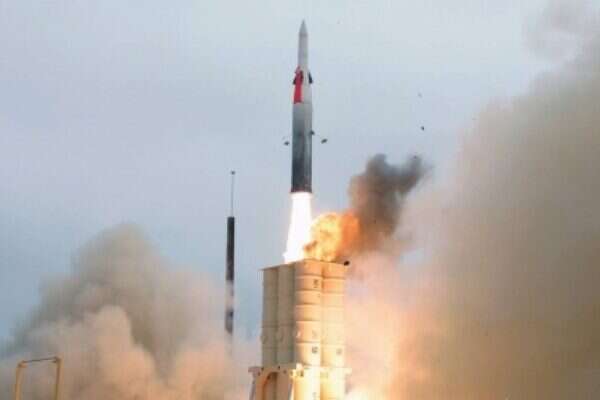
As politicians and the media continue to speculate about a possible military strike on Iran's nuclear facilities and rhetoric escalates between Iran and the West, the Israel Air Force has begun to accelerate its development of the Arrow 3 missile-defense system, Israel Hayom has learned. The Arrow 3 considered the most advanced anti-ballistic missile system in the world is being phased into service and is scheduled to be operational in a year and a half, rather than 2015, the originally scheduled date. The army is also planning to recruit soldiers to serve in specialized Arrow units within six months. Meanwhile, Israel and the U.S. have also said they are planning the "most significant" joint drill in the allies' history, to take place next May. The Defense Ministry and the U.S. Defense Department signed a deal last July to jointly develop the Arrow 3 as the upper tier of Israel's multi-tiered air-defense system, which aims to provide a comprehensive shield against various rocket and missile threats. It will operate in conjunction with the Arrow 2, which is already deployed throughout the country. The Arrow 3 exo-atmospheric interceptor includes a two-stage interceptor based on hit-to-kill technology. Its compact design, outstanding maneuverability and diverse capability serve to enhance its effectiveness against all types of ballistic missiles and warheads. It will be able to intercept intermediate-range ballistic missiles and other weapons 60 miles above the Earth's surface. "The closer a missile launched toward Israel is to striking, the faster its speed," a senior air force official said on Sunday. "Therefore it is preferable to intercept it at an earlier stage." "The entire Arrow disposition will change," the air force official said. He went on to explain that currently the Arrow system is decentralized, with each battery operating as an individual unit. "With the arrival of the Arrow 3, there will be a centralized command and control point for the system, but the option to have each battery operate separately will still exist should the need arise," the official said. Israel has been reinforcing its defenses, and just last week Israel's Homefront Command conducted a large civil defense exercise in Holon, which included the simulated evacuation of victims of missile strikes to the Wolfson Medical Center. Participants in the drill included civilian emergency services, police rescue services, fire-fighting units, Magen David Adom (ambulance services) and National Emergency Management Authority officials. A short while after the test ended, the Defense Ministry issued a statement saying, "Israel tested a rocket propulsion system with the launch of a missile from Palmahim Air Force base. The experiment was planned some time ago and was executed as planned. The experiment was successful." According to foreign media reports, the experiment did not involve the Arrow anti-ballistic missile system, and instead tested an Israeli-made offensive ballistic missile capable of delivering a nuclear weapon. "This was an impressive achievement and an important step in Israel's missile and space program," Defense Minister Ehud Barak said. "The test was planned a while ago, and it once again proved the high technological level of our engineers, technicians, and defense industries." The missile test was conducted in tandem with Israel's participation in a NATO air force exercise in Sardinia, Italy. Fourteen Israel Air Force F-16 fighter jets took part in maneuvers alongside Italian and other NATO planes. The Israeli squadron commander pointed out that the drills focused on long-range offensive maneuvers, and said, "The exercise gave us an excellent platform to test our capabilities in unfamiliar territory. We have a harder time conducting such maneuvers in Israel, due to its size." Earlier this year, Israel Aerospace Industries (IAI) conducted preliminary tests of the Arrow 3 system. The test was revealed by Aryeh Herzog, then director of the Defense Ministrys Homa project, which deals with the states missile defenses. Held in an undisclosed location in Israel, an Arrow 3 interceptor missile was launched against an incoming projectile, successfully destroying it after a few hundred meters of flight. The test itself did not involve firing the missile in its full capacity, but aimed only to test its proper separation from the launch container. Iran factored high in the U.S. and Israel's decision to develop the Arrow 3 system, particularly in light of declarations by Tehran that it possesses missiles that could strike Israel. "If the Zionist entity wants to attack us, we will strike at the heart of Tel Aviv before their planes even leave our airspace," Iranian air force commander Brig. Gen. Amir Ali Hajizadeh said this summer. "We have reached the conclusion that we do not need a range of more than 2,000 kilometers, because Israel is no further than this from our borders." Iran has conducted at least six test flights of the Shahab 3 missile, which defense analysts have said could hit Israel and U.S. military bases in the Gulf region. This week, the U.N. nuclear watchdog, the International Atomic Energy Agency (IAEA), is expected to issue its most detailed report yet on Iran's nuclear program. Meanwhile, Israel and the U.S. will embark on the "largest" and "most significant" joint exercise in the allies' history, U.S. State Department Assistant for Political and Security Affairs Andrew Schubert said Sunday. Schubert said that 5,000 Israeli and U.S. soldiers would participate in the military exercise in which they would test their defenses against ballistic missiles. He also said such joint exercises would "allow us to learn from Israels experience in urban warfare and counterterrorism." During the drill, called "Austere Challenge," Israel and the U.S. plan to test air-defense systems including the Arrow 3 and the Thaad (Terminal High Altitude Area Defense), as well as the Arrow 2, Patriot, Magic Wand, Iron Dome, in a simulated ballistic missile attack on Israel. Israel and the U.S. have conducted joint military drills in recent years as concern rises in Israel about Iran's growing arsenal of missiles and nuclear ambitions with a three-week drill in 2009 the last one to make headlines. "The challenge is missile interception in an era of planes," a senior IAF official told Israel Hayom on Sunday. "The Americans are eager to conduct this drill because we are their 'laboratory' in this context." The IAF's aerial defense forces have already established a special administrative body to prepare for the joint drill, scheduled for May 2012.
Amid talk of Iran war, Israel accelerates Arrow 3 program
Israel is stepping up its development of the Arrow 3, considered the world's most advanced anti-ballistic missile system • Israel, U.S. planning "largest" and "most significant" joint exercise in the allies' history.
Load more...