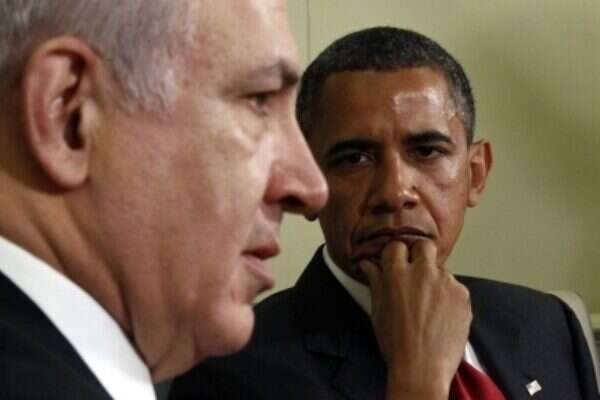
U.S. President Barack Obama said Tuesday that the U.S. is weighing whether to back Palestinian efforts to seek U.N. recognition for an independent state and that recent remarks by Prime Minister Benjamin Netanyahu dim hope for a negotiated two-state solution to the Israeli-Palestinian conflict. Obama's comments at the White House did little to repair rocky U.S.-Israeli relations, which were aggravated by a Wall Street Journal report earlier this week alleging Israel spied on sensitive negotiations about Iran's nuclear program. The report said Israel acquired information from confidential U.S. briefings and other means and shared it with members of Congress to build a case against making a deal with Iran, which has repeatedly threatened to destroy Israel. Netanyahu is feuding with the White House over the emerging deal with Iran. He has also come under fire for comments he made just ahead of the Knesset election last week, in which his Likud party scored a decisive victory. Netanyahu said a Palestinian state would not be established while he was prime minister and warned his supporters that Israeli Arab voters were heading to the polls "in droves." Netanyahu has since backtracked on those campaign statements, but the White House has reacted with skepticism. "Netanyahu, in the election run-up, stated that a Palestinian state would not occur while he was prime minister," Obama said. "And I took him at his word that that's what he meant. "Afterwards, [Netanyahu] pointed out that he didn't say 'never,' but that there would be a series of conditions in which a Palestinian state could potentially be created," Obama said. "But, of course, the conditions were such that they would be impossible to meet any time soon." Obama said he is evaluating U.S. policy on the Israeli-Palestinian conflict. But he said that in light of Netanyahu's comments, the "possibility seems very dim" for the Israelis and the Palestinians to agree to live side-by-side in peace and security. "We can't continue to premise our public diplomacy on something that everybody knows is not going to happen, at least in the next several years," Obama said. Obama also said his disagreements with Netanyahu over Iran and the Palestinians should not be framed as a personal issue. He said he has a "businesslike relationship" with Netanyahu and has met with him more than any other world leader. "This can't be reduced to a matter of somehow let's all, you know, hold hands and sing 'Kumbayah,'" Obama said. "This is a matter of figuring out how do we get through a real knotty policy difference that has great consequences for both countries and for the region." Fractures in the U.S.-Israeli relationship recently have been played out at the U.S. Capitol. Obama was upset when Republican House Speaker John Boehner did not consult with the White House before inviting Netanyahu to give a speech to Congress just as the Iran nuclear talks were approaching a critical juncture. Some Democrats skipped the speech in which Netanyahu boldly warned that an emerging nuclear deal with Iran would not prevent it from developing nuclear weapons, but rather pave Iran's path to the bomb. The U.S. has been leading world powers in negotiations aimed at curbing Iran's nuclear program. The so-called P5+1 group -- Britain, China, France, Russia and the United States plus Germany -- is rushing to craft a framework for a deal to prevent Iran from developing nuclear weapons in exchange for relief from sanctions before a deadline expires at the end of the month. Netanyahu's office called The Wall Street Journal report "utterly false," saying Israel "does not conduct espionage against the United States or Israel's other allies." Foreign Minister Avigdor Lieberman said Israel obtained information through other participants. "All the information we obtained is from a different side and not through the United States," Lieberman told Army Radio. Defense Minister Moshe Ya'alon said "there is no way" that Israel spied on its closest and most important ally. Ya'alon noted that Israel has received no complaints from the U.S., which he said would be expected in such a case. "I am sorry it came out this way," Ya'alon said. "I have checked whether anyone from the intelligence community received a complaint, because if there was such a thing we should have received a complaint. We did not receive any complaints, but apparently someone has an interest in sparking a dispute, or creating a bad atmosphere in our relations." Obama said Tuesday he did not want to comment on other nations' intelligence services, but noted, "We have not just briefed Congress about the progress, or lack thereof, but we also briefed the Israelis and our other partners in the region." When asked about the allegations that Israel spied on the nuclear talks, senior senators said they never gleaned any details from the Israelis that they did not already know or had not learned in briefings by the Obama administration. According to Israeli officials cited in The Wall Street Journal report, Israel did not spy directly on American negotiators, but obtained details through other means, including close surveillance of Iranian leaders who were being told the latest deals being offered by U.S. and European officials. The paper said European officials, particularly the French, have been more transparent with Israel about the closed-door discussions than the Americans. Lawmakers denied knowing anything about it. Boehner said he was "baffled" by The Wall Street Journal report and was not aware of any spying. Sen. Bob Corker (R-Tenn.), chairman of the Senate Foreign Relations Committee, said he did not remember anyone from Israel ever sharing information with him that he did not already know or had surmised from news accounts. "One of my reactions was, why haven't [the Israelis] been coming up here sharing information with me-" Corker said, smiling. "I haven't had any of them coming up and talking with me about where the deal is. So I was kind of wondering who it was they were meeting with. I kind of felt left out." Asked whether he was ever briefed in greater detail by Israeli officials, Sen. Tim Kaine (D-Va.) said, "Never. Oh no. I have talked to Israeli officials here and in Israel." Sen. Lindsey Graham, (R-S.C.), a critic of Obama's foreign policy, said the same thing. "No one from Israel has ever briefed me about the agreement. A bunch of us met with Mossad [Israel's intelligence service]. That was a bipartisan exercise. "I hope somebody is spying on Iran," Graham added.
Obama: Dim hope for end to Israeli-Palestinian conflict
President Barack Obama says U.S. weighing whether to back Palestinian statehood efforts at U.N. • Obama: I have a "businesslike relationship" with PM Benjamin Netanyahu • Defense Minister Moshe Ya'alon: Someone is trying to sabotage U.S.-Israel ties.
Load more...