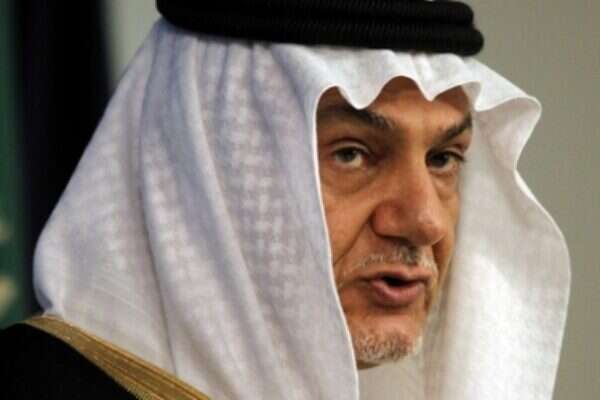
Israel's warnings of an impending nuclear arms race in the Middle East if Iran is allowed to acquire nuclear weapons have apparently been for good reason. Saudi Prince Turki al-Faisal said on Monday that his country would demand the same terms that Iran would get in any nuclear deal with world powers, and that other countries in the region would do the same, risking a wider proliferation of nuclear technology. "I've always said whatever comes out of these talks, we will want the same," Faisal told the BBC. Faisal, a brother of Foreign Minister Prince Saud al-Faisal, has previously served as head of Saudi intelligence and as Riyadh's ambassador to Washington and London. Although he is no longer a government official, his comments are widely understood to reflect the thinking at senior levels of the al-Saud ruling family. Saudi Arabia sees Iran as its main regional rival and fears that an atomic deal would leave the door open to Tehran gaining a nuclear weapon, or would ease political pressure on it, giving it more space to back Arab proxies opposed by Riyadh. "If Iran has the ability to enrich uranium to whatever level, it's not just Saudi Arabia that's going to ask for that," the prince was quoted as saying by the BBC. "The whole world will be an open door to go that route without any inhibition, and that's my main objection to this P5+1 process." According to Faisal, on a visit to Riyadh earlier this month, U.S. Secretary of State John Kerry was told by Saudi officials that they found Iran's support for armed Shiite groups in the region as troubling as the prospect of an atomic bomb. "Iran is already a disruptive player in various scenes in the Arab world, whether it's Yemen, Syria, Iraq, Palestine, or Bahrain," Faisal told the BBC. "So ending fear of developing weapons of mass destruction is not going to be the end of the troubles we're having with Iran. Now it seems that Iran is expanding its occupation of Iraq, and that is unacceptable." Meanwhile, Iranian diplomats have twice confronted their American counterparts about an open letter from Republican senators who warned that any nuclear deal could expire the day President Barack Obama leaves office, U.S. officials said Monday. The officials, noting the administration's warnings when the letter first surfaced, said the GOP intervention was a new issue in the tense negotiations facing an end-of-month deadline for a framework agreement. The letter came up in nuclear talks Sunday between senior U.S. and Iranian negotiators, the officials said, and the Iranians raised it again in discussions Monday led by Kerry and Iranian Foreign Minister Mohammad Javad Zarif. Zarif was quoted by Iranian state media after the meeting as saying the topics included the potential speed of a softening of U.S. economic sanctions and the new issue of the letter from the senators. "It is necessary that the stance of the U.S. administration be defined about this move," he was quoted as saying. Kerry and Zarif met for nearly five hours in Lausanne, Switzerland, the start of several planned days of discussions. Most of the Iranians then departed for Brussels, where they were to meet with European negotiators. In Brussels, EU foreign policy chief Federica Mogherini said that "we are entering a crucial time, a crucial two weeks." And German Foreign Minister Frank-Walter Steinmeier said that after "more than 10 years of negotiations, we should seize this opportunity." "There are areas where we've made progress, areas where we have yet to make any progress," British Foreign Secretary Philip Hammond said. "But the fact that we're all here talking shows the commitment on both sides to try to reach an agreement." In Washington, State Department spokeswoman Jen Psaki said the GOP letter was a "distraction" but would not sidetrack the talks. "Negotiations in our view, and I think most people's view, are not about a letter that was ill-informed and ill-advised," she told reporters. "We certainly anticipate that the focus of the discussions will remain on the issues at hand." In the end, the talks and a potential agreement depend on Iran showing the world that its nuclear program is exclusively peaceful, said the U.S. official, who briefed reporters in Lausanne only on condition of anonymity. The goal for a full agreement is the end of June.
Iran deal could spark nuclear arms race, warns Saudi prince
"If Iran has the ability to enrich uranium to whatever level, it's not just Saudi Arabia that's going to ask for that," Saudi Prince Turki al-Faisal tells BBC, as nuclear talks between Iran and Western powers enter "a crucial two weeks."
Load more...