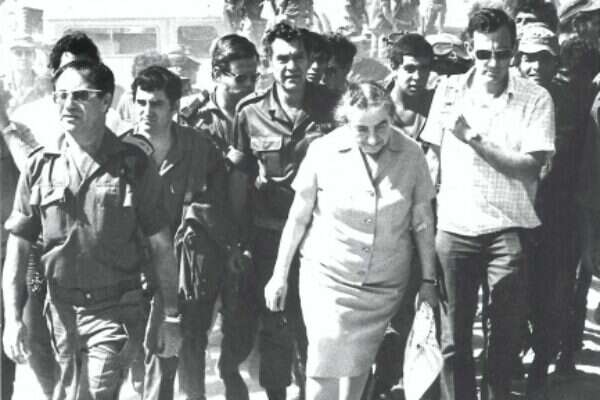
The date is Oct. 29, 1973, only days after a cease-fire between Israel and Egypt has gone into effect. Israeli Prime Minister Golda Meir arrives at the tactical headquarters of the IDF's southern command to be briefed by IDF commanders. Among them are Lt. Gen. (res) Haim Bar-Lev, who had been drafted into active duty to serve as commander of the Egyptian Front during the Yom Kippur War, as well commander of the Southern Command, Maj. Gen. Shmuel "Gorodish" Gonen. After 38 years of being classified, the transcript of this historic meeting was made public Wednesday by the IDF and Defense Establishment Archives. The transcript reveals that upon arriving at the Southern Command headquarters, Meir was bombarded by hoards of eager press, to whom Meir lamented, "How many times do I need to tell you? I did not come here to be photographed. Jerusalem is the place for journalists and photo sessions, not here." The transcripts then turn to intense discussions regarding matters of state. Maj. Gen. Gonen begins with a review of the situation on the ground. "The war started on Saturday while we sat on the waterfront ... we began the war with 254 armored tanks and by Sunday afternoon we were down to 100, 110, with roughly 150 damaged between Saturday afternoon and Sunday morning," he says. The briefing continues and Meir hears how Egypt's Third Army was encircled. "A strange thing occurred yesterday," says Gonen, "while the Egyptian convoys were on their way they [the Egyptians] opened artillery fire." The transcripts have Meir trying to understand why live fire was being exchanged with Egyptian convoys that according to all IDF military intelligence were attempting to deliver supplies to 25,000-30,000 surrounded Egyptian forces. Bar-Lev attempts to clarify the matter, explaining, "I told them, the U.N. and the Red Cross, that according to us, the convoys could carry on their path ... I told him to inform his authorities so that they could make contact with the Egyptians and instruct them to stop this line of fire ... and that Israel had agreed to move 100 cars from within the convoy. I insisted that we had to get the Egyptians to stop firing, because if we didn't such a move would be physically and technically impossible." The Yom Kippur War earned its name because it started on the holiest day in the Jewish calendar, the Day of Atonement. On Oct. 6, 1973, joint Egyptian and Syrian forces launched a coordinated, surprise attack against Israel, and all warnings were issued too late for IDF reserve soldiers to be called up in an orderly matter. According to the Israel Ministry of Foreign Affairs, the war was the fiercest Arab-Israeli war since the 1948 War of Independence. It claimed the lives of 2,688 Israeli soldiers. Public protest in the wake of the traumatic Yom Kippur War eventually led to the resignation of Meir and, in the watershed election of 1977, the rise of Menachem Begin.
A rare glimpse: Golda Meir at IDF command headquarters in 1973
The IDF reveals previously classified transcripts of Prime Minister Golda Meir's confidential war briefings • Lt. Gen (res) Haim Bar-Lev and Maj. Gen. Shmuel 'Gorodish' Gonen also quoted in rare transcripts.
Load more...