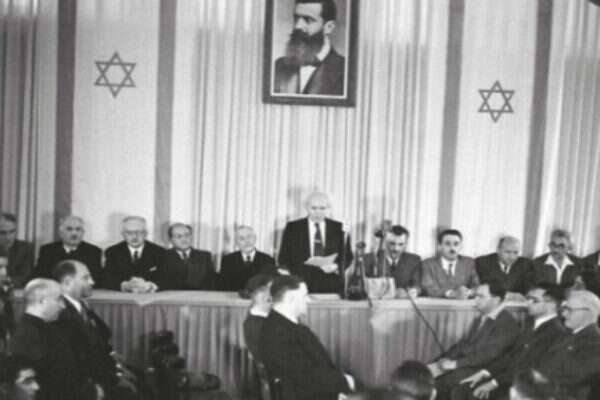
Who decided to declare the establishment of the State of Israel specifically on Friday, the fifth day of the Hebrew month of Iyyar 5708, May 14, 1948, at 4 p.m. -- despite heavy American pressure not to do so and threats of invasion by the neighboring Arab countries- The answer to this question is not at all simple, and is still a subject of debate among historians. According to the prevalent version of events, the decision to declare the establishment of the State of Israel was reached at the end of a 13-hour marathon meeting of the Provisional Government of Israel (which became the temporary government after the state's establishment was declared) two days before the declaration, on Wednesday, May 12. In this version, the vote that was held at the end of the meeting was close -- six in favor and four opposed. It was on the strength of the decision that Ben-Gurion called the historic meeting in which the state was declared and the Declaration of Independence read aloud. "There was no vote," claims Dr. Mordechai Naor, a historian and scholar of Israeli history and, until recently, the chairman of the public council of Beit Ha'atzmaut, Israel's Independence Hall, where the state was declared. Naor's new book, entitled "The Friday that Changed Destiny," includes about 200 documents and approximately the same number of photographs that tell, in great detail, the story of all the events, great and small, that preceded and surrounded the events of those crucial days. Among the documents cited in the book are speeches and writings by S. Yizhar, Shmuel Yosef Agnon, Supreme Court Justice Zvi Berenson, David Ben-Gurion, Moshe Sharett, Menachem Begin, Yitzhak Rabin and Israel's first president, Chaim Weizmann, together with articles from the press from the period. "The Friday that Changed Destiny" was published by the Yehuda Dekel Publishing House by businessman Boaz Dekel in memory of his grandfather, Eliyahu Dobkin, one of the heads of the Jewish Agency (Dobkin, who was considered the immigration minister during the years immediately preceding the establishment of the State of Israel, was among the first 10 people to sign the Declaration of Independence). It was also published in conjunction with the Society for Preservation of Israel Heritage Sites and Beit Haatzmaut. "Very worrisome statements were made at that meeting," Naor told Israel Hayom this week. "Golda [Meyerson, later Meir] reported that King Abdullah of Jordan, who had promised until then that he would not join the Arab attack, had gone back on his word. And Moshe Shertok (later Prime Minister Moshe Sharett) told of the warnings issued by American Secretary of State George Marshall (a five-star general and war hero who did not support the Zionist idea and clashed with President Harry Truman over it) that if the Jews declared a state they should expect no American aid should there be an invasion. The Americans demanded a postponement of the declaration and a three-month armistice agreement. The army's representatives, Yisrael Galili and Yigal Yadin, who attended the meeting, provided a bleak forecast if an invasion took place: a 50-50 chance that the "yishuv" (Jewish community in pre-state Israel) would withstand it. The members of the Provisional Government hesitated. They were not confident that the army -- which had not been established yet -- would be strong enough to defeat an Arab invasion." Ben-Gurion, who wanted to establish the state right away, gave an enthused speech to those who were opposed to the idea. When he finished speaking, the decision to declare the establishment of the State of Israel passed by a narrow majority. Most of the reports published since that time agree, though there is one problem: the minutes of that meeting contain no mention of the vote. Naor has a personal letter from Ben-Gurion proving, he says, that no such vote ever took place. "I interviewed Ben-Gurion personally in 1968 for my master's thesis. After the interview, I sent him a letter asking him to clarify the issue of the vote. He answered me with a handwritten letter (a reproduction of it appears in the book). In the letter, he confirms that a vote was held about marking the state's borders in the Declaration of Independence -- and the proposal to mark the borders was rejected by a majority of five to four. In the matter of accepting the cease-fire, as the Americans proposed -- which meant putting off the declaration -- Ben-Gurion wrote, in his own handwriting: 'A cease-fire in the Land of Israel is not known to me at all, and in the protocols in my possession there is no decision about it at all. ... There was no vote ... according to the material in my possession.'" So does that mean Ben-Gurion declared the establishment of the state on his own- Naor: "Ben-Gurion relied on a resolution by the Zionist General Council that had been made in early April. The resolution had three clauses: 1. The state would be established immediately upon the conclusion of the British Mandate. 2. Thirty-seven representatives of the provisional government (the legislative body, which developed into the Knesset) would be chosen (according to the map of political parties). 3. The underground movements would be united into a single army. The last point was the most difficult to perform, and the events connected with that are well-known." Then why hold a meeting of the Provisional Government at all- "Ben-Gurion wanted legitimacy for the decision to make the declaration from two agencies: the Provisional Government and the Mapai Central Committee. Neither of them gave him an easy time of it, particularly considering the fact that one-third of the delegates in the Mapai Central Committee were doves who wanted to avoid war at any cost. But in the end, he did not receive the legitimacy he sought. I believe the reason he did not bring the subject up for a vote was because he wanted to avoid creating a majority and a minority on such an essential matter. He wanted a feeling of unity and unanimous support." It seems the declaration was preceded by quite a mess, as is conventional in these parts. "Do not forget that the meeting of the Provisional Government ended at 3 a.m. on Thursday, and the declaration was planned for 4 p.m. on Friday. That left very little time for preparations. Still, they managed to buy parchment and a gilded pen (from Dov Lautman's parents' store) to sign it with. As is well-known, the Declaration of Independence had not been written on the parchment yet. Ben-Gurion read the declaration from typed sheets of paper that were stuck to the parchment, and the signers wrote their signatures on the bottom portion of the parchment, leaving space for the declaration, which was written afterward. Only 27 members of the Provisional Government were present at the signing. Nine were in Jerusalem, which was under siege, and another was in New York. Those 10 people added their signatures over the next few weeks afterward when they managed to reach Tel Aviv. The scroll itself was kept in a safe that Bank Leumi put at the service of the newly founded state." And yet, it seems the state functioned fairly decently from the moment it was founded. "Do not forget that we had been establishing it for 30 years. All the institutions functioned as ministries without the title. What were Magen David Adom and Kupat Holim if not the Health Ministry? There was radio, there were newspapers, the army was established within 17 days. In the early days, we were an economic miracle: the gross national product went up by 10% every year, like China today." Who were the signatories- "As I said, they represented the balance of political power at the time. Among the 37 signatories there were only two women: Golda Meyerson and Rachel Cohen-Kagan. The vast majority of the signatories were from Eastern Europe, mainly czarist Russia. One was from Yemen and only one was native-born (of Mizrahi origin) -- Bechor-Shalom Sheetrit from Tiberias. But they also represented, more or less, the demographic makeup of the yishuv, of which 85% was Ashkenazi [of European origin]." If the signatories of the Declaration of Independence could be here today, would they be pleased with the way the state looks now- "In my opinion, no. ... But life changes and we have to adapt. There was a great deal of hope then that unfortunately does not exist anymore."
Who decided to declare the establishment of the state?
"The Friday that Changed Destiny," a new book by Dr. Mordechai Naor, tells the story of all the events, great and small, preceding and surrounding the events of those crucial days • "There was no vote" prior to Ben-Gurion's fateful decision, he concludes.
Load more...