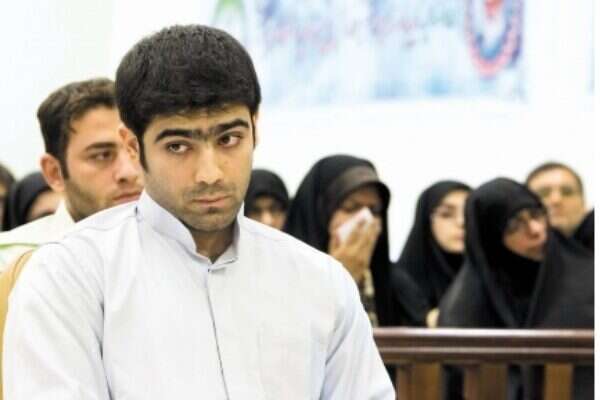
Lately, Tehran has been afflicted with a spy obsession. The Ayatollahs' regime sees spies everywhere it looks, in the air, at sea and on land. General Frazar Ismail told Iranian news agency IRNA this week that the Iranian air force prevented two foreign surveillance aircraft from entering Iranian airspace. Speaking on Iran's Air Force Day, Ismail took the opportunity to stress that Iran is not solely dependent on its advanced Russian S-300 missile defense system to defend its strategic sites. Ismail's declarations were made just as a young Iranian was convicted of assassinating an Iranian nuclear scientist for the Mossad. Is Tehran nervous- A dangerous profession On the eve of his trial two weeks ago, Majid Jamali-Fashi told the cameras how he was enlisted by the Mossad to assassinate nuclear physicist Prof. Massoud Ali-Mohammadi in 2010. For Iran, it was clear proof that Israel has done everything in its power to sabotage the Iranian nuclear program. Iran has published so many spy stories in the past 15 years that it is hard to differentiate between the real and the fabricated, but one thing is true -- someone did assassinate the nuclear scientist. It seems obvious to Iranian who stood to benefit from the crime. Just like the assassination of Majid Shahriar in November 2010, a double assassination attempt in which Shahriar's fellow nuclear scientist Dr. Fereydoon Abbasi was also targeted and wounded. Clearly someone intended to make nuclear science into a very dangerous profession. On January 12, 2010 Prof. Massoud Ali-Mohammadi was preparing for another workday at the nuclear physics department in the University of Tehran. Mohammadi, who lived in the upscale north Tehran neighborhood of Qeytariyeh, approached his Peugeot car when an explosive charge placed on the motorcycle behind his car detonated and killed him. The charge was detonated using a remote control device and was activated precisely as the scientist approached his vehicle. Iranian authorities issued numerous reports about the assassination, and the regime leaders' responses went to show just how high-up Mohammadi was in the Iranian nuclear program, which is a badge of pride for the Islamic republic. Iran sentenced the Iranian citizen who claimed he worked for the Mossad, Majid Jamali-Fashi, 26, to death as the man responsible for the scientist's assassination. Reuters reported that "Israel declined to comment." Iran's chief prosecutor Abbas Jafari Dowlatabadi expressed confidence on the day of the bombing that those behind the assassination would be arrested and punished. Iranian media concurrently reported that "anti-revolutionary forces aligned with the arrogant powers [Israel and the U.S.]" were behind the bombing. This week, almost a year and half after the assassination, Iran finally revealed the man responsible, in their view. Majid Jamali-Fashi confessed under interrogation that he was a Mossad agent and had been given the mission of assassinating the senior scientist. Fashi was added to a long list of Iranians who, according to Tehran, worked for the Mossad. There is an ongoing joke in Iran that any unemployed person can easily find a job. Where? Take a guess. That's right, the Mossad. The Iranian television channel PARS TV reported earlier this week that Majid Jamali-Fashi admitted to being the Israeli agent who murdered the nuclear scientist, after receiving extensive training in Israel. The 26-year-old is an expert in kick boxing. According to the report, Fashi flew to Turkey in October 2007 to get political asylum in a European country. While in Turkey he met Iranian exiles, one of whom had an interesting offer for him. "One of the people I met during my visit to Turkey was an older man. He offered me to join him at the Israeli consulate and get a high-paying job there. He said the salary I could earn there would easily cover my expenses, " Fashi told Iranian TV. Fashi told his interrogators how he was enlisted into the Mossad and received training in Israel to carry out Mohammadi's assassination. "I woke up early, and went to a storage room as I had been instructed, where equipment lay waiting for me. I had to prepare the explosives. I got on my motorcycle and went to the rendezvous point where I was supposed to meet my handlers. I drove near the nuclear scientist's house and saw that it was empty, then I parked my bike next to the house. I was then told that my mission was complete and that I was to leave the area." Fashi told the investigators that he was not acting out of ideological motives but rather financial ones. "My financial situation was dire and I had the qualifications to perform what needed to be done," he said. He admitted to receiving $120,000 for the mission. "Some people are born for these missions," Fashi said. Training in Herziliya Fashi's story thrilled Iranians as he revealed the inner workings of the Mossad. "It took me a long time to pass all the tests. They wanted to see how I perform under pressure, how I establish contacts. It took a exactly a year from the day I enlisted until I met with an actual Mossad agent face to face. For a year I just performed tests, no meetings," he said. But after the first year Fashi went to numerous meetings around the world until finally landing in Israel. "They gave me an Israeli passport that belonged to an Israeli citizen born in Tel Aviv, and though it had my picture, the name was someone else's -- Ram Solimani." The Iranian Mossad operative received various types of training at a compound in Herziliya, and was even given field tests in Israel, tests that were vital according to his trainers. "My instructor spoke with me privately, He praised my performance and my work and said the mission I would be assigned is of paramount importance. He told me that a large number of people were enlisted for the same purpose and that they are relying on me. If I fail, it could cost the lives of many participants," Fashi said. Fashi flew abroad multiple times after assassinating Mohammadi. He maintained contact with Iranian Mossad agents via a special laptop. "The laptop I received was different. I was promised that Iranian authorities would never be able to detect the computer, and that they don't have the capability to decipher a word that I receive. The computer had two versions of Windows, a 'red' version and a 'white' version. I sent messages using the red version." Iranian authorities said this week that the Fashi is only one of many who operated in the country. They are still searching for those responsible for purchasing the motorcycle, the storage room, and the explosives. Fashi claims that he never saw his accomplices. Either way, he received a death sentence. According to Iranian law, the accused is entitled to 20 days during which they can appeal their sentence. It's hard to believe that Fashi will receive any mercy from the Ayatollahs' regime after he confessed to murder and "collaborating with Israel and its intelligence agency," a severe offense in Iran. Fashi's crime is so serious that it is deemed "war against God." Iran was quick to accuse not only Israel but Washington of involvement in the assassination. The Americans quickly denied the claim, and global media outlets reported that Israel had refused to comment. Bombs and smart worms There is no doubt that the assassination of the Iranian nuclear scientist constituted a serious blow to Iran's nuclear program. Much was reported and published in the international media about the secret war the West is conducting alongside sanctions against Iran in the Security Council. Iran describes its nuclear program as civilian while the West says is military. It is clear to Iran that the West, and Israel in particular, are recruiting agents in their country. They are even recruiting within the Revolutionary Guards, in an attempt to subvert the equipment, scientists and facilities of Iran's nuclear program. This culminated in the announcement by Iranian president Mahmoud Ahmadinejad in November 2010 that the Stuxnet worm had sabotaged the country's nuclear project after it attacked several centrifuges. The New York Times reported that Israel had installed centrifuges in Dimona just like those in Iran and tested the Stuxnet virus on them. The Iranians then claimed that the "Mossad" physically planted the worm in Iran through an agent ton the ground. Incidentally, the virus, along with the scientists' assassination, did indeed delay Iran's nuclear program. They were factors in the war against the Iranian bomb. And of course, there was also the double attack against two Iranian nuclear scientists in November 2010, which Fashi was not involved in. Motorcycles attached explosives to the cars of the two scientists, Majid Shahriari and Fereydoun Abbasi. Then too, Iran quickly pointed a finger at Israel. Shahriari was killed in the attack. He was a member of the nuclear energy department at Beheshti University in Tehran. The head of Iran's atomic energy agency, Ali Akbar Salehi, said that Shahriari had been his student for years and "worked well with the atomic energy." The other scientist wounded and killed was Dr. Fereydoun Abbasi, who reportedly worked at the Iranian Defense Ministry and was a member of the Iranian Revolutionary Guards. He was considered one of the few experts in Iran who knew how to separate isotopes. His assassination was carried out in an almost identical way to that of Shahriari: Motorcyclists approached his car and attached an explosive device to it. "This action exposes the true face of Zionist terrorism and those who defend it," Ahmadinejad's office said after the incident. History of 'espionage affairs' The story of Fashi's conviction is fascinating. There is only one problem - how much of it is really true given that the Iranians frequently like to report on spies being exposed in their country. In 1998, shoe dealer Daniel Tefillin was arrested on suspicion of running a Jewish spy network in Iran. A year later, the entire network was "exposed" when authorities arrested 13 other Jews. The West put pressure on Iran to release 10 of them after the other three were released without trial. The whole world believed that the accusations were false. One of the Jews was a teacher, another a cemetery guard. The remaining 10 suspects were imprisoned for terms ranging from four to 13 years. In the end, all of them were released. In 2004, Iran again accused Jewish citizens of spying. The Iranian Foreign Ministry spokesman at the time, Hamid Reza Asfi, claimed that "Iranian intelligence arrested a group of eight Zionists who were part of a spy ring for Israel." But today the situation is different, and Iran is convinced that the U.S. and Israel are cooperating in leading and recruiting agents on Iranian territory to sabotage Tehran's nuclear project. The case of scientist Shahram Amiri is especially mysterious: the senior scientist disappeared in 2009 after making pilgrimage to Mecca and then went missing. The Iranians claimed that he was arrested by the Saudis and extradited to the U.S. British media claimed that he had defected to the West with important information on Iran's nuclear project. In July 2010, the scientist suddenly returned to Iran. He claimed he had been abducted by the CIA and offered $50 million for information on the nuclear project. Iranian Jews are not fond of reports on Israeli spy rings operating in Iran because they immediately cast suspicion on Jews in the country, something that has existed in the past. Iranian Jewry is doing everything it can to demonstrate loyalty to the regime. In the enchanted city of Isfahan, for example, in Palestine Square, right in front of a mosque named "Al-Aqsa," there is a synagogue where Jews pray every Saturday. During each of the Republic's holidays, the Jews take care to hang a sign on the synagogue showing their solidarity with the country. Meanwhile, the U.N. General Assembly is preparing to convene later this month. The Iranian nuclear threat will probably be on the agenda again. It's also very possible that scientists at the nuclear physics department in Tehran universities are weighing raising the issue of a different type of threat hovering over them, and may even consider asking for a raise in their salaries.
Nuclear assassination
Tehran recently sentenced an alleged Iranian "Mossad agent" to death for helping sabotage the country's nuclear program • Iranians were thrilled to hear the story of the suspect's involvement with the Mossad and the agency's inner workings.
Load more...