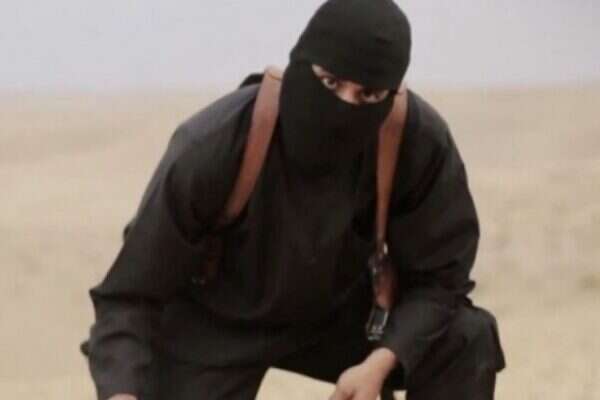
"Jihadi John," the masked man with a British accent who appears in Islamic State videos and has beheaded several Western hostages, is Mohammed Emwazi, a 26-year-old Briton from a well-to-do family who grew up in West London, the Washington Post reported on Thursday. "I have no doubt that Mohammed is Jihadi John," one of Emwazi's close friends told the Washington Post. "He was like a brother to me. ... I am sure it is him." According to the report, Emwazi graduated from the University of Westminster with a degree in computer programming, and is believed to have traveled to Syria around 2012, where he later joined Islamic State. The Washington Post said a British human rights group representative who had been in contact with Emwazi before he left for Syria also said he believed Emwazi was Jihadi John. "There was an extremely strong resemblance," Asim Qureshi, research director at the rights group, CAGE, told the paper. The friends, who spoke on the condition of anonymity to the Washington Post, said they believe that Emwazi started to radicalize after a planned safari in Tanzania following his graduation from Westminster. According to the Washington Post: "Emwazi and two friends -- a German convert to Islam named Omar and another man, Abu Talib -- never made it on the trip. Once they landed in Dar es Salaam, in May 2009, they were detained by police and held overnight. It's unclear whether the reason for the detention was made clear to the three, but they were eventually deported." Then, according to the report, "Emwazi flew to Amsterdam, where he claimed that an officer from MI5, Britain's domestic security agency, accused him of trying to reach Somalia, where the militant group al-Shabab operates in the southern part of the country." Emwazi reportedly denied the accusation, but one former hostage said Jihadi John "was obsessed with Somalia and made his captives watch videos about al-Shabab," an al-Qaida ally. That incident was a turning point for Emwazi, Qureshi said at a press conference in London on Thursday. "Mohammed was quite incensed by his treatment, that he had been very unfairly treated [by British authorities]," said Qureshi. Qureshi described Emwazi as "extremely kind, gentle and soft-spoken, the most humble young person I knew." Shortly afterward, according to emails Emwazi wrote to Qureshi, he decided to move to his birthplace, Kuwait, where he began working for a computer company. He reportedly returned to London twice, the second time to finalize his wedding plans to a woman in Kuwait. In June 2010, he was again detained by British intelligence agents, who fingerprinted him and searched his belongings. He was prevented from returning to Kuwait when he tried flying back the next day, the Washington Post reported. "I had a job waiting for me and marriage to get started," he wrote in a June 2010 email to Qureshi. But now "I feel like a prisoner, only not in a cage, in London. A person imprisoned and controlled by security service men, stopping me from living my new life in my birthplace and country, Kuwait." Some four months later, according to the report, when a court in New York sentenced Aafia Siddiqui, an al-Qaida operative convicted over the attempted murder of U.S. personnel in Afghanistan, Emwazi expressed sympathy for her, saying he "heard the upsetting news regarding our sister.
This should only keep us firmer towards fighting for freedom and justice." One friend told the Washington Post he believed Emwazi sought to travel to Saudi Arabia to teach English in 2012, but was unsuccessful. Soon afterward, the friend said, he was gone. "He was upset and wanted to start a life elsewhere," another friend said. "He at some stage reached the point where he was really just trying to find another way to get out." However, it was still unclear how Emwazi ultimately managed to leave Britain. A former hostage said Jihadi John was part of a team guarding Western captives at a prison in Idlib, Syria, in 2013. Another former hostage said Emwazi participated in the waterboarding of four Western hostages. Former hostages, according to the Washington post report, described Jihadi John as quiet and intelligent. "He was the most deliberate," a former hostage said. U.S. officials declined to comment for the report, and Emwazi's family "declined a request for an interview, citing legal advice." Meanwhile, the co-author of the Washinton Post report, Adam Goldman, told the British Telegraph on Thursday that "intelligence officials in Britain and the U.S. also knew the name but were keeping it a closely held secret rather than officially announcing it or leaking it to the press." Goldman added that Western intelligence also knew the names of Emwazi's British-accented colleagues, known by the Beatles nicknames "George" and "Ringo."
'Jihadi John' identified as Londoner Mohammed Emwazi
The masked man appearing in Islamic State videos with a British accent, who has beheaded several Western hostages, is Mohammed Emwazi, a 26-year-old computer programmer from a well-to-do family who grew up in West London, the Washington Post reports.
Load more...