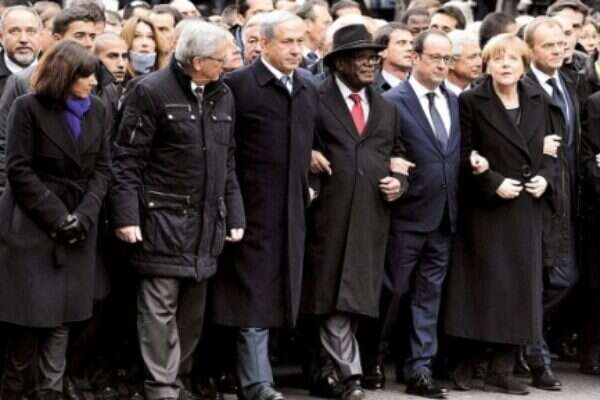
The Jews who were murdered in the kosher supermarket in Paris last week were not Israelis. They had never lived in Israel, nor did they or any of their family members have Israeli citizenship, but their families still chose to lay them to rest a long way from home, in Jerusalem. This proved that no matter where they are, Jews have an inextricable link to Israel, regardless of which country's emblem appears on their passport. Prime Minister Benjamin Netanyahu's decision to travel to France and attend Sunday's mass rally, which saw millions, including prominent world leaders, gather in the French capital to honor the victims, as well as his decision to attend the memorial service held later that evening in the Grand Synagogue of Paris, reflected that he understood that. Unfortunately, there were some who did not. Netanyahu's political rivals rushed to lambaste him over his short trip, meant to express his condolences to the French Jewish community and participate in the global protest against terrorism. Yesh Atid leader Yair Lapid even went as far as saying, "We have been exposed to the impolite Israeli -- a prime minister who cuts ahead in line is in very bad form." Even when Elysee officials later clarified that protocol had dictated that Netanyahu march alongside other world leaders in the front row of the protest rally, Lapid did not see fit to amend his statement. This, of course, comes as no surprise, as even during his term as finance minister he always focused on headlines rather than on facts. Last week's terrorist attacks were the last straw: The attack on the offices of the satirical magazine Charlie Hebdo saw millions of French take to the streets, braving the cold to wave protest signs; while the attack on Jews in the kosher supermarket garnered a more understated response, which was more a perfunctory courtesy than a sympathetic gesture. Those protesting the attack on the magazine made the pencil their symbol, donning shirts with the slogan "Je suis Charlie" ("I am Charlie"), but only the Jews wore shirts reading "Je suis Juif" ("I am a Jew"). Members of the Jewish community in Paris were visibly moved to see Netanyahu standing alongside prominent European leaders, and later on, in the synagogue. French Jews, who have always been deeply affiliated with their homeland, felt that for the first time, someone was truly sympathetic to their pain in a manner that exceeded mere lip service. They were not focused so much on Netanyahu the individual, but on what he represented -- Israeli Jews. Only a few years ago, any Israeli leader who dared urge French Jews to make aliyah would have been scorned and denounced. In the 1970s and 1980s, the Jewish Agency dispatched hundreds of emissaries worldwide to encourage Jews to immigrate to Israel, but the move enraged the local Jewish communities, prompting the Jewish Agency to cease its proactive efforts in the 1990s and call its envoys home. Since then, it has sufficed in offering assistance to those who sought it out for themselves. But something has changed in France. The fact that the Israeli prime minister can, from his podium, openly call on French Jews to make aliyah, proves as much. Netanyahu's political rivals and the media were so preoccupied with their criticism of him that they had completely overlooked something else that took place during the leaders' protest, despite it being glaringly obvious: the fact that Palestinian Authority President Mahmoud Abbas took part in the event as well. If there is one thing that illustrated Europe and France's stubborn refusal to clearly define the problem they face, it was Abbas' participation in the Paris rally. Abbas is not a head of state -- at best he is the head of a small Arab tribe, no different from dozens, if not hundreds, of others. Just like Caliph Mirza Masroor Ahmad, head of the Ahmadiyya Muslim community that numbers 20 million people worldwide -- over twice as many as Abbas' tribe -- was not invited to participate in the rally, the Palestinian Authority's president had no place there, either. Statistical oversights The Likud campaign was taken aback by the fierce criticism leveled at Netanyahu, as well as by its vile nature. While election campaigns are naturally rife with barbed criticism, Likud official still believed that given the tragic circumstances, the prime minister's political rival would exercise some minimal form of decorum. Not only were they proven wrong, they found themselves facing what has so far been the worst week for the Likud since the March 17 elections were called. The criticism of the prime minister, however, was ill-timed and ill-focused. If at first other party leaders claimed Netanyahu erred in traveling to France, now that the victims have been laid to rest everyone understands how important the trip was, both to the French Jewish community and the Israeli French community. If at first other party leaders insisted the French, and especially President Francois Hollande, did not want Netanyahu to attend the rally, it has now become clear exactly how important it was for Netanyahu to go, whether his hosts liked it or not. Even if Elysee officials had, at some point, believed the Israeli prime minister could march alongside other dignitaries in the second row, Netanyahu should have made his way to the front. Any Jew who occasionally dares to set aside the innate inferiority expected of him would have wanted Netanyahu to do so. And with all due respect -- if the president of Mali, a Third World African country, belongs on the front row, so does the representative of the people whose brethren were killed. It would have been embarrassing otherwise. After all, Netanyahu did not travel to Paris to represent himself. True, the French were displeased by Netanyahu's arrival. They would have preferred it had he arrived at a later date, or perhaps not at all, because they were, and are, busy covering up the truth. The French would rather blame an ambiguous enemy for the terrorist attacks. They prefer to bury their heads in sand and keep sitting in their cafes, oblivious to all this political nonsense. Until the next terrorist attack, that is. For generations, France has been doing its best to ignore the existence of any religion. In Israel, like in most Western countries, the Central Bureau of Statistics issues annual reports detailing the number of Muslims and Christians living in the country, but such statistical research is barred in France, and there is no official state data on the number of Muslims living there. If such data existed, it would probably alarm even the most peace loving of Frenchmen. In the "Hitchhiker's Guide to the Galaxy," author Douglas Adams hilariously describes one of most hideous monsters a space traveler could encounter, as the one easiest to deal with. It is so stupid, he wrote, that it believes that if you cannot see it, it cannot see you, so should you face its bared teeth, all you have to do is close your eyes. Paris, it seems, believes that if it has no data on the number of Muslims living in France, they must not be living there. Naturally, Netanyahu cannot abide by this destructive policy, which might undermine France, and perhaps the whole of Europe, faster than anyone thinks. Jews are the first to pay the price: Over the years, they have become accustomed to disguising synagogues, shaving their beards, and turning the other cheek to the occasional attack on the Metro. Every few months or years, depending on the times, they must also endure terrorist attacks, but the French government, and with it the people, prefer to ignore the situation. Condolences are expressed and polite compassion is offered by way of going through the motions, but nothing more. Back to basics Habayit Hayehudi presented its Knesset list this week, representing good news from supporters who feared the veteran national religious party was about to undergo a character overhaul. Some feared that party Chairman Naftali Bennett sought to make Habayit Hayehudi into some version of the Likud: a party that had a more generic appeal to nonreligious voters, whose roster included Muslim and Druze representatives, and one that would sideline the national religious sector's interests -- the same interests that had inspired its inception. Those fears proved unfounded on Thursday, but the list yielded by the party's primaries was not the one Bennett had hoped for. Between the slots reserved for the chairman's nominations and the slots reserved for women, Bennett had every opportunity to shape Habayit Hayehudi's list in his image. The party's registered voters, however, had something else in mind, as illustrated by the conservative result. Habayit Hayehudi's primaries left Bennett with a classic national religious list, despite his promises for a "brand new day." The new Knesset roster is almost identical to its predecessor, and with the exception of MK Ayelet Shaked, Habayit Hayehudi members voted for religious candidates across the top 15 slots, which are considered realistic placements. Bennett may have declared Habayit Hayehudi was about to embark on a new path, "Zionist" Druze and Muslim members in tow; and he may have even changed the party bylaws to accommodate him should Habayit Hayehudi form the government, but he still ended up with the same dull stars, whose shimmer had long since faded. Make no mistake -- Habayit Hayehudi has presented a solid list, comprising MKs and ministers that have proven themselves during the 19th Knesset's term, but Bennett had other plans. At this time, however, the multiple reserved slots at his disposal may work against him, because if he uses them, he risks pushing several newfound associates further down the list, potentially excluding them from the next Knesset. Youth before experience Professional soccer has leagues. You have the national league, the major league, and the minor leagues, and each player is ranked according to the level in which he plays the game. This week, however, saw the Labor Party join none other than the junior league. The Knesset list presented by Labor on Wednesday may appear young and fresh, but it does not suit a ruling party. With a blend of women, young politicians, and social activists, all eloquent and photogenic individuals, Labor's list is enough to give Kulanu and Yesh Atid a run for their money, but it falls short of the basic criteria required of a crown contender. With the exception of Labor Chairman Isaac Herzog, Hatnuah Chairwoman Tzipi Livni, and MK Amir Peretz, none of the names on Labor's list have any ministerial or executive experience. One only has to imagine Herzog, with MKs Stav Shaffir and Itzik Shmuli by his side, navigating Israel's security and economy, to feel the earth slightly quake under one's feet. Labor's list has also debunked the claims Herzog made against his predecessor, MK Shelly Yachimovich. At the time, he claimed that Yachimovich only pursued social objectives, while a ruling party must pursue diplomatic and security objectives as well. The new list, however, has proven that Labor voters are not interesting in pursuing anything at all.
The most unjustified criticism
The Likud campaign was stunned by the magnitude and vile nature of the criticism leveled at Prime Minister Benjamin Netanyahu over his visit to Paris this week • In contrast, the French Jewish community welcomed him.
Load more...