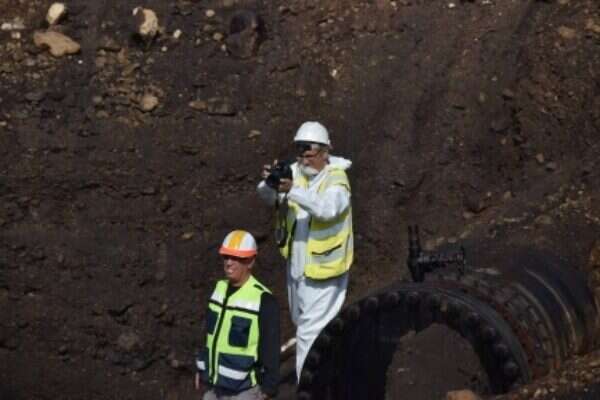
The Environmental Protection Ministry's Green Police on Wednesday confiscated part of the burst Eilat-Ashkelon oil pipeline and has forbidden company employees from accessing it, as part of its ongoing investigation into the Eilat Ashkelon Pipeline Company's (EAPC) oil spill last week in southern Israel which has created the worst ecological disaster ever in Israel's Arava region. According to recently appointed Deputy Environmental Protection Minister Ofer Akunis, "the examination [of the pipeline] is crucial as there could be criminal elements at play." Akunis toured the affected area on Wednesday. "I am formulating a plan that will soon be brought for government approval to help the restoration process of the area and nature reserve. The responsible party for this crisis will pay the price, as dictated by law. I will demand that EAPC fully cooperate with the costs of restoration." Akunis met with representatives from Beer Ora, one of the towns close to the spill zone, and instructed the ministry to have a doctor in the town on-call at all times, out of fear for air pollution. That same fear prompted Akunis to close the Evrona Nature Reserve to hikers until further notice. The Environmental Protection Ministry said Monday that the crude oil leak in southern Israel was four times bigger than first believed, and that as much as 5 million liters of oil have polluted the Evrona Nature Reserve in Israel's Arava area. Environmental protection groups have rallied against EAPC, decrying the company's immunity from prosecution and shrouded operations. Amit Bracha, director of Adam Teva V'Din, the Israel Union for Environmental Defense, appealed on Wednesday to President Reuven Rivlin and Attorney-General Yehuda Weinstein to open a criminal investigation against EAPC and its board members. Bracha also called for a lifting of the veil around the company's operations and rescinding their immunity. "The scope and severity of the incident prompt a serious suspicion of criminal activity," which Bracha said included violations of water pollution, environmental damage prevention and cleanliness codes. Bracha said the violations point to the fact "that steps were not taken and appropriate plans were not made to prevent or mitigate widespread damage." The Society for the Protection of Nature in Israel, whose personnel has been working nonstop since the spill began, also called for EAPC's operations to be made transparent. SPNI representatives appealed to Prime Minister Benjamin Netanyahu, who currently holds the Finance Ministry portfolio, to use his powers and release EAPC's data regarding safety, health and environmental protection measures. "All authorities have been undergoing a process of transparency. The public should see justice and accountability for the [EAPC] company's activities. In recent years there have been multiple serious incidents, in which oil from EAPC's pipelines harmed the environment. There is a foundation to suspect that these incidents that were publicized were not the only ones," SPNI members wrote in the letter to Netanyahu. The protests have not been in letters alone. A few Meretz activists, as well as Meretz MK Tamar Zandberg, protested outside EAPC's compound in Ashkelon's industrial area on Wednesday. The protesters called for rescinding the company's immunity and for EAPC to take responsibility for the spill.
Government confiscates EAPC pipeline as evidence in oil spill
Activists and Meretz MK Tamar Zandberg protest outside Eilat Ashkelon Pipeline Company compound in Ashkelon's industrial area, calling for rescinding the company's immunity and for it to take responsibility for last week's oil spill.
Load more...