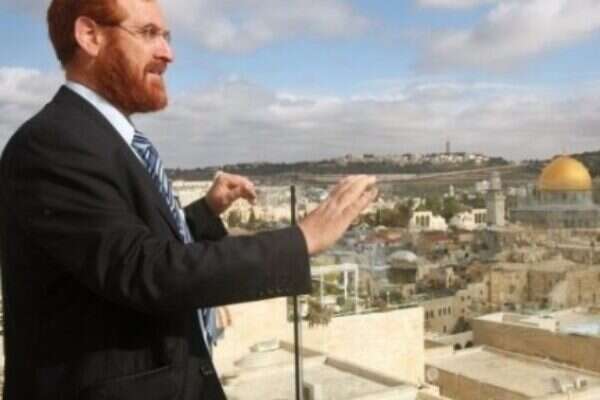
Writing this piece about Yehuda Glick, who is fighting for his life at this very moment after being shot at point-blank range by an Arab assailant on Wednesday, is not the standard, run-of-the-mill journalistic assignment for me. There is a personal element at play. Glick is an old friend, an ideological comrade and an adversary at the same time. He is a kind man who, for months, cared for the orphans of the Ames family, whose parents, Yitzhak and Talia, two members of the Temple Mount Faithful, were killed four years ago by terrorists in the Hebron area. Glick's main preoccupation over the past few years dovetails with the area that I've been focusing on in my duties as journalist, researcher and in Israel's public arena: the Temple Mount and Jerusalem. While I was writing articles and books and studies about the Mount and its "players," Glick was visiting the site, and he was there countless times. He visited the Temple Mount with brides, another time with grooms, another time with yeshiva students and another time with soldiers and rabbis. Just a few months ago, he took the close friends of the three Jewish teens who were kidnapped by Hamas operatives in August, to pray for their safety on Temple Mount. On one occasion, he visited the Temple Mount with a band-aid over his mouth in protest of the Israeli ban on Jews praying there, even in a whisper. When he began to pursue his Temple Mount agenda, he told a skeptic such as myself that if people were to have encountered Jews in Lodz circa 1940 and asked him whether he thought that the Zionist movement failed or succeeded, they would have trouble finding one person who would predict that in eight years' time a Jewish state would be established. We will succeed on the Temple Mount as well, Glick vowed. We began as just a few people. You'll see. Slowly, but surely, we will expand to dozens of people, then hundreds. Eventually, it will reach thousands. Those days have indeed arrived. Glick is one of those responsible for their arrival. That is why he was the target of an assassination attempt. For years, Glick has been adamant in pressing the right of Jews to pray on Temple Mount, in contravention of the Israeli government's directive. Glick has consistently defied these orders, convinced that eventually he will prevail and the law banning Jewish prayer will eventually be overturned. This persistence is what turned Glick into a target in the eyes of the Muslims. They marked him, disseminating his photograph on Facebook and other sites. His profile became a familiar one. The Arab mourners on the Temple Mount have already thrown their shoes at him. The Waqf guards have already given him evil stares. Glick, a big believer in people who has friends on both the Right and Left, tried to engage in dialogue, even with the Muslims. They refused. The police have never quite understood what this man, a redhead with a large kippah on his head and religious textbooks in his hands, was doing on the Temple Mount. Every trip to the Temple Mount sent their blood pressure sky high. They looked at him with astonishment, but also with great fear. On more than one occasion, the fear proved too much and he was banned from entering the Temple Mount. Glick never gave up. He repeatedly appealed to the courts, and, from time to time he achieved a small victory. He even got one judge to say that he supported a partition arrangement on the Temple Mount similar to what was done with the Cave of the Patriarchs in Hebron. His relationship with the captains of the site is complicated. He has accused the police of lying, but he also made sure to express his appreciation for the officers and their commanders for each time they protected him and other Jews who visited the site. Turning on that famous Glick sense of humor, he thanked them for making him learn to worship without a prayer book. Glick began his public career as the head of the Temple Institute, which is located in the Jewish Quarter of the Old City. The institute deals with researching the site as well as planning its reconstruction. Glick is one of the more tireless activists whose worldview is in large part shaped by the Temple Mount, though it was clear to him that the circle of Temple Mount adherents would expand not through the desire to build the third temple, but by waging a battle for the right of Jews to pray there. It would be a battle fought for the freedom to worship, a question of human rights that are universal to all religions. Loyal to this line of thinking, Glick was a regular guest of the Knesset Interior Committee. He managed to win over its chairperson, MK Miri Regev, who has become one of the more outspoken champions in the struggle to permit Jewish worship at the site. Glick also gave a speech about the Temple Mount to a large Likud gathering. He was even invited by the leftist group Keshev to give remarks at a conference which warned about the growing power of Temple Mount movements. Just six months ago, Glick went on a two-month hunger strike in protest of the authorities' decision to ban him from the site. Knesset Speaker Yuli Edelstein, who was once Glick's boss when Glick served as his spokesperson at the Immigrant Absorption Ministry, begged him to stop the hunger strike. Glick thanked Edelstein for his concern, but he referred him to Public Security Minister Yitzhak Aharonovitch and Prime Minister Benjamin Netanyahu, asking him to pressure them to change the rules and regulations that would permit Jewish prayer on the Temple Mount. Glick's family immigrated to Israel from New York in 1974. Having taken up residence in Beersheba, he focused on Bible studies and enrolled in a number of yeshivas. A few years ago, he received a tour guide certificate from the Tourism Ministry, specializing in -- what else -- the history of the Temple Mount. The 2005 disengagement from the Gaza Strip and the destruction of Gush Katif and the settlements of northern Samaria constituted a major crisis in his life. As a result, he resigned from public service and the ministry in which he worked. Eighteen months ago, he took part in a conference on the Temple Mount that I initiated. It was held at the Menachem Begin Heritage Center. Glick patiently listened to both supporters and opponents, among them former Justice Dalia Dorner, the archaeologist Dan Bahat, and Rabbi David Stav. Afterward, Glick described to them the present-day reality on the Temple Mount. "I don't go up to the Temple Mount to demonstrate, but to reconnect with my Creator," he said. "The problem is that I'm denied this right. A Muslim is permitted to play soccer on the Temple Mount, to urinate there, to have a picnic there, and even to curse at me, but if I dare to whisper a prayer, I immediately become 'provocative.'" When I joined a delegation of media people that ascended to the Temple Mount over a year ago, Glick could not hide his joy. He was hopeful that this visit would lead to a change in the way the press viewed the issue of the Temple Mount, and that it would cease to regard it as simply "a matter for lunatics." Glick certainly did not expect to be targeted for assassination, but ironically, the attempt on his life may end up helping his cause.
The redhead who wouldn't give up
"I don't go up to the Temple Mount to demonstrate, but to reconnect with my Creator," Yehuda Glick says • He did not expect to be targeted for assassination, but ironically, the attempt on his life may end up helping his cause.
Load more...