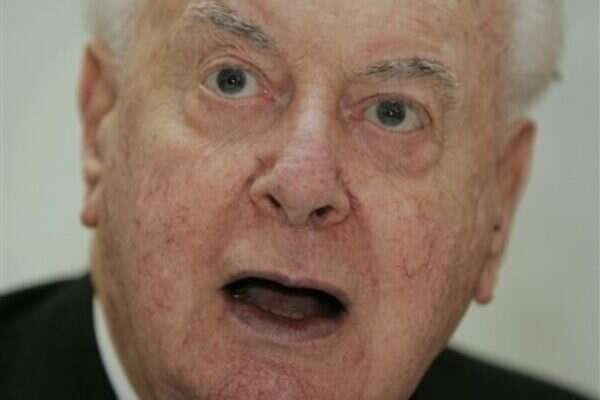
Many years ago on vacation in Sydney, a group of friends and I were on an ordinary inner-city train when a very tall man with an impressive sweep of white hair stooped under the doorway and got on board. The chatter in the car cut off and everyone turned to look at him. We couldn't help it. The embarking passenger was none other than Australia's most iconic former prime minister, Gough (pronounced "Goff") Whitlam, a towering 1.94 meters (6 feet 4 inches), imposing and instantly recognizable. The great man nodded briefly at all the staring faces, sat down in a nearby seat, and looked out of the window. A man sitting opposite him piped up, sheepishly: "G'day, Gough." Whitlam glanced at him. The stranger was emboldened. "That was pretty rough, what happened to you," the man said. Whitlam gazed at him, expressionless, then gave the briefest of nods. "Yeah, it was," he said. He looked around, at everyone looking at him. "G'day," he said to all of us. "Have a good one." He resumed staring out the window. We all left him alone. Gough Whitlam, the country's most written-about former leader, passed away on Tuesday at the age of 98, sparking a flood of tributes from Australian political and communal leaders, and mixed emotions among many in the local Jewish community, which recognizes the many significant reforms he initiated, but still bears scars from his "even-handed" approach to Israel during the 1973 Yom Kippur War. Born in Melbourne and raised in Sydney, Whitlam showed an early interest in human rights and joined the Australian Labor Party while doing military service in the Australian air force during World War II. In 1952, he was elected to the federal House of Representatives as a member of the Labor opposition, rising over the next two decades to become the party's deputy leader and then leader. He was known for his soaring intellect and biting wit. One notorious anecdote that Whitlam himself liked to tell has it that during an agitated parliamentary session, Country Party MP Sir Winton Turnbull shouted: "I am a Country member!" Whitlam replied: "I remember." "Turnbull could not understand why, for the first time in all the years he had been speaking in the House, there was instant and loud applause from both sides," Whitlam said. In December 1972, campaigning on a platform of change under the slogan "It's Time," Whitlam led the Labor Party to victory for the first time in 23 years, and became prime minister. Whitlam's government was in power for just three years, but during that time it initiated major reforms that brought Australia into the modern age. It introduced universal health care; abolished university fees to create greater opportunity (re-introduced in recent decades); reformed welfare payments to include then-stigmatized single mothers; introduced equal pay for women; created no-fault divorces; introduced a multi-million dollar national program to build sewerage infrastructure for thousands of homes in then-unserviced suburbs of Melbourne, Sydney and other large cities; reduced the voting age from 21 to 18; pulled the last Australian troops out of Vietnam and abolished conscription; replaced the British "God Save the Queen" with "Advance Australia Fair" as the national anthem; created the Aboriginal Affairs Department and recognized the land rights of Australia's indigenous people; introduced federal legislation barring racial discrimination; cut import tariffs, opening the Australian economy to the world; and established diplomatic relations with China (after first visiting in the early 1960s, paving the way for U.S. President Richard Nixon's historic visit soon afterward). Australian Jews, while acknowledging all this, also remember Whitlam's discomfiting views on Israel. "He was a great reformer who expanded the poorly resourced Australian welfare state, but not a friend of the Jews," said Monash University Associate Professor Dr. Philip Mendes, author of the recently released book "Jews and the Left: The Rise and Fall of a Political Alliance." Whitlam, who visited Israel before and shortly after the 1967 Six-Day War but not after he was elected, had "what was at times a tumultuous, disappointing relationship with the Jewish community, with his somewhat cynical and indifferent 'even-handed' approach when the survival of Israel was at stake during the difficult period of the 1973 Yom Kippur War," Dr. Colin Rubenstein, executive director of the Australia/Israel and Jewish Affairs Council, was quoted as saying on J-Wire. Before being elected, Whitlam had "emphasized his fraternal ties with the ruling Israeli Labor Party and friendship with leaders such as Golda Meir and Yigal Allon," Rubenstein wrote in an extensive article on Australian-Israeli relations in 2007. But after his election, there was "a sharp departure" in Australian Labor Party policies toward Israel. "The Whitlam government moved farther from the United States and closer in its foreign policy to the nonaligned movement, where condemnation of Israel was the norm," Rubenstein wrote. "Although Whitlam described this policy as 'even-handedness and neutrality,' such neutrality was a far cry from the sort also proclaimed by his conservative predecessors. "The effects of this new policy became most apparent during the 1973 Yom Kippur War when Australia failed to condemn either the Egyptian and Syrian attacks that launched it, or the Soviet airlift of arms supplies to the Arab combatants.
Once the United States began to airlift arms and supplies to Israel, the Australian U.N. representative, on instructions from Canberra, condemned both airlifts, with a particular emphasis on America's. Even before this, there had been repeated one-sided condemnations by Australia in the United Nations of all Israeli reprisals for terrorist and cross-border attacks, but silence about anti-Israeli aggressions." The seminal moment came during a 1974 meeting with Labor Party-affiliated Jews, when Whitlam became annoyed by hostile questioning and equated Israeli responses to terrorism. Most controversially, he referred to the Jewish community as "you people," reportedly saying, "You people are hard to please" and "You people should realize that there is a large Christian Arab community in this country." Mendes says that while many historians cite that meeting as pivotal to the decline in Jewish support for the Labor Party, by that time most Jews had already moved up from the working class into the middle class and had shifted their support to the conservative coalition. "However, Whitlam's apparent hostility to Israel provided an ideological justification for this shift, and it seems some Jewish businessman moved their donations over to the coalition at that time," Mendes said. It is Whitlam's controversial dismissal, of course, that is most engraved in Australians' memories. In late 1975, the opposition Liberal-Country Party coalition had control of the Senate and decided to block supply, meaning that the government would run out of money by the end of November. Whitlam refused to call an election as the opposition was demanding, and a stalemate ensued. Urged on by opposition leader Malcolm Fraser, Governor-General Sir John Kerr, the queen's representative in Australia, decided to use his powers and intervene -- something his predecessors had always refrained from doing. On Nov. 11, 1975 -- later termed by Whitlam "a day that will live in infamy" -- unilaterally, and without any warning, Kerr sacked the prime minister and dissolved both houses of parliament. That action brought angry protests and sparked Whitlam's most famous speech. Standing, shocked, on the steps of Parliament House, he told a large crowd: "Well may we say 'God save the queen,' because nothing will save the governor-general. The proclamation which you have just heard read by the governor-general's official secretary was countersigned Malcolm Fraser, who will undoubtedly go down in Australian history from Remembrance Day 1975 as Kerr's cur." However, although many Australians were infuriated by the dismissal -- and some called for cutting ties with the U.K. and turning Australia into a republic -- their support ended up being overtaken by concerns over the Whitlam government's big-spending policies. In the forced election held a month after the sacking, the Liberal-Country Party coalition, headed by "Kerr's cur," won by its largest majority ever. Whitlam spent two years as opposition leader before stepping down in 1977 and leaving politics altogether the following year. In the 1980s he was appointed Australia's ambassador to UNESCO, and remained active in communal and academic positions until his death. That was Whitlam. The only Australian prime minister to be fired. A former head of government who would board a local train on his own, sans security guards or any other trappings, with a ticket he had bought himself in hand, sit in a regular seat, acknowledge the tentative commiserations of an ordinary Joe for the extraordinary events of years earlier, and say "G'day" to a bunch of anonymous staring passengers. A larger-than-life leader who fought for the rights of ordinary people and who moved among ordinary people, but who was still not quite one of them.
Goodbye, Gough
Gough Whitlam, Australia's most written-about former prime minister, passed away on Tuesday at the age of 98, sparking a flood of tributes from Australian political and communal leaders, and mixed emotions among many in the local Jewish community.
Load more...