A plane carrying seven Israelis injured in the blizzard and avalanche in Nepal's Annapurna Range last week arrived at Ben-Gurion International Airport early Sunday, much to their relief. The injured Israelis were immediately taken to hospital, where most of them were treated for frostbite. The brutal storm last Tuesday killed at least 43 people, including four Israelis. One of the Israeli survivors, Shir Lasri from Karnei Shomron, embraced her family and friends, who had come to welcome her at the airport. "We were lucky," she said. "The snow was crazy. We walked eight hours and saw people dying along the way. There are no words to describe it. My friend, Nadav Shoham, was killed. I feel as if I'm in a bad movie, waiting to wake up." According to Lasri, the Nepalese army evacuated the injured but then "just left them, without treatment." "We got in touch with the army, we helped rescue and warm up the injured people, we took off their wet clothes and dressed them in warm clothes. It's lucky that we Israelis help one another," she said. Roi Fatal, 32, from Jerusalem, another survivor, was classified as lightly wounded and hospitalized at Hadassah Medical Center. "We started on Tuesday at 5 a.m. at an altitude of 4,900 meters [16,000 feet] above sea level," Fatal said. "We wanted to climb to 5,416 meters [17,770 feet] above sea level. We saw a few centimeters of snow on the ground, so we asked the locals, and they said it was fine. We started to ascend and suddenly a terrible storm began. Visibility was 5 meters [16 feet] and our footsteps immediately disappeared. "At that point, we saw a little cabin that fit about 30 people inside. The roof had holes, and snow was coming in. I decided to wait there. At about 3:30 p.m. the Nepalese people there said, 'Friends, if you don't go down [the mountain] now, you will be buried here.' So we said, 'If they are telling us that, and they themselves want to walk down now, then we will go too.' We were a group of about 40 tourists who began to walk down." After about 20 minutes, Fatal lost the group and was left on his own. "I could see maybe 10 meters in front of me. I couldn't see a single footprint. I decided to move forward in the direction I had seen the group walking," he said. "After a few steps I fell into a hole in the snow that came up to my waist. I tried to get out, thrashing around, but I couldn't. Snow continued to fall all the while. And slowly, the snow covered me all the way up to my head. I kept moving the snow with my arms so I could breathe. I put a sock on each hand to try to insulate them from the cold as much as possible." Fatal spent the night buried in the snow. "I fell asleep and woke up," he said. "I removed the snow from my eyes, created a path for air so I could breathe, and again fell asleep and then woke up. The snow was on top of me. "Around seven o'clock, I heard people walking. I raised my arms up high and screamed for help. Two Nepalese people and two Israelis, students from Hadassah Ein Kerem Medical Center, found me and saved my life." However, Fatal's struggle did not end when he was first found. The rescuers pulled him out of the snow, changed him out of his wet clothing and brought him to a less snowy area. They brought him sleeping bags and said they were going to go call for help. But, when a helicopter came to the area three hours later, it didn't land. "It began to fly lower but then went back up and flew off. I said to myself, 'Okay, I guess they couldn't land,' but later I realized they must have thought I was a corpse, and that is why they didn't land. The sun began to go down and I fell asleep for another cold night." After a few long, stressful hours, rescuers from the Nepalese army came and helped Fatal into a helicopter. "From Tuesday until Thursday, I was alone -- more than 30 hours," he said. "I did not doubt for a moment that they would come save me, and I had no doubt that it would be Israelis coming to save me from the snow. I really believed that. I didn't lose hope for a minute." Fatal, who lost friends in the disaster, says he will return to Nepal to finish the trek. Eitan Idan and Mor Sapir are hospitalized in neighboring rooms at Sheba Medical Center's burns unit. Sapir, who is being treated for frostbite on his hands, said: "It turned from the best time to go on this trip to a complete nightmare. Nature proved just how strong and terrible it can be. "The people of Israel kept us strong. The people who were killed were great people who stayed behind to help others. It is sad to think about those who lost their lives, but we must look forward and be thankful that we are here today." Sapir completed his army service about a year ago, after five years serving as a company commander in the Engineering Corps. "For us, it is like he was born again," his father said. Also on the plane that landed in Israel early Sunday morning was Professor Avraham Rivkind, the head of the Shock Trauma Unit at Hadassah Medical Center in Jerusalem. He had been flown into Kathmandu to help treat the victims of the avalanche. Speaking to Israel Hayom, he said, "At one hospital in Kathmandu, they barely did anything to help the wounded. At another hospital that was more like a Western hospital, the treatment improved." Rivkind also spoke about the sense of mutual responsibility among Israeli trekkers. "It was amazing," he said. "Loving their friends as they love themselves, while fighting for their lives. It is a rare thing. There were girls who took off their warm clothes to give the people coming down from the mountain while they stayed in their underwear. If it were a war, the Israel Defense Forces would have awarded all its honors. I was very impressed and I salute them. "I would also like to note that attorney Pninat Yanai is the one who initiated this aid effort." Rivkind said that four of the injured Israelis were hospitalized at Sheba Medical Center and three were hospitalized at Hadassah Ein Kerem Hospital. The three patients at Hadassah Ein Kerem sustained mild to moderate injuries, according to the hospital's medical director, Professor Yoram Weiss. Professor Zeev Rothstein, director of the Sheba Medical Center, said that of the patients there, one was treated for an injury to her eye and released, and the others were being treated for moderate to serious frostbite on their hands and feet. The patients were taken from both hospitals to Assaf Harofeh Medical Center for treatment in a hyperbaric chamber meant to restore oxygen flow to tissue affected by frostbite. They are also receiving frostbite treatments never used before in Israel. Professor Eyal Winkler, head of the plastic surgery department at Sheba hospital, explained how the new treatment works. "It uses the hormone-like compound Prostaglandin, which causes the blood vessels to expand," he said. "It makes the finger, a narrow, cylindrical body part, receive a higher blood supply." The bodies of Tamar Ariel and Agam Luria, who died in the disaster, were expected to arrive in Israel on Monday, and their funerals will take place on Tuesday.
Credit: Reuters
The seven Israelis were among more than 500 people rescued from a trekking route popular with foreign adventure tourists that circles Annapurna, the world's 10th-tallest peak. Almost half those rescued were foreigners.
X
שיתוף כתבה
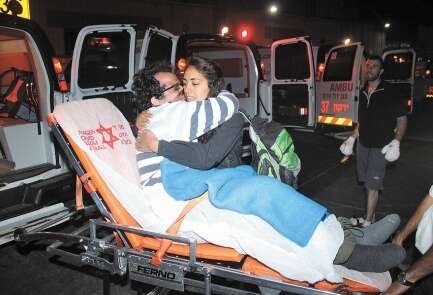
Israeli trekkers return home as Nepalese rescue efforts conclude
Seven injured Israelis return from avalanche-stricken Nepal, sent to hospital for frostbite treatment • Survivor Roi Fatal: "I did not doubt for a moment that they would come save me, and I had no doubt that it would be Israelis coming to save me."