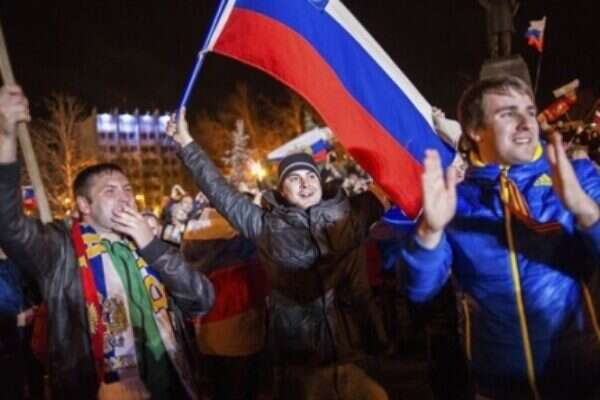
Crimea's Moscow-backed leaders declared a 96-percent vote in favor of quitting Ukraine and annexation by Russia, in a referendum Western powers said was illegal and will bring immediate sanctions. With three-quarters of Sunday's votes counted in Crimea, a Black Sea peninsula that is home to 2 million people, 95.7% had supported annexation by Russia, chief electoral official Mikhail Malyshev was quoted by local media as saying. Voter turnout was 83%, he added -- a high figure given that many who opposed the move had said they would boycott the vote. But many ethnic Tatars and Muslims, who make up 12% of Crimea's population, boycotted the vote, fearful of a revival of the persecution they suffered for centuries under Moscow's rule. Russia's lower house of parliament will pass legislation allowing Crimea to join Russia "in the very near future," Moscow's Interfax news reported Monday. "Results of the referendum in Crimea clearly showed that residents of Crimea see their future only as part of Russia," the report said. As state media in Russia carried a startling reminder of its power to turn the United States to "radioactive ash," President Barack Obama spoke to Russian counterpart Vladimir Putin, telling the Russian president that he and his European allies were ready to impose "additional costs" on Moscow for violating Ukraine's territory. But Obama said Russian forces must first end "incursions" into its ex-Soviet neighbor while Putin renewed his accusation that the new leadership in Kiev, brought to power by an uprising last month against his elected Ukrainian ally, were failing to protect Russian-speakers from violent Ukrainian nationalists. Moscow defended a military takeover of the majority ethnic Russian Crimea by citing a right to protect "peaceful citizens." Ukraine's interim government has mobilized troops to defend against an invasion of its eastern mainland, where pro-Russian protesters have been involved in deadly clashes in recent days. U.S. and European officials say military action is unlikely over Crimea, which Soviet rulers handed to Ukraine 60 years ago. But the risk of a wider Russian incursion, as Putin probes Western weakness and tries to restore Moscow's influence over its old Soviet empire, leaves NATO calculating how to help Kiev without triggering what some Ukrainians call "World War III." On Lenin Square in the center of the Crimean capital Simferopol, a band struck up even before polls closed as the crowd waved Russian flags. Regional premier Sergei Aksyonov thanked Moscow for its support. The regional assembly is expected to rubber-stamp a plan to transfer allegiance to Russia on Monday before Aksyonov travels to Moscow, although the timing of any final annexation is in doubt. Putin may choose to hold off a formal move as diplomatic bargaining continues over economic and diplomatic sanctions that many EU states fear could hurt them as much as they do Russia. A pressing concern for the governments in Kiev and Moscow is the transfer of control of Ukrainian military bases. Many of the bases are surrounded and under control by Russian forces, even though Moscow formally denies it has troops in the territory beyond facilities it leases for its important Black Sea Fleet. On Sunday, the Ukrainian and Russian militaries agreed on a truce in Crimea until March 21, Ukraine's government said. Crimean leaders have said Ukrainian troops can serve Russia or have safe passage out of the region. But some leaders in Kiev have said they expect their forces to defend their positions. West mulling sanctions The White House said in a statement on the call with Putin that Obama "emphasized that Russia's actions were in violation of Ukraine's sovereignty and territorial integrity and that, in coordination with our European partners, we are prepared to impose additional costs on Russia for its actions." The European Union will raise the stakes on Monday by slapping sanctions on officials. EU diplomats were haggling over a list of people in Crimea and Russia who will be hit with travel bans and asset freezes for actions which "threaten the territorial integrity, sovereignty and independence of Ukraine." An initial list of 120 to 130 names will be whittled down to "tens or scores" before EU foreign ministers take the final decision in Brussels on Monday, diplomats said. Ministers are also expected to cancel an EU-Russia summit scheduled for June in Sochi, where Putin last month hosted the Winter Olympics. The risk of Europe becoming locked in a damaging spiral of economic retaliation with Moscow, from which it buys much of its energy, depended on Russia, Dutch Foreign Minister Frans Timmermans said ahead of the EU meeting in Brussels: "I would do anything possible to avoid sanctions, because I believe everybody will suffer if we get into sanctions," he said. The U.S. administration is also preparing to identify Russians to punish with visa bans and asset freezes that Obama authorized this month. It, too, is likely to act on Monday. The Kremlin statement again highlighted concerns, largely dismissed by Kiev and its Western allies, that Russian-speakers who make up a sizeable minority of Ukraine's 46 million people were facing violence and intimidation. "Vladimir Vladimirovich Putin drew attention to the inability and unwillingness of the present authorities in Kiev to curb rampant violence by ultranationalist and radical groups that destabilize the situation and terrorize civilians, including the Russian-speaking population," the statement said, adding that Putin had suggested European security monitors should be sent to all parts of Ukraine because of the violence, it said. "This is a total victory. A 100% win," a pro-Russia protester said. "We here in Donetsk support Crimea. We don't support the Kiev authorities that are ruling today." In Kiev and the Ukrainian-speaking west of the country the mood was somber. "This isn't a referendum - it's a show for the Russians to legitimize taking over," said Kyrylo Sergeev in the capital. Another man in Kiev, Vasyl Olinyk, said: "This could be war, not between Ukraine and Russia but maybe World War III." As Ukrainian television channels played patriotic songs over images of tanks rolling in to reinforce the eastern border, where the president says Russia has massed troops ready to invade, the head of the national security council said a Moscow plot, code-named "Russian Spring," to foment violence and justify invasion was failing to garner significant support. "The plan has failed," Andriy Paruby said. "Despite all the Kremlin's technical powers, we have managed to keep control." Meanwhile, a Western official briefed on security discussions suggested NATO governments were taking the risk of invasion seriously. "Putin would be mad to invade Ukraine," he said, forecasting a quick victory over Ukraine's armed forces being followed by a long insurgency and civil war. "He is much better playing it long, fomenting rebellion among the ethnic Russians and waiting until the very weak Ukrainian government collapses. "However ... Putin may decide to go for the jugular. ... He has the means and he may decide to exploit events as they unfold to achieve his long-term strategic end: re-establishment of Russian power in its 'near abroad.'" Putin's approval ratings hit all-time high Meanwhile, the Russian president's popularity has skyrocketed, as a new poll found that his approval ratings were at 71.6%. Still, the Kremlin's increased oversight over the public airwaves and near-complete control of commercial airwaves has been cause for concern, as Moscow's grip on internet and satellite television services' providers has grown tighter over the past few months. As part of the crackdown on independent broadcasting outlets, which flourished during former Russian President Dmitry Medvedev's term -- when Russia-U.S. ties were closer -- the Kremlin has shut down several popular TV channels. Last week, the editor of the leading Lenta.ru news website was fired after running an interview with a pro-Ukrainian politician, and replaced with a pro-Kremlin journalist -- a move that promoted 39 of the website's 84 employees to resign. Russian government censors shut down three more news websites and a popular political blog the next day over their affiliation with the opposition. Access to the popular pro-western radio station Echo of Moscow has also been blocked. The operations are backed by a recent law passed by the Kremlin, allowing government censors to shut down media outlets without a court order. With state-run television as the primary source of information in Russia, the same poll found that 90% of the Russian public believes its news reports are "completely objective."
Credit: Reuters
The Kremlin and the White House issued statements saying Obama and Putin saw diplomatic options to resolve what is the gravest crisis in East-West relations since the Cold War.
Russia overwhelmingly wins Crimea vote, West readies sanctions
Some 96% of Crimean voters back annexation by Russia as West's concerns over possible Russian invasion of Ukraine grow • Moscow to pass bill allowing Crimea to join Russia "in very near future" • Putin's approval ratings skyrocket.
Load more...