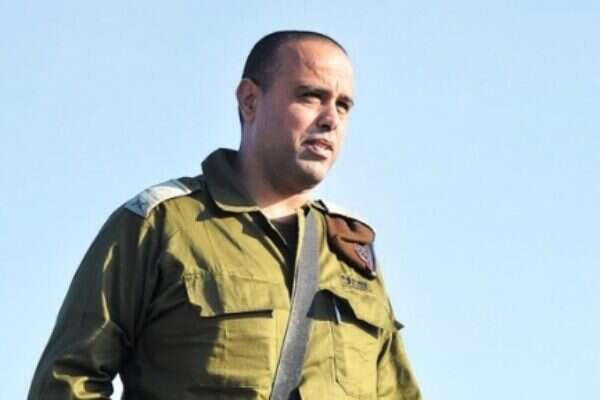
"There is no third intifada, and there are no signs indicating that one is about to erupt anytime soon," Brig. Gen. Tamir Yadai, who commands the Israel Defense Forces' Judea and Samaria division, stated emphatically. In the first media interview that he has granted since taking over the job, he tells Israel Hayom that the attacks of recent months were all isolated incidents that have nothing to do with one another. Unlike the first intifada, which sprouted from the ground up; and unlike the second intifada, which was orchestrated and guided by the Palestinian leadership; we are now facing "an arbitrary succession of disjointed points with no clear line connecting them." Israel Hayom: Still, we have the dynamics of terrorism at work here. TY: "The basis will always be there. The fact that some of the people [involved in terrorist acts] come from different backgrounds, and that some of them are brothers of shahids or prisoners or those who are just plain opposed to the peace process always creates a constant platform which gives rise to these phenomena. And, still, I would rather deal with this migraine than the cancer that we had here earlier. Yes, these are difficult things we are dealing with and they need to be taken care of, but these aren't the awful shooting attacks that we experienced here or the massive bombings. These aren't even terror cells." IH: So what are we dealing with here- TY: "In the end, what we have here are lone assailants of a different type, perpetrators who sometimes try to mimic one another, but there is no one, constant line that can connect all of the events. When I speak with Palestinians, there are those who say to me that it's because of the peace process, and there are those who say that it's because the peace process isn't serious. There are also those who claim that it's because of the tensions caused by domestic strife within the Palestinian Authority, or the result of pockets of anarchy in various places, and there is always an explanation by someone saying it's an act of revenge to retaliate against the price tag incidents, or for no other reason than we were there. The range of possibilities and assessments is wide, but there is no one, organizing concept." Facts and feelings Despite Yadai's explanations, 2013 was different when examining the terror graph. Since last summer, we have seen a spike in the number of "grass-roots" crimes like stone throwings and firebombs as well as a rise in "serious" attacks which claimed the live of four Israelis in Judea and Samaria: Evyatar Borovsky was stabbed to death at Tapuach Junction; Sgt. Tomer Hazan was kidnapped and murdered near Qalqilya; Cpl. Eden Atias was murdered by a teenager from Jenin while riding a bus bound for Afula; and Staff Sgt. Gal Kobi, who was shot in Hebron. There were also incidents involving Noam Glick, who was stabbed near her home in Psagot; and the bus in Bat Yam which was partially blown up by an explosive manufactured and planted by a terror cell from the Bethlehem area. "We are examining the data on a weekly basis," Yadai said. "Last week, 1,624 Palestinians took part in disorderly conduct. Two, three weeks before that, when the Palestinians marked Youth Week and the anniversary of the death of Yasser Arafat, with all the news about his alleged poisoning, 2,500 took to the streets, which is a tiny fraction of the total Palestinian population. That's all. There isn't a widespread popular protest. And when the average Palestinian looks around and sees the chaos in the Arab world, I believe that he's saying to himself, 'I don't want to be like them'. He earns a living, he has food to give his children. His situation isn't that bad." IH: So where is all this talk about an intifada coming from- TY: "'Intifada,' certainly my interpretation of the word, is certainly not on the agenda, not on ours, and not on theirs. In my estimation, this is not the direction in which the current leadership wants to steer Palestinian society." IH: What if the diplomatic negotiations break down tomorrow- TY: "We are preparing for a wide range of contingencies irrespective of anything that goes on beyond our control, because that is our job. But you have to differentiate between an estimation and preparation. I've already stated my estimation. Even if there is no agreement on the horizon, there won't be a third intifada. Despite this assessment, I am preparing for it as if [the Palestinians] have officially declared it." On the ground, this means operational plans, equipping of forces, drills, and readying the troops. It is part of an overall, comprehensive plan that was first put in motion over a year ago and accelerated in recent months due to an ever-growing concern that we are on the cusp of a substantial wave of violence -- one that never came. IH: The citizens in the area under your command speak of a loss of a sense of security. TY: "You have to differentiate between feelings and facts. Feelings are personal. A woman could be mugged on a certain highway, or someone could get hit with a firebomb on another highway. The feelings they experience are acute and difficult, there's no doubt about it. But alongside feeligns and senses there are also facts, and you need to keep things in proportion. [The well-known singer] Amir Benayoun performed before 3,000 people recently at the Cave of the Patriarchs [in Hebron], [rock star] Ehud Banai brought thousands to see him perform in Yatir, 3,000 women turned out for a wine festival in Shiloh." "[Singer] Boaz Sharabi played at a special nature event in Sebastia, and there were at least 12 instances this year when large groups of 20 to 25 busloads of people visited Joseph's Tomb each time. On the whole, this is the best answer you could give to the settlement enterprise, and that's just one part of it. When a tender was recently announced in Tekoa, a place where they recently had stones thrown in its direction, it took only a few days before all of the houses were sold." Yadai believes that the best indicator of life in the territories today could be found in Rami Levy supermarkets in places like Adam and Gush Etzion, where "large number of Jews and Arabs come" to do their shopping. "It is possible to focus on a situation that is solely problematic, but it is also possible to recall where we were just a few years ago and to appreciate what we have today," he said. "That doesn't mean we don't have to do our utmost to combat, without compromise, every rock-thrower and firebomb until there are no more." There is a partner Yadai, who has been commanding the Judea and Samaria division for the past nine months, came up through the Golani infantry brigade. Before his current position, he commanded a regional division stationed near the border with Egypt. He also served stints as Golani brigade commander and northern brigade commander. Thanks to his long years of military experience, he is intimately familiar with the terrain of Judea and Samaria. In 1999, he was seriously wounded while commanding a battalion in Hebron. In 2002, he led an outfit from the crack Egoz commando unit on a mission to overtake the Muqata compound in Ramallah. Yadai was the officer responsible for commanding the siege imposed on Arafat. The circumstances in the West Bank today as opposed to those heady days are completely different. The IDF has complete freedom of movement on all fronts, and the threat level is much lower. "It's not a case of terrorist organizations losing motivation," he said. "We are simply not allowing them to lift their heads above ground. I always say that what we have here are two divisions: a day division, and a night division. Thus far, we've talked about the day division. The night division is actually an entire apparatus that is constantly foiling attacks, making arrests, interrogating suspects, asking questions, and doing whatever possible to keep the organized, conventional terrorism at a level that is almost nonexistent." IH: Still, though, Hamas is trying to carry out terrorist attacks. TY: "Between April and July, we really saw somewhat of an increase in attempts by Hamas to carry out attacks which were directed from Gaza via Turkey (mostly by those Hamas operatives released in the Gilad Schalit transaction). I'm happy to say that we've managed to foil all of these attempts, and once we obtain information about an effort to organize and attempt an attack, we immediately act. Still, I don't delude myself into thinking that we always know everything. At any moment, we could be taken by surprise with an attack." IH: Like what happened in Bat Yam. TY: "Yes, despite the fact that the Islamic Jihad's infrastructure is less 'heavy' than that of Hamas, which makes it harder to identify and locate." IH: Could you explain how such an attack is planned and carried out without you knowing about it- TY: "We are living with a blanket that sometimes covers the feet while at other times it covers the head, but we can't have it cover everything all the time. A two- or three-person terror cell could arise without us knowing about it beforehand, and there will always be some ground that we can't totally cover. Whoever promises 100 percent results in foiling attacks is misleading you." When it comes to terrorism, one of the most serious threats that has preoccupied the IDF high command in recent years is that posed by global jihadists. These elements have made their presence felt more intensely in recent months in Judea and Samaria, where Palestinians are exposed to an increase in activity from extremist preachers and attempts to recruit them under the banner of an ideology that today serves as the rallying call for tens of thousands of militants across the Middle East. Yadai says that as of now, there is no clear, present threat on the ground. Still, he warns that an end to the fighting in Syria will "free up" fighters searching for their next challenge, with many of them liable to pass through Jordan on their way to the Palestinian Authority, the prefect venue for them to try and upset the existing order and directly fight Israel. Yadai believes that such a scenario is a very unpleasant one for the PA, which is exerting a great deal of effort in imposing its authority by means of its security apparatus. "The level of cooperation between us is very good," the brigadier-general said. "Whenever there's anything related to anti-terror efforts, the cooperation between us is tight. When there's an issue related to public matters, we need to be a bit more modest in our expectations of them." IH: Explain. TY: "When there's a demonstration or protest over the rising cost of living or a demand for prisoner release -- issues that are considered consensus matters on the Palestinian street -- our expectations that they separate the demonstrators from us need to be limited and reasonable. Ultimately, it depends on the quality of the commanders on the ground. In some areas, the quality is better, while in other parts it's not as good. But on the really important issues, they are a partner, no doubt." IH: If you give them information about a terrorist about to attack, they will arrest him- TY: "No question." IH: In every front- TY: "Absolutely." IH: Why- TY: "Because at the end of the day, they understand that if they don't act, we will, and that the terrorists not only threaten us but they also threaten them." IH: For years, we've been talking about how the PA has been tacitly approving of terrorism while claiming otherwise, how it's had a "revolving door policy" of letting terrorists out of their prisons. Is this still going on- TY: "On the whole, no. It's not the Israel Prison Service, but, on the whole, if someone's arrested, then he's arrested. They don't play around with that." IH: You are describing a very calm set of circumstances. TY: "I'm describing what is taking place on the ground. I don't think the Palestinians currently have a reason to go nuts, and I'm not certain that they want to go back to the situation that prevailed here just 10 years ago with all the anarchy and bodies strewn along the streets. Anyone who walks around Ramallah these days will notice traffic lights that are working, and [diners and shoppers going to] McDonald's and Starbucks and Zara. When they get home, they see images of what is taking place in Syria. There's no doubt in my mind which reality they prefer." Getting in too deep Of all the attacks that have taken place in Judea and Samaria in recent months, one has yet to be solved -- the shooting in Hebron that killed a Givati infantryman, Staff Sgt. Gal Kobi. Yadai says that there are still no leads in the investigation. "There was a point where we thought it may have been a case of friendly fire," the brigadier-general said. "But all of the preliminary investigations that we did ruled out this scenario, so it looks like a terrorist attack. But we are continuing to dig deep and we're not letting up. I have no doubt that we will find the culprit in the end." Other attacks that were solved straddled the fine divide between criminally motivated acts and those fueled by nationalist sentiment. There was the murder of Sraya Ofer, a resident of the Jordan Valley, as well as the kidnapping and stabbing death of IDF soldier Tomer Hazan in Psagot. Yadai is particularly disturbed over the Hazan murder, which in his view "is a new template for kidnapping" -- one where an Israeli is led into Palestinian territory and subsequently killed. "That was an attack that took place against the backdrop of a trap where the soldier was lured," he said. Yadai revealed to us that security forces recently foiled a plot by Palestinians to do harm to Israelis who routinely enter Palestinian-ruled areas to shop, trade, or simply spend leisure time. In some cases, the would-be perpetrators and planners were arrested. In other instances, Israelis were warned in advance not to enter the West Bank. "This really concerns me, because it could happen again tomorrow morning," Yadai said. "We still have control over soldiers' movements, but civilians do as they please and they could ultimately pay with their lives and also create a headache for us as well." Another factor that complicates life for the IDF is the paradoxical situation created by the Palestinians who illegally enter Israel. Yadai cites estimates which say that between 40,000-50,000 Palestinians cross the Green Line without permits to find work. With the money they earn in Israel proper, they feed and clothe 250,000 people in the West Bank. According to Yadai, even if the authorities arrest everyone, the police only have a 10-person interrogation limit per day, so most of them will go free and try to enter Israel once again. IH: So are we throwing up our hands in despair- TY: "No, we are doing the maximum, but you need to understand the limits we are dealing with. The separation fence hasn't even been completed yet, and with all of the routine missions and tasks we have, it's not serious to expect us to succeed 100 percent of the time." The division commander points to another paradox altogether. The security checks for Palestinians who were granted work permits are slow and arduous. Many of them prefer to simply enter illegally just to save themselves the hassle and time. Worst of all, there are Palestinians with permits who can't find work in Israel in the field in which they are permitted to pursue employment, hence they work in another field altogether. "We could arrest two Palestinians tomorrow who work in construction," he said. "One will have a permit to work in cucumber fields, but he couldn't find work there so he went to work in construction, and the other one is just an illegal alien. The first guy will be arrested and interrogated, and his work permit will eventually be revoked and he won't be allowed to enter Israel anymore while his employer will be hit with a hefty fine, and the second guy will go free without any punishment and he'll try and come back into Israel the next day." "So, for the Palestinian, it's preferable to be an illegal alien," Yadai said. "It's not rational, and it's certainly not rational to think that a patrol by soldiers from the 77th Battalion, which is on the ground right now, will solve the problem on its own." A hair's breadth away from chaos Defense officials leveled harsh criticism at the extreme right-wing activists who were involved in the incident in the Palestinian village of Qusra on Tuesday. Defense Minister Moshe Ya'alon labeled them "terror operatives," while Yadai expressed concerns over the possibility that Arabs might seek revenge against Jews over the incident. "This was a very serious event with the potential to make a bad reality much worse," Yadai said. "It only ended as it did because of the efforts of a handful of Palestinians. These Jewish outlaws could have ignited the entire area. I wish I could say this event was fully behind us." Actions by extreme right-wing activists "are something we, as people, should first and foremost be ashamed of and I'm sure that 99% of the population in Judea and Samaria, who are law-abiding citizens, would agree with me. "I find this phenomenon to be wrong on a moral and ethical level, and as a division commander I find it disturbing on an operational level, over the potential they have to embroil the entire sector in a different reality. We have already faced incidents that have brought us within a hair's breadth away from complete chaos," he said. Asked to elaborate, Yadai cites a recent incident that entailed Jewish extremists throwing a Molotov cocktail at a house in the Palestinian village of Sinjil, northeast of Ramallah and close to the Shilo settlement. "That event ended with a burned-down balcony and some damage to the adjacent room, but what if there was a baby in that room, who would have died from smoke inhalation? That would have brought about a different reality," he said. "Another example is [the Palestinian village of] Susya. There are Palestinians who routinely plow a disputed plot nearby. "Three people can come out of the nearby settlement and pick a fight. That's the type of event that begins and you have no idea where it ends. You could have fatalities on your hands and a brand new situation on the ground." According to Yadai, the IDF spares no effort in trying to prevent such acts. "The military and the Shin Bet, which is in charge of the issue, are sparing no effort here. People have been arrested, interrogated and barred from the area. We saw a relative calm here until this latest event. I hope we're able to calm things down."
'There is no third intifada'
Brig. Gen. Tamir Yadai, commander of IDF Judea and Samaria division, tells Israel Hayom, "There are no signs indicating that [an uprising] is about to erupt" • Yadai: "Whoever promises 100 percent results in foiling attacks is misleading you."
Load more...