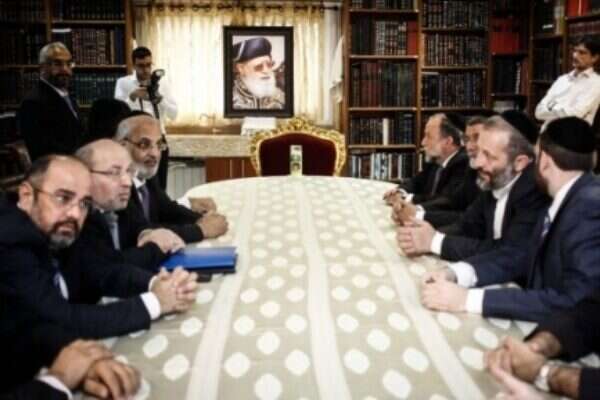
On a Tuesday evening two and a half weeks ago, in an event hall in the center of the country, hundreds of people assembled to participate in the annual celebration commemorating Rabbi Matzliah Mazuz, who was murdered in Tunis and was the father of Rabbi Meir Mazuz, a prominent Sephardi rabbi and the king of gematria (a Jewish system of numerology that assigns numerical value to a word or phrase and significance to the resulting number). On the surface, it seemed like one of the many commemorative celebrations that take place in the Sephardi haredi community, but it was not. Without advance coordination and apparently without prior preparation, almost everyone who could play major roles in the big future split-off of Shas was there. At 9 p.m., Shas former Chairman MK Eli Yishai showed up on his home court. The emcee of the evening went out of his way to heap compliments on Yishai, using carefully chosen phrases sauch as "beloved of the people" and the greatest and most significant compliment to the ears of Shas members, "Maran's [Rabbi Ovadia Yosef's] faithful servant." Feeling at ease, Yishai scattered smiles everywhere, shook the hand of every rabbi and rabbi's follower and, later on, raised a great deal of money for the yeshiva by selling 300,000 shekels ($86,000) worth of rights to a Torah scroll in memory of Yosef. Besides Mazuz, who spoke in Yishai's favor in the past -- when Yishai was humiliated at Yosef's memorial ceremony, Mazuz circulated a letter stating that "an insult to Yishai would make Shas crumble" -- Rabbi Shlomo Moshe Amar, the former Sephardic chief rabbi, attended as well. Amar, who was painfully "cut out" of Shas, is building a group of admirers outside Shas' bastions. Also present was the kabbalist Rabbi Benayahu Shmueli, who has a stable position among Shas rabbis. Still, some dare to mention him as being among those rabbis who share Yishai's vision that when he resigns from the party with several other Knesset members, those rabbis will also stand behind him and give him spiritual support. Threatening calls in the middle of the night The talk about a split is far off and close by at the same time. On the one hand, elections for the next Knesset are far off, and an official, public split is not on the horizon. On the other hand, those who belong to what is known as "Yishai's camp" have not been considered members of the party for some time. Yishai formed a one-man faction within Shas. He does not recognize MK Aryeh Deri as party leader, does not talk to him or to Housing Minister Ariel Atias except to wish them a good Sabbath, does not attend votes, and does not vote against the government or criticize it even on subjects that are considered golden opportunities for opposition MKs. For example, the latest report on poverty was released. Yishai is dealing with the matters under his responsibility (for example, the committee that appoints rabbinic judges) with complete independence and holds meetings with all the MKs and ministers on an ongoing basis. Despite the well-publicized and fake reconciliation between Yishai and Deri, there is a great deal of background noise between the two, which is also nourished by the small conflicts of the assistants and wheeler-dealers at the party's lower levels. Thus, for example, Deri's people say that at the well-publicized annual memorial celebration, Deri heard that Yishai had arrived a few minutes earlier than he and had entered the hall. Only then did Deri decide to continue on to another meeting in Ashdod, hoping that Yishai would leave by the time he got back. In the end, the two sat down with only embarrassment and Mazuz in common. The saga continued when Shas organ Yom Leyom ran photographs of the event, but cut Yishai out of them and left Deri in. Yishai's people hurried to complain that there had been "orders from above. The newspaper staff denied it, and a brief probe revealed that Yishai actually was mentioned several times in the newspaper, and the decision had been an individual one by the writer. Another source of conflict between the two camps was Yishai's birthday, about which Yishai's people claimed that all those who attended had received threats, and that they themselves were being subjected to countless incidents of harassment such as telephone calls in the middle of the night from unidentified callers and threats that they must "break off all connection" with where they were or else "things would be very bad for them." Some of them even filed police complaints. Officials of Deri's camp treated the event with contempt, and even as they condemned verbal and physical threats, they still made stinging comments. "Eli Yishai says that the 'territory' supports him, but actually there were hardly 30 people at his birthday celebration. That is simply insulting," they said. How much damage is the contretemps with Yishai causing? Nothing more than headlines, it seems -- or, as Deri's people put it, "the annoying kid in the class who pinches people's backsides." Party officials say, "It is not that Deri tried to do something and Yishai stopped him. There are some friction and some noise, but actions are not being stopped. Our greatest good fortune is that now we are at the beginning of a term and not facing a decision. If we were facing an election today, we would be in awful shape." A controversial appointment The real troubles are actually in the party's holy of holies -- its spiritual leadership. Just this week, four months after the passing of Yosef, the party succeeded in convening its council of sages for the first time. That should not have been a difficult problem, since the council is made up of only four rabbis. In the past, when Yosef wished for it, these four rabbis showed up on two hours' notice. Of course, things are different today. A tough struggle going on behind the scenes is spilling over to Shas' nobility -- the late Yosef's own family. "The council is the party's basis and constitutes its right to exist, and only now people have managed to convene it," members of Yosef's family say. "This is not merely an emotional matter or about the fact that Rabbi Ovadia [Yosef] passed on and someone must continue his legacy. Rather, it is a practical matter: the mayoral elections took place without the council meeting, and even the decision to sign the agreement between the Torah education network and the Education Ministry was made without the council." Members of Yosef's family also say that a serious conflict among the rabbis is behind the story of the council's meeting, and information exists that could change and distort the party's history. "The rabbis were not ready to accept the fact that Rabbi David Yosef had been brought into the council and was unwilling for it to meet without him. Many people in the family feel badly about that appointment." Family members have a serious complaint. "Maran [Rabbi Ovadia Yosef] never wanted Rabbi David [Yosef] on the Council of Sages. They sold the public a story that it was what he wanted, circulated a letter during the days of mourning that it was the rabbi's will, and some of his sons would not sign it because it was a lie. Even Rabbi Shalom Cohen [the head of Porat Yosef Yeshiva and the most prominent member of the Council of Torah Sages] argued with Rabbi David about announcing his appointment the evening of Maran's memorial ceremony. Rabbi Cohen did not want to bring him in, and pressure was applied to him. In the end, he said, 'I heard it was what the rabbi wanted.' He did not say, 'I know it is what he wanted' or 'This has great significance.'" Of course, the fingers of blame point at Deri, a close friend of David Yosef's since they studied together in yeshiva. Some people say that Deri wanted to use David Yosef's appointment to gain absolute control over the party. "Everyone who was truly close to Rabbi Ovadia [Yosef] knows what he really wanted, and it was not that Rabbi David become a member of the Council of Torah Sages. In addition, it was even talked about once and the rabbi ruled it out. It is a complete lie." The rabbis who are members of the council also have criticism for the way the party is handling matters. One example is Rabbi Shimon Baadani, one of the council members who told his people any number of times that he was angry over the party's current behavior. "They do not ask me what I think, and they do what they want," he said. Members of Yosef's family make these statements with a great deal of heartache. "Things are developing in an unhealthy direction that is not good. This is not schadenfreude; this party is improtant to us and we cannot remain silent about what is happening." Standing in the eye of the storm So where is Shas, which won 17 seats in its heyday, heading? The answer everyone agrees upon is that it is headed toward change. Yishai's split-off is inevitable even if it takes a long time until it happens. The joining of Amar, Mazuz and Shmueli with Yishai will make Shas' "big bang" happen sooner. Ariel Atias, who is considered one of the party's stable anchors, has also spoken aloud about leaving political life and is even having meetings with businessmen. Although Atias will not leave Jerusalem, he will follow his heart, which is set on the private sector. Until the changes begin taking shape, party chairman Deri remains responsible for Shas' image, just as he planned. His people say they feel Shas is stable despite the conflicts. "For the first time after 30 years, Shas is without Rabbi Ovadia. It is natural that there be changes, and shocks as a result of them." According to Deri's people, Shas is more independent than it used to be. "We are no longer a division within United Torah Judaism," they say. The MKs say that Deri is attentive and takes their views into consideration. "In the past, an MK could not go against the chairman. If he did, he would be summoned to Rabbi Ovadia. That is what happened to Haim Amsalem. Today, we must make sure to embrace everyone so that nobody will run away and cause an uproar," a party MK said. Deri's associates take a different view. "So far, faction meetings lasted for 20 minutes, during which Yishai would say what was happening and give orders. Today, Deri listens to all the MKs and consults with them." There is no certainty about the party's agenda either. Now that Yosef is gone, Deri will have to prove himself directly to the voters, and the most evident thing now is that Shas has no real or stable agenda. Deri continues making statements about social justice, but many people in the party wonder whether the message is really getting through and will bring in enough voters. Deri can count on six to seven Sephardi-Hardi seats (which do not include the establishment of a party headed by Yishai). But he will have to work hard for anything beyond that. Is Shas headed for collapse? It depends on whom you ask. The pessimistic MKs talk about unending conflicts, a humiliating dismissal of activists that caused bitterness, about the chairman's inability to communicate with the prime minister or with the cabinet ministers, and about a weak opposition. The optimistic ones talk about stability. "Shas is more than 11 MKs. It has schools, city council members, charitable organizations. The average Shasnik does not want to fight as long as schools stay open, salaries are paid and everything that worked still works," a party official said. Party members say that Deri's real work is beginning now. "So far, Deri was busy putting out fires: the elections for the chief rabbinate, the mayoral elections and the rabbi's passing. Now that things have calmed down, more or less, Deri can work." Many people agree that Deri's big test is yet to come. As he knows very better than anyone else, in politics you are high up one day and down the next. Apropos revolutions and lack of relevance: one of the revolutions Shas underwent was the public disappearance of the Yosef family, headed by the rabbi's youngest son Moshe Yosef and his wife Yehudit, who for years were considered the party's strong ones. Moshe and Yehudit, who were often in the eye of the storm, now enjoy calm the like of which they never experienced. Moshe works on his father's books and manages the family kashrut business, while Yehudit lectures about the rabbi's life and times. No one knocks on the door, no one asks to come inside and no one even consults them. Without a doubt, these are different times for Shas.
What next for Shas?
Is Shas, which in its heyday had 17 Knesset seats, heading for collapse? • It depends on whom you ask • Four months after the death of Rabbi Ovadia Yosef, Shas is facing many changes, with the party's future uncertain.
Load more...