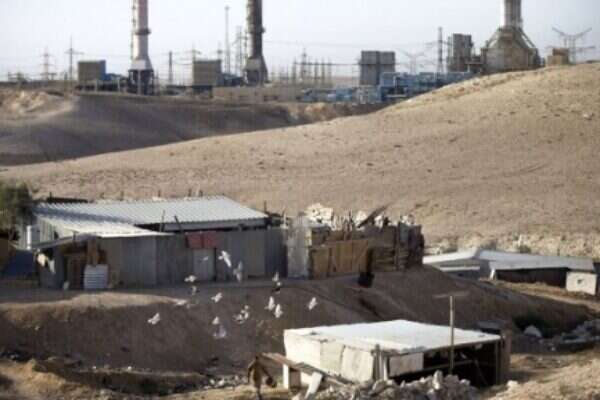
Ten days ago, the Knesset Finance Committee held a meeting about the dire economic situation of Bedouin shepherds in the Negev. The person who initiated the discussion, MK Afu Agbaria (Hadash), argued that following a tour of the unrecognized villages in the area, he discovered that the aforementioned economic distress stems from fewer available pastures, the lack of water at the same discount rate enjoyed by the agriculture industry, the closure of markets and monetary fines for leading herds illegally.
His comments were supported by the chairman of the Council of Bedouin Shepherds, Muhammad Abu Farha, who said that the situation is not conducive to earning a respectable living. Ibrahim el-Atrash, a shepherd, warned that he and his colleagues would eventually become a burden on the state.
These sentiments have drawn the ire of regional council heads in the Negev and the police at the Beersheba, Dimona and Negev township stations, who we spoke with this week. They paint a complex picture, which has only gotten worse over the years, whereby the Bedouin have made the lives of the Jewish residents in the Beersheba-Dimona-Arad triangle increasingly difficult.
The Prawer plan, one of the Negev regional council heads told us, "is just another excuse for the Bedouin, as they themselves say, to start an intifada against the government." He added: "In actuality, they have already begun a mini-intifada against civilians and against any symbols of government. Why? Because they believe only in force. The revenge aspect is their way of life, the bedrock of their culture. This is how they act in relation to the lands they claim they own, and in relation to employment; if you dont give them what they want they threaten to become professionally unemployed, to have dozens of children and so on. This is their method. Along the way, they make our lives more difficult in a number of different ways, which only shows that we need to change our approach to them -- no more weak handedness."
At the police stations in Beersheba, Dimona and the regional townships, responsible for all of the small Bedouin communities in the aforementioned triangle, complaints from citizens and organizations about damage to infrastructure, theft and the stoning of buses and private cars traveling on the roads in the area, have piled up in the hundreds in recent years. The situation has been compounded by the practice of protection payments that small business owners and factories are forced to provide, if they hope to avoid becoming the victims of arson, systematic agricultural theft and more.
"I will never forget that night, in July of this year, when I returned from Beersheba to Dimona after my sister's wedding," said Batsheva, a resident of Dimona, recounting what she described as a chilling experience. On one of the turns in the road she noticed three young men, who began throwing rocks at the car she was driving, with three family members inside.
"It was frightening. I was the driver and I was tired. I saw death before my eyes," she describes. "A few rocks hit the car, and to my incredible luck, none hit the front windshield or side windows. I don't know where I got my courage from, but I slammed on the breaks, I got out and walked toward them, while my family was yelling at me to get back in the car. It was crazy, but God was with me and they ran away. Since that night I no longer drive on the roads in the Negev at night -- I'm not willing to take any more risks."
The Bedouin do not like to hear these accusations. A dignitary from one of the villages told us about the phenomenon from a completely different, much calmer angle: "They will probably think we started an intifada against our Jewish neighbors, but this is not true. We have good, neighborly relations. If we have complaints against the state and its institutions, then we will deal with them through the authorities. Just so it is clear -- no one decided to go out and hurt innocent civilians as part of our struggle for our rights over our lands. No [Benny] Begin and no Prawer will solve the problem. We have a very bitter disagreement with the state, and it is true that the state's attitude toward us has crossed all lines, but we will solve this through dialogue, not violence."
Shmulik Riffman, head of the Ramat Negev Regional Council, agrees that a dialogue with the Bedouin must be launched to find a solution to the land dispute. "I urge the prime minister to push aside pressure from politicians. This is not the time for empty words, it is the time to show leadership and fix this problem once and for all."
Riffman, in contrast to the Bedouin, is certain that the Prawer plan is the best proposal put forth thus far. "The problem is not being solved because the Bedouin don't have any real leadership," he said. "Not one of them is capable of elevating the agreement proposed by the government through the Prawer plan into a starting point for a possible solution," he said.
"The Bedouin, in their approach, remind me of the Palestinians, who have yet to reach a peace agreement with the State of Israel because they always think that the next deal on the table will be better than the current one. Their thought process always leads them to ask why they should take a deal they consider bad today, if tomorrow they can take a better deal. Over 30 years have passed because of this thought process.
"As someone who has lived in the area for decades and is well-versed in the problem at hand, I think the state is being very generous with the Bedouin through the Prawer plan," Riffman said. "If they are wise enough to accept the proposed solution, they will only benefit. The problem is that they have the ears of too many listless and visionless politicians. Worse even, they lean on the Arabs from northern Israel and on politicians from the [Palestinian] territories."
Riffman implores a solution to the Bedouin problem because in his view, the Jews will fare worse then the Bedouin should the situation persists. "I havent suddenly become a leftist or bleeding heart. I believe that devising a solution is a national need. The Negev is perceived by the government as some far-away place, which is why this is not a burning issue for it, but if we don't resolve the Bedouin problem we will not be able to develop the Negev."
Despite being able to testify to the existence of a "Bedouin intifada" -- "they break in, steal, destroy national infrastructure, smuggle drugs from Egypt, steal from farmers" -- Riffman provides a surprising plot twist: "I am concerned less about a Bedouin intifada than a Jewish intifada, because the day will come when the Jews will have had enough of this terrorism and they will turn their guns on the Bedouin.
"I am hearing more and more Jews who are fed up and want to take the law into their own hands, and this is regrettable. I cannot shut my eyes and say that this will not happen."
Meanwhile, a Bedouin sheikh from one of the nearby villages says that the concerns of the Jewish residents are justified. "We are the owners of all the Negev lands," the sheikh declares. "We were here before the state, before the British and before the Turks. We have titles over these lands. Whatever is taken from us by force, will be returned to us by force and by wisdom."
טעינו? נתקן! אם מצאתם טעות בכתבה, נשמח שתשתפו אותנו