Those were dark and terrible days, a chapter in Jerusalems history that the story of the siege and the destruction of the Second Temple, as it is told in our time, prefers to skip over or at least play down. Over the months that preceded the destruction of the Second Temple in besieged Jerusalem, starvation was rampant. Women stole food from their husbands, children from their fathers and mothers from their babies. The hunger, which was caused by the rebels who were fighting the Roman army, brought out all the evil that human beings are capable of perpetrating.
During this week of the fast of the Seventeenth of Tammuz, three weeks before the anniversary of the destruction of the Temple on the Ninth of Av, the Antiquities Authority and Elad have revealed, for the first time, archaeological evidence that could confirm the historical theories about this unflattering chapter in Jewish history.
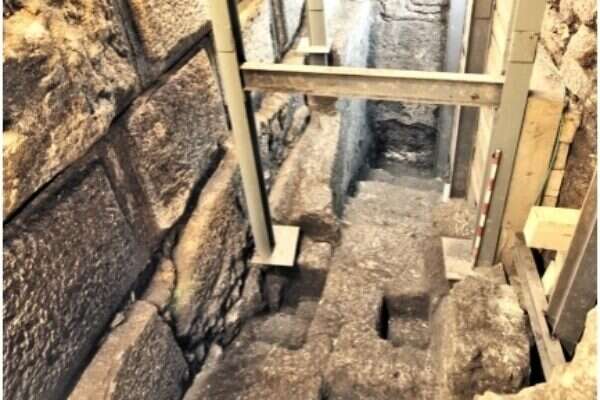
A small cistern was recently discovered fairly close to the southwestern corner of the wall surrounding the Temple Mount (outside it). It apparently served as a hiding place for a family that lived in Jerusalem roughly 2,000 years ago, who went inside to eat their meals for fear that the rebels would steal their food.
According to archaeologist Eli Shukron, who has been excavating the area for many years, the evidence is circumstantial but the likelihood is high. Shukron will present the find at the annual Megalim conference of the City of David to be held this coming Thursday.
Flavius Josephuss work 'The Jewish War' spends pages describing the acts of the rebels in the weeks before the Temples destruction. Josephus describes how the rebels ambushed the inhabitants of Jerusalem almost everywhere to steal the few scraps of food they had left. Those interested in probing the discovery of the cistern, which is revealed here for the first time, must go back to his horrific account.
When they saw any house locked up, this was to them a signal that the people within had gotten some food; whereupon they broke open the doors, and ran in, and took pieces of what they were eating almost up out of their very throats, and this by force: the old men, who held their food fast, were beaten; and if the women hid what they had within their hands, their hair was torn for so doing; nor was there any commiseration shown either to the aged or to the infants, but they lifted up children from the ground as they hung upon the morsels they had gotten, and shook them down upon the floor. But still they were more barbarously cruel to those that had prevented their coming in, and had actually swallowed down what they were going to seize upon, as if they had been unjustly defrauded of their right. They also invented terrible methods of torments to discover where any food was....
The inhabitants natural response to the rebels atrocities was to eat in hiding. Josephus wrote of the people of Jerusalem, Many there were indeed who sold what they had for one measure; it was of wheat, if they were of the richer sort; but of barley, if they were poorer. When these had so done, they shut themselves up in the inmost rooms of their houses, and ate the corn they had gotten; some did it without grinding it, by reason of the extremity of the want they were in, and others baked bread of it, according as necessity and fear dictated to them: a table was no where laid for a distinct meal, but they snatched the bread out of the fire, half-baked, and ate it very hastily.
For the first time in the history of the archaeological excavations in Jerusalem, what appears to be the first archaeological evidence of the terrible starvation Josephus describes was recently found: a place of concealment where one starving family hid from the rebels.
It is a small cistern connected by a shaft to the home that once existed above it. Three clay cooking pots, one of them coated with a thin layer of charred organic material (apparently food), were found on the floor of the cistern. Beside them was a tiny clay lamp capable of shedding light on the food but not on those eating it, so that neither the rebels nor the Romans would discover them.
The refuge of the starving
The one who made the discovery is Eli Shukron, who has been excavating in the City of David for many years. Like other dramatic finds uncovered in the same area in recent years, the cistern was also located in an area at the end of a drainage canal beneath the Herodian street that ascends from the Siloam Pool in the City of David to the southwestern corner of the wall around the Temple Mount, at the foot of the wall.
The excavation of the drainage canal is still in progress, and some of it has already been opened to the public. Israel Hayom is the first to report that the archaeologists who are digging underground have already reached the boundary of the Mughrabi Ascent that borders on the womens section of the Western Wall to the south. It is also the limit of their excavation permit, but from there they can continue crawling northward through the tunnel, through the continuation of the drainage tunnel, to the place where Charles Warren arrived in the 19th century beneath what is now the mens section of the Western Wall.
On the way to the small cistern, the refuge of the starving, Shukron and his workers found a series of mikvaot ritual pools quarried out of the bedrock from the period preceding the construction of the Western Wall. These ritual pools formed part of the ruins of a residential neighborhood that had existed there and had been demolished to make way for the western supporting wall of the Temple Mount what we know today as the Western Wall. The residents were evacuated and the neighborhood demolished, but there was no way to remove the ritual pools that had been dug into the bedrock, so in some places they were filled with soil and the wall built over them.
Now that the foundations of the Western Wall have been discovered, these ritual pools have been found as well.
But then, as the excavations progressed toward the northwest, a digging tool being used by one of the workers suddenly fell and seemed to be swallowed by the earth. His fellow workers shone a flashlight at the empty space that had opened beneath them and saw it was a cistern. They removed the seal of stones and black cement (which was commonly used in Second Temple times) from the opening and crawled inside, where a further surprise awaited them another opening that was also sealed. Breaking through it, they discovered that the large cistern was connected to a smaller one. It was in the second, smaller cistern that they discovered the cooking pots and the tiny lamp. That smaller cistern was the refuge of the starving.
Confirmation from two different sources
The dirges that are read in the synagogue on the Ninth of Av, some of which mention the destruction of the Second Temple, include descriptions of the terrible hunger similar to the ones Josephus wrote in The Jewish Wars. The historian Professor Jonathan J. Price of Tel Aviv University, one of the experts on the period of the siege of Jerusalem and the writings of Josephus, says that the midrashic works, particularly Eicha Rabba, contain similar horrific accounts. Both Josephus and the midrashim tell us the same dreadful story. Every time we have two sources that did not influence each other, that are independent, from different places, that tell about the same thing, we can trust them quite a bit, he said. The terrible hunger lasted for several months. It worsened after the rebels burned the granaries in a gang war that took place on the streets of Jerusalem.
One particularly horrifying account by Josephus, which illustrates the madness that the hunger caused among the inhabitants of Jerusalem and the rebels who tormented them, can be found in the sixth book of The Jewish Wars. It describes the events of the month of Tammuz, several weeks before the destruction.
Nor would men believe that those who were dying had no food, but the robbers would search them when they were expiring, lest any one should have concealed food in their bosoms, and counterfeited dying; nay, these robbers gaped for want, and ran about stumbling and staggering along like mad dogs, and reeling against the doors of the houses like drunken men; they would also, in the great distress they were in, rush into the very same houses two or three times in one and the same day. Moreover, their hunger was so intolerable, that it obliged them to chew every thing, while they gathered such things as the most sordid animals would not touch, and endured to eat them; nor did they at length abstain from girdles and shoes; and the very leather which belonged to their shields they pulled off and gnawed: the very wisps of old hay became food to some; and some gathered up fibres, and sold a very small weight of them for four Attic [drachmae]. But why do I describe the shameless impudence that the famine brought on men in their eating inanimate things, while I am going to relate a matter of fact, the like to which no history relates, either among the Greeks or Barbarians? It is horrible to speak of it, and incredible when heard....
There was a certain woman that dwelt beyond Jordan, her name was Mary; her father was Eleazar, of the village Bethezob, which signifies the house of Hyssop. She was eminent for her family and her wealth, and had fled away to Jerusalem with the rest of the multitude, and was with them besieged therein at this time. The other effects of this woman had been already seized upon, such I mean as she had brought with her out of Perea, and removed to the city. What she had treasured up besides, as also what food she had contrived to save, had been also carried off by the rapacious guards, who came every day running into her house for that purpose. This put the poor woman into a very great passion.... [S]natching up her son, who was a child sucking at her breast, she said, O thou miserable infant! for whom shall I preserve thee in this war, this famine, and this sedition-... As soon as she had said this, she slew her son, and then roasted him, and ate the one half of him....
Whose fault was it-
When Shukron arrived at the small cistern, he recalled Josephuss dreadful descriptions of the starvation and froze in his tracks. Similar pots and eating utensils had been found on the floor of the drainage tunnel, which Josephus describes in detail elsewhere in the book (in those places, the Romans broke through the stone paving above the tunnels and killed the rebels they found there). But the small cistern under the house, with its empty cooking pots and tiny lamp, corresponds well with Josephuss account of the meager provisions and the people who ate them in the most hidden parts of their homes for fear of the rebels.
The cistern fits the description particularly well because the shaft that ascends from it is not in the center but on the side. Also, the lamp that was found there is of a sort that produces only weak light, unlike the larger lamps that were found in nearby areas and in the drainage tunnels. In addition, no human bones were found there, so it was not a hiding place where rebels were killed. But coins from the first, second and third years of the First Jewish Revolt (6768 CE) were found there.
Shukron believes that there is a high likelihood that we have before us the first archaeological evidence that supports the dreadful accounts of Josephus, who described the terrible hunger in Jerusalem just before the Second Temple was destroyed and the persecution of the Jewish population by the rebels, who lost all semblance of humanity in their search for food.
Professor Price, with whom we spoke this week after the discoveries were made, says that Josephuss descriptions are so horrific that the prominent historian Yitzhak Baer published an essay roughly 40 years ago in the journal Zion casting doubt on their accuracy and claiming that some of his statements were inventions, imitations or texts copied from other historians. But according to Price, The fact that the midrashim and, partially, other historians include these dreadful accounts in their descriptions shows that these events did in fact take place.
The reason we do not talk much about it is because in our tradition, the great rebellion and the destruction of the Temple are seen as terrible offenses that the Romans perpetrated against us. The Romans are seen as the historical villains who brought the beginning of the second exile upon us, and we are the victims. To linger over the descriptions of the terrible starvation and the rebels acts against the population of Jerusalem is to include ourselves among the offenders and the criminals which, of course, is not a very popular thing to do. Still, Price says, it is historical truth, which of course does not wipe out the Romans crimes.
טעינו? נתקן! אם מצאתם טעות בכתבה, נשמח שתשתפו אותנו