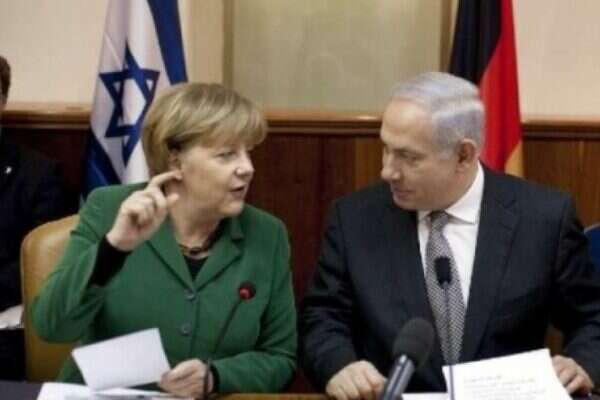
Prime Minister Benjamin Netanyahu departed on Wednesday morning for a two-day visit to the Czech Republic and Germany where he is expected, at least in Berlin, to hear sharp opposition to plans to build in E1 between Jerusalem and Maaleh Adumim. Ahead of Netanyahu's visit this week, Germany, considered Israel's closest ally in Europe, urged it to refrain from expanding settlements. Netanyahu will stop briefly in Prague on his way to Berlin to thank the Czechs for being the only European state to join Israel and the United States in opposing the Palestinian statehood resolution at the U.N., underscoring how important the issue was for him. On Wednesday night and Thursday, Netanyahu will meet with German Chancellor Angela Merkel in Berlin. The settlement issue will overshadow consultations between the German and Israeli governments on issues ranging from Israel's defense and security to greater cooperation in science and research and could further strain already cool working relations between Netanyahu and the German chancellor. The Israeli prime minister is still smarting from what he considers Berlin's betrayal after Germany abstained in a U.N. vote last week that upgraded the Palestinians' status from observer entity to nonmember state observer. He had wanted Berlin to vote no. Ruprecht Polenz, a member of the ruling Christian Democratic Union party and chairman of the Parliamentary Foreign Affairs Committee, told the Deutsche Welle newspaper, "It's Germany's aim to enable a democratic Jewish state to coexist peacefully with its neighbors." This can only be guaranteed by a two-state solution, Polenz said. According to the Deutsche Welle, the head of the German-Israeli Parliamentary Group, Jerzy Montag of the Green party, is hopeful that "Chancellor Merkel will speak out openly and clearly, without breaking the close and historical Israeli-German ties. He added that due to Germany's special responsibility for Israel, the government should more openly endorse the two-state solution. "But Germany does not have to support every one of Israel's moves," Polenz told Deutsche Welle, referring to the settlements plan. However, he does believe that Israel is more likely to take constructive criticism from a trusted ally. Regarding the Palestinian Authority's U.N. statehood bid, Polenz emphasized that aspects of the U.N. resolution do in fact support a peaceful solution. "In the resolution, the Palestinian side, for the first time, acknowledges the existence of an Israeli state," he told the Deutsche Welle. "There's talk of a Palestinian state coexisting side-by-side with Israel within the borders of 1967, plus mutually agreed border changes. That's precisely the formula that used to be on the table," Polenz added. Polenz is convinced that the German government had very good reasons to not veto such a resolution. Should E1 go ahead, Netanyahu and Foreign Minister Avigdor Lieberman would "bury the dream of a democratic, Jewish state" by creating instead an entity that would have to include a large Palestinian population, Polenz said in emailed comments to Reuters. Merkel issued a video message on Saturday saying how much she was looking forward to "friendly discussions" with Netanyahu when they dine together on Wednesday. She again backed Israel's right to defend its citizens from attack, leaving it to her spokesman Steffen Seibert to issue a surprisingly strong warning on Monday over the settlements plan. The Israeli government is sending out a negative message with this move. It is eroding trust in its willingness to negotiate, and the land for a future Palestinian state is disappearing further," Seibert said. A senior Israeli government official said the Jewish state hoped Merkel would not repeat the admonition herself in public. Polenz said that Israel should seize the initiative and launch fresh peace talks instead of settlement building. "I am concerned that with continued settlement building the time frame for a two-state solution will probably run out within the next two years," he said. "We have a unique relationship stemming from our history, and are in a fundamentally different position from our European neighbors. Friendship cannot be questioned, whatever the relations between our governments," said Reinhold Robbe, a former Social-Democrat lawmaker and president of the German-Israeli society. Germany's commitment to Israeli security includes sales of arms. In March, Berlin said it would sell Israel a sixth military submarine and shoulder millions of euros of the cost. Just last week, according to news magazine Der Spiegel, Germany's Federal Security Committee agreed to the export of shoulder-fired anti-tank weapons and bunker-busting weapons to Israel to help it defend itself from attacks by Hamas from Gaza. A defining feature of Merkel's time as chancellor has been her eagerness to engage with Israel herself, rather than hand the portfolio to her foreign minister, as her predecessor Gerhard Schröder tended to do, Robbe said. But this means she must now engage in difficult talks with Netanyahu directly and put all subjects on the table, he said. The two governments will hold a joint session on Thursday when Netanyahu and Merkel will also give a news conference. Israel, for its part, is continuing to put forth a "business as usual" attitude toward the international community, despite the recent announcement of settlement construction in the E1 area near Jerusalem that prompted rebuke from many world capitals. Israel has no plans to back down from the decision, top Israeli officials have stated. European foreign ministers will meet next Tuesday to discuss how to respond to Israel's action. U.K. Foreign Secretary William Hague said that further steps could be taken against Israel if it does not change its decision, but added that calling the British ambassador home and imposing sanctions on Israel are not under consideration. Hague said on Tuesday that European sanctions against Israel in response to its latest plans to build settlements on disputed land were not an option. However, he told parliament that he was in talks with other European foreign ministers about formulating "incentives and disincentives" to support U.S. efforts to bring Israel and the Palestinians back to the negotiating table. On Tuesday, Israel's ambassadors in Brazil, Australia, Egypt and Ireland were summoned for reprimands by the foreign ministries of those countries. Netanyahu said on Tuesday that the root of the Israel-Palestinian conflict was not settlements or land, but rather "the existence of the State of Israel and the desire to wipe us off the face of the earth." Foreign Minister Avigdor Lieberman, who unexpectedly cancelled his participation on the trip to Europe, said that "construction in Jerusalem will continue." "This is not a crime," he said. "Everything is being done in accordance with Israeli law. We have made decisions and we will go through with them."
'Germany does not have to support every Israeli move'
Ahead of meeting tonight between Prime Minister Benjamin Netanyahu and Chancellor Angela Merkel in Berlin, Ruprecht Polenz, a member of the ruling Christian Democratic Union party and chairman of the Parliamentary Foreign Affairs Committee, says German government had very good reasons not to veto Palestinian U.N. resolution.
Load more...