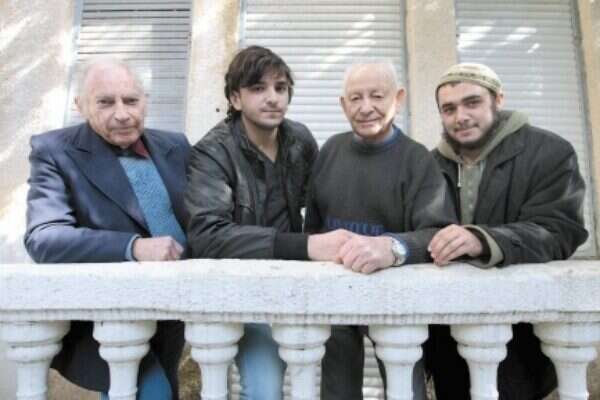
When people asked me what I wanted to be when I grew up, I always said I wanted to be the head of an organized crime family, said Haim Sofer, 19, an actor at Hamartef Theater, which is run by a non-profit organization dedicated to helping youth at risk. "But the theater and the meetings with Holocaust survivors changed me. In the theater, I play whatever I want, but inside, in my soul, Ive already become a different person. Standing on stage and playing the role of a Holocaust survivor has changed me. It made me think in a different way, made me cry like Id never cried in my whole life." Haim is part of a stage production and a film entitled The Strength to Tell, a rare collaboration between young people on society's fringes and Holocaust survivors who were witnesses at the trial of Nazi Adolf Eichmann. The film was produced by the Shem Olam Institute and directed by Noam Demsky. It depicts the psychological process experienced by witnesses to the trial and their intimate meetings with young people at Hamartef Theater in Jerusalem, which finds at-risk youths with acting talent and encourages them to use that talent to integrate into society. When Haim, who recently began his term of national service, first entered a small printing shop in Tel Aviv, he marched straight to the tiny office of Avraham Aviel, 83, a Holocaust survivor. With a shocked expression on his face, Haim asked him, What you havent retired yet- With his usual patience, Aviel answered, Young man, I dont intend to stop as long as I can still work and contribute something. Sofer, a young man with a beard and wild hair that does not hide the earring in his left ear, has moved people just as much as he has been moved by the experience himself. These people came from different places, and the beauty of it is this near-impossible meeting, which turned into conversations on a personal level, Demsky, the director, said. The main thing is to be content Aviel, who arrived in Tel Aviv in 1946, was 14 years old when his family was taken to the death pits. (Today he is married, a father of three and grandfather of nine.) He and his older brother, Pinhas, managed to flee to the forest, but during one of their forays outside to find food, they encountered German soldiers. Avraham managed to run away, but Pinhas was left behind and shot to death. Aviel recalls, When Demsky contacted me saying that he wanted to arrange a meeting between young people and witnesses at the Eichmann trial, how could I say no? We are obligated to tell the story so that what happened will never be forgotten. I invited them to my home right away and Haim, who heard my story, decided that he wanted to play me in the production. Does the character match reality- It doesnt matter. Whats important is that the need to help these kids and be role models for them came out of the story about Avraham as a character. The process we go through together brings us closer. As long as these kids arent on the street and this lets them engage in activities that are important and positive, thats what matters. Was it hard to meet with a generation so much younger- Theyre trying to do something positive and theyre working very hard, so I accepted them gladly and with love. I had them over to my home. Haim says, It was really an experience. At one time in my life, I didnt believe in myself. The greatest message I learned from Avraham was not to complain when things get tough because theres always something a lot tougher, not to give up on yourself and not to lose hope. If he saved himself from death, I can save myself, too. Avraham explains, I felt it was important to tell the kids, and also to say in the film, that if we remember what happened in the past, not only will that prevent it from happening again, but it will also make our lives happier. At that time, none of us dared to dream that we would have a state. In the past, the Jewish people was trampled on and humiliated, and today Hebrew is spoken all over the world. At that moment, Avraham turns to Haim, takes him by the shoulder and tells him, The main thing is that you should be content. You dont look happy to me. A warm embrace inevitably follows. We still dont know everything Nahum Hoch, 86, was 16 when he escaped from the gas chamber in Birkenau. Tears often well up in his eyes. The weight he gives to every word he utters when he recalls the sights and memories of his youth is palpable. Listening to you is very moving, he suddenly tells Avraham. I thought I was the only one who was optimistic. He asks questions about Liberty and Loneliness, one of two books that Aviel published, saying, The thing that is most important and interests me the most is to read in order to learn how to cope with loneliness. Today, Nahum, who came to Israel in March 1948, is far from alone. He lives in an assisted living facility near Ashdod. He is married, the father of a daughter and the grandfather of three. Our greatest victory over the cursed Nazis is that my eldest grandson is going into the IDF this year, he says proudly. But Nahum returns right away to the pain inherent in the project. The subject of the Holocaust is still locked inside me and affects my way of life. Passing things on to the young people is part of doing everything possible so that it will not be forgotten, so that there will be no more holocausts. Neta, a young girl who portrays Nahum in the production and who recently joined the IDF, is not afraid to tell him about her breakup with her boyfriend or the difficulties that she has with her parents, despite the gap in their ages. Nahum says, I always tell them to look at people who have it worse than they do and think again about their goals in life. They need to focus on those goals. After all, theres a good side to everything. Bar Pozailov, an 18-year-old from Jerusalem, and the feisty one among the group, is in the process of becoming religiously observant. He identifies with Nahums message, but when he has trouble articulating his feelings, Avraham steps in, seeking to counsel him. My late father tried to organize resistance in the Carpathian Mountains until he got an order from the Zionist organization in Budapest not to resist. Did you know that? But everywhere, you hear, They went like sheep to the slaughter. Avraham continues, There are a lot of things they dont teach in school, and thats exactly what Im trying to do to pass on to you what wasnt passed on to us. Young people were left without knowledge. If we know whats going on and keep our eyes open, then events like the Holocaust will certainly never happen again. Nahum, who agrees with Avraham, mentions the unfairness of questions such as Why didnt you resist- He says, For me, the war will never be over. But now I feel a need to tell about it and pass things on to the young people, to teach them to resist and ask the real questions. They say its a spoiled generation, but I dont agree. I think that this is a generation that isnt being taught things the way they should be. Not another Holocaust film Yoaz Ben-Yosef, the production manager of the Ma'aleh film school, says, The idea is that there is supposedly no resemblance between young people, who are our future, and people like Nahum and Avraham. Yet these young people are passing on the message of the Holocaust like people pass a torch. Pozailov, who plays the character of Yitzhak Yosef Kleiman, explains, This isnt just another Holocaust film that talks about Hitler, who murdered 6 million Jews. Here, were talking about ourselves. For example, I play Yitzhak, who to this day has the small, old suitcase that his mother gave him when he was a child, with his prisoners uniform with its old smell inside it. I saw it and felt a strong connection to Yitzhak because he wears a skullcap and fringes today and is accepting of the fact that Im becoming more religious. The teen continues, When I asked Yitzhak how he survived the Holocaust as an observant person, he said, When youre 12 years old in Auschwitz, its hard to survive as an observant Jew, but when I came out of the terror, I knew that I had to go back to my life as a religiously observant person. That gave me a lot of strength because Ive had a lot of hard knocks in my life. I came from a non-religious world that doesn't support and shows contempt for religion. There were times when I said, Why the hell am I doing this? Im going to forget about it. I asked: Where was God? And heres Yitzhak hes the answer to it all. It sounds like a profound connection. I admire him a lot for having survived Mengeles baton selection, in which anyone who didnt come up to the height of the baton was sent to death. He taught me that its alright to be scared and even be scared to death. The youths learn not just that it's okay to be scared, but also to express their feelings, like in Haim's case when he goes into Avrahams character. I didnt cry during the rehearsals, but during the performances I went into the character so deeply that I started to cry. And Im not the sort of person who cries. How do you explain it- Avraham was with his brothers and his mother in the death pits, and she told him: Say Shema Yisrael and let us die as Jews. He answered, I dont want to say Shema Yisrael. I dont want to die. He had a strong will to live, and thats what drew me to connect with him. After that, I fell in love with him because of the determination and the stubbornness that kept him alive. Have you kept in touch- We have a lot of conversations. Before I met him, I was a completely different person. Now my dreams are different. Theyre not about becoming the head of an organized crime family anymore. At the end, Demsky, the director, compliments the young actors. I fell for them big-time. I saw right away that they were giving it their all. I saw an opportunity to do something good with them and to propel the subject forward. Every time something moving or interesting occurred, I got the feeling Id made the right choice. The meetings gave the survivors the strength to tell their stories, and they gave the young people the desire to listen to the stories, which have in a sense become their own.
At-risk youth take stage to recount Holocaust survivors' stories
Holocaust survivors who wish to preserve their memories of the past, painful as they may be, are participating in a new project with at-risk youth, who portray these elders in a new production and film.
Load more...