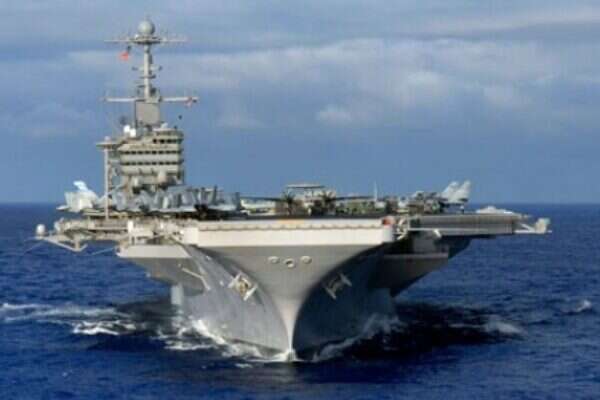
A classified Pentagon war simulation held this month concluded that an Israeli attack on Iran would result in American intervention and would lead to hundreds of U.S. casualties, The New York Times reported on Monday. The senior officials who held the simulation emphasized that the war game was not conducted as part of any preparation for a U.S. strike on Iran, and added that a regional conflict was not the only possible outcome of the war game. The simulation's conclusion, that in case of an Israeli strike on Iran, the U.S. would be dragged into a regional war, is likely to boost those in the White House, Pentagon and the U.S. intelligence community who are warning against the inherent dangers of an Israeli attack. The two-week-long simulation, dubbed Internal Look, assesses the possible outcome of the U.S. being dragged into war as a result of an Israeli strike. The simulation predicted that Iranian forces would attack the U.S. fleet in the Persian Gulf, an attack that would kill about 200 Americans. As a result, the U.S. would have to respond. Officials told The New York Times that, "under the chain of events in the war game, Iran believed that Israel and the United States were partners in any strike against Iranian nuclear sites and therefore considered American military forces in the Persian Gulf as complicit in the attack. Iranian jets chased Israeli warplanes after the attack, and Iranians launched missiles at an American warship in the Persian Gulf, viewed as an act of war that allowed an American retaliation." Meanwhile, Defense Minister Ehud Barak said Monday that Israel viewed the threat posed by a nuclear-armed Iran with greater urgency than the rest of the world did. Barak also reiterated recent Israeli assessments that Iran's nuclear program was on the verge of becoming immune to disruptions by a possible military strike. The remarks are likely to fuel already rampant speculation that Israel is preparing for a strike before Iran moves most of its nuclear facilities underground and beyond the reach of a precision attack. In testimony to the Foreign Affairs and Defense Committee, Barak also said that harsher international sanctions against Iran would be needed to try to pressure Tehran to abandon the suspect elements of its nuclear program. Barak also invoked a theme that has become a recent mantra with Israeli leaders that the Jewish state will not leave its fate to others to decide. "The world, including the current U.S. administration, understands and accepts that Israel necessarily views the threat differently than they do, and that ultimately, Israel is responsible for taking the decisions related to its future, its security and its destiny," he said. Barak's office released his statements before the committee in a media release. Iran's nuclear program, Barak said, "is steadily approaching maturation and is verging on a 'zone of immunity' a position from which the Iranian regime could complete its program without effective disruption, at its convenience." Barak sent jitters through the world two months ago, when he first coined the "zone of immunity" phrase, a reference to Iran's movement of sensitive nuclear operations deep underground in heavily fortified bunkers, in an effort to compromise any military strike. Earlier this month, Prime Minister Benjamin Netanyahu said Israel had not yet decided whether to attack, but senior officials who advocate a pre-emptive strike say Israel, with relatively limited firepower, would have to strike by summer to be effective. Israel, just hundreds of miles from Iran, sees a nuclear-armed Islamic Republic as the biggest threat to its survival. This has been underscored by the controversies surrounding Iran's nuclear program, President Mahmoud Ahmadinejad's repeated references to the destruction of the Jewish state, Iran's arsenal of ballistic missiles capable of striking Israel and its anti-Israel allies in Lebanon and the Gaza Strip. Israel, like the West, believes the key elements of the Iranian program primarily uranium enrichment suggest ambitions to obtain nuclear weapons. Iran claims its nuclear program is for peaceful purposes, such as energy production. But while the U.S. and Israel agree that a nuclear Iran must not be tolerated, they differ on how urgently military action might be needed. Israel does not want Tehran to reach the point where it is technologically capable of building a bomb a point it estimates is just months away. But the U.S., with its superior firepower, thinks the tripwire could be months further down the line. The U.S. has been urging patience, saying harsh international sanctions and additional diplomacy should be given time to work. Israel is skeptical they will be effective, especially because Russia and China have been blocking stronger action. Also Monday, President Shimon Peres sent Iranians his traditional greeting for the Persian new year, wishing for "peace and coexistence" despite tensions over their country's nuclear program. Speaking first in Farsi and then in Hebrew, Peres also urged Iranian leaders not to threaten anyone or make their "children flee home" an apparent reference to the possibility of war. The greeting was broadcast over Israel Radio's Farsi service, which is popular in Iran.
'US will be dragged into regional war if Israel strikes Iran'
Classified Pentagon war simulation concludes that Israeli attack on Iran would result in American intervention and hundreds of U.S. casualties, The New York Times reports • In war game, Iran attacks U.S. fleet in the Persian Gulf, sparking regional war.
Load more...