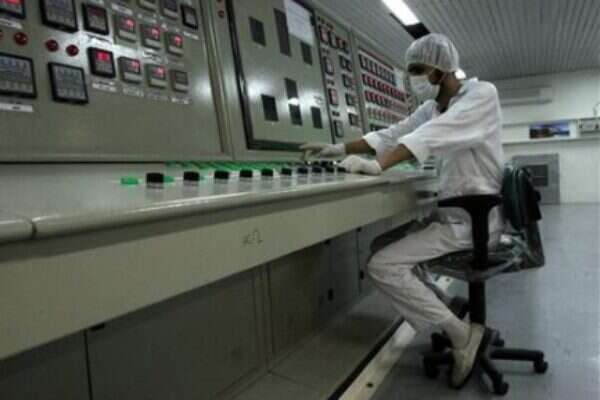
Washington believes Iran is about to begin enriching uranium at an underground nuclear facility near Qom, Bloomberg News reported on Thursday. According to the report, the U.S. believes Iran is only weeks away from obtaining a 20 percent grade of uranium enrichment. The possibility of Iran conducting sensitive atomic activities in the underground facility deep inside a mountain, diplomatic sources said on Wednesday, could up the ante in a stand-off with big powers demanding Tehran curb such work. Iranian experts have carried out the necessary preparations at Fordow near the Shiite Muslim holy city of Qom, paving the way for the Islamic Republic to start higher-grade uranium enrichment at the site.
The machines, equipment and nuclear material needed to be transferred and installed at Fordow, the sources added, suggesting the work itself -- until now conducted above ground at another location -- could start when Iran takes the decision.
"They are ready to start feeding," a diplomatic source said, referring to the process in which low-enriched uranium gas is refined by centrifuges to increase the fissile isotope ratio.
Meanwhile, an Iranian parliament member revealed on Thursday that his country was set to begin construction of an additional nuclear facility "for civilian purposes."
Awaz Khidirpur said the plant would be built within three years near the city of Shahreza, 70 kilometers (43 miles) south-west of Isfahan.
Officials in Iran's Atomic Energy Organization denied Khidirpur's apparent revelation, and said there were no plans to build any additional nuclear facilities.
Tension is escalating between Western powers and Iran after a U.N. nuclear watchdog report last month that said Tehran appeared to have worked on designing a nuclear weapon, and that secret research to that end may be continuing.
Enriched uranium can be used to fuel power plants and other types of reactors, which is Iran's stated aim, or provide material for atomic bombs if processed much further, which the West suspects is the country's ultimate intention. Nuclear proliferation expert Shannon Kile noted that Iran earlier this year announced it would shift its most sensitive enrichment activity to Fordow but said that the actual start would still be significant.
"Obviously, for people who are concerned about Iran's ability to 'break out' and to enrich to weapons-grade this is a pretty good step along that route," said Kile, of the Stockholm International Peace Research Institute (SIPRI) think tank.
Iran's decision last year to raise the level of some enrichment from the 3.5% purity needed for civilian power plant fuel to 20% worried Western states that feel this will bring Tehran much closer to the 90% suitable for an atomic bomb. Iran says the 20% material will solely replenish its fuel stock for a medical research reactor.
Iran's main enrichment plant is located near the central town of Natanz. But the Iranian leadership said in June that it would shift its higher-grade activity from Natanz to Fordow, a site that would offer better protection from any military attack and could sharply boost output capacity.
A commander of the elite Revolutionary Guard was quoted by the semi-official Mehr News Agency on Wednesday as saying that Iran will move its uranium enrichment plants to safer sites if necessary, without elaborating.
The U.S. and Israel, Iran's adversaries, have not ruled out military action if diplomacy fails to resolve the long-running nuclear dispute, which has the potential to spark a wider conflict in the Middle East.
Meanwhile, an Iranian engineer on Thursday said his country managed to down a U.S. drone last week by disrupting its communications system. A former Pentagon official, however, denied that the drone shown on Iranian TV belonged to the U.S.