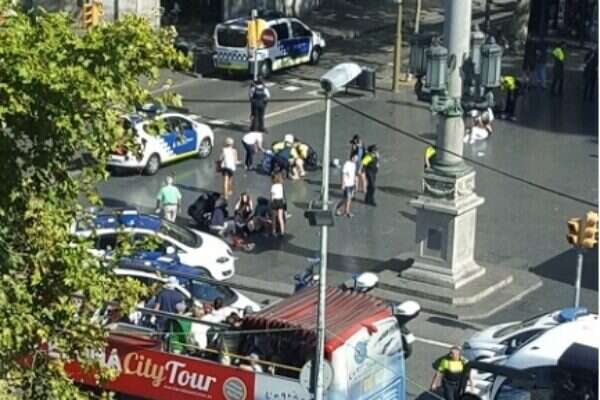
Spain mounted a sweeping counterterrorism operation on Friday after a suspected Islamist militant drove a van into crowds in Barcelona on Thursday, killing 14 people and wounding over 100. A second ramming attack in the resort town of Cambrils left seven people injured. Spanish police said it appeared as if the attacks were linked. Spanish authorities said Friday that it appears a terrorist cell of between eight and 12 people was involved and had been planning to carry out further attacks using gas cannisters. Thursday's attack in Barcelona was the deadliest attack in Spain since March 2004, when Islamist militants placed bombs on commuter trains in Madrid, killing 191 people and wounding more than 1,800. Las Ramblas, where Thursday's ramming attack took place, is a hugely popular tourist destination. Authorities said citizens from 24 countries were among the casualties. The Israeli Foreign Ministry said Friday that while 20 Israelis known to be in Barcelona have yet to contact their families, it had no knowledge of any Israeli casualties in the attack. Israel's Ambassador to Spain Daniel Kutner told Israel Radio that after the Barcelona attack, diplomats had been dispatched to hospitals to ensure no Israelis were among those hurt or killed. The Islamic State terrorist group claimed responsibility for the deadly rampage along Barcelona's famous avenue. A statement carried by Islamic State's Amaq news agency said, "The perpetrators of the Barcelona attack are soldiers of the Islamic State and carried out the operation in response to calls for targeting coalition states" -- a reference to a U.S.-led coalition against the Sunni jihadi group. Spain has several hundred soldiers in Iraq providing training to local forces in the fight against Islamic State, but they are not involved in ground operations. The Islamic State made no claim as to the Cambrils attack. If the involvement of Islamist militants in the Barcelona ramming is confirmed, it would be the latest in a string of attacks in the past 13 months in which they have used vehicles to bring carnage to the streets of European cities. That modus operandi -- crude, deadly and very hard to prevent -- has killed well over 100 people in Nice, Berlin, London and Stockholm. Before the van plowed into the tree-lined walkway of Las Ramblas, one person was killed in an explosion in a house in a separate town southwest of Barcelona, police said. Residents there were preparing explosives, a police source added. The police said they had arrested two men, a Moroccan and a man from Spain's North African enclave of Melilla in connection with the ramming, though neither was the van driver. Authorities later named the prime suspect as Maghrebi Driss Oukabir, a French citizen of Moroccan origin, who they said had rented the van which was used in the attack, although it was unclear whether he had been the one to drive it. Spanish public broadcaster RTVE and other news outlets reported Oukabir went to the police in Ripoll to report that his identity documents had been stolen by his brother. Spanish media said the IDs with his name were found in the attack van. Witnesses to the van attack said the white vehicle had zigzagged at high speed down Las Ramblas, ramming pedestrians and cyclists, sending some hurtling through the air and leaving bodies strewn in its wake. Mobile phone footage showed several bodies strewn along the Ramblas, some motionless. Paramedics and bystanders bent over them, treating them and trying to comfort those still conscious. The incident took place at the height of the tourist season in Barcelona, which is one of Europe's top travel destinations with at least 11 million visitors a year. Before Thursday's attack, government data showed that police had arrested 11 suspected jihadists in the Barcelona area so far this year, more than anywhere else in Spain. A second ramming attack took place in Cambrils, a coastal town some 100 kilometers (62 miles) from Barcelona, in the early hours of Friday morning. Spanish Police on Friday shot and killed five people wearing fake bomb belts who staged a car attack in the seaside resort. Authorities said the back-to-back vehicle attacks -- as well as an explosion earlier this week elsewhere in Catalonia -- were connected and the work of a large terrorist group. Authorities were still reeling from Thursday's Barcelona attack when police in the popular seaside town of Cambrils fatally shot five people near the town's boardwalk who had plowed into a group of tourists and locals with their blue Audi 3. Six people, including a police officer, were injured. Catalonia's Interior Minister Joaquim Forn told Onda Cero radio that the five suspects killed in a subsequent shootout with police were wearing explosive belts that were later determined to be fake. "They were fakes, but very well made, and it wasn't until the bomb squad carried out the controlled explosion of one that they could determine they were fakes," he said. Forn said that the Cambrils and Barcelona attacks were being investigated together: "We are not talking about a group of one or two people, but rather a numerous group," he said. Cambrils Mayor Cami Mendoza said the town had taken precautions after the Barcelona attack, but that the suspects had centered their assault early Friday on the narrow path to Cambrils' boardwalk, which is usually packed with locals and tourists late into the evening. Spanish Prime Minister Mariano Rajoy called the killings a "savage terrorist attack" and said Spaniards "are not just united in mourning, but especially in the firm determination to beat those who want to rob us of our values and our way of life." Israelis who were in Las Ramblas during the attack described a scene taken right out of a horror movie. The attack, which took place near a local kosher restaurant in the popular tourist destination, left many shocked. "I can still hear the sirens and the screams," Orem Marcus, who was shopping with his wife nearby told Israel Hayom. "It was like something out of a movie. I heard a boom and then endless sirens of police cars, helicopters in the air, and a great hustle and bustle. All the tourists were hysterical, especially since all the stores just closed very suddenly." Barcelona Rabbi Meir Bar-Chen said, "Terrorism is terrorism against any person created in the image [of God]. Our hearts go out to the victims and we wish them a full and speedy recovery." Bar-Chen added that the Jewish community in Spain has "every faith in the Spanish security services who do everything within their power to secure the community institutions."
Spain says Barcelona ramming attack part of larger terrorist plot
Islamic State claims Las Ramblas attack that killed 14, wounded 100 • Manhunt for driver ongoing • Second attack in resort town of Cambrils injures seven • Spanish police: Attacks the work of a terrorist cell that also planned to detonate gas cannisters.
Load more...