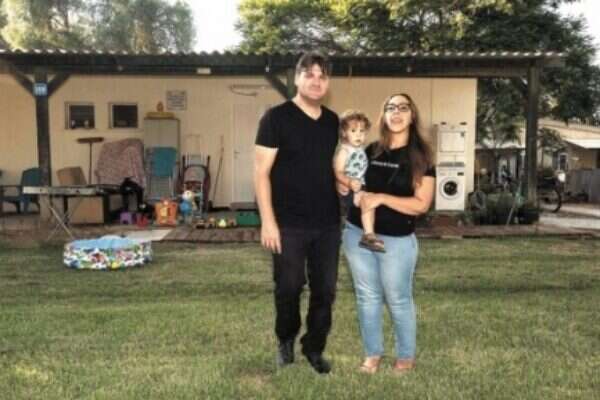
Almost three years after the end of Operation Protective Edge, Israel's clash with Hamas that saw Israel's southern communities bombarded with rockets, the Gaza periphery is blooming. Although many residents are worried that the calm could be torn apart at any moment, building starts are at record numbers and more people are moving into the area than are leaving. Maya and Marcus Lieberman, parents to Ariel (a year and 10 months) are one of the couples who have moved to Kibbutz Nirim in the Eshkol Regional Council. The kibbutz took a brutal hit in the 2014 operation against Hamas: on the last day of the fighting, residents Zevik Etzion and Shahar Melamed were killed by a Qassam rocket fired from Gaza. "The Gaza periphery communities are known for their quality of life because of the supportive community, the good schools, the quiet surroundings, and personal safety [of residents], despite the proximity to the Gaza Strip," explains Maya Lieberman. "We had a lot of concerns, and after Ariel was born, we decided the time was right. The security situation wasn't ideal. The security consideration was a dominant one, but what eventually determined our decision was the quality of life, the school system, and mostly the wonderful community and the ideal place to raise children," she says. The numbers are encouraging. Since Protective Edge ended, about 80 new families have moved to communities in the Eshkol Regional Council, many of them to communities flush against the Gaza border fence. Some of the families are natives who are returning, and others are new arrivals from all over the country. The total population of the Eshkol Regional Council has increased by 1,200 people since the end of the operation. Almost all the communities there have waiting lists of potential new residents, but there are almost no available homes. Aside from the demographic increase, the Eshkol region has seen economic recovery and growth. In the period immediately after Protective Edge, construction on the first industrial park in Eshkol was expedited. The park takes up an area of 300 dunams (74 acres) in a triangular pocket bordered by Israel, Gaza, and Egypt and is home to agriculture and packing businesses, factories, a gas station, and restaurants. A business center and offices are planned. The government has invested tens of millions of shekels in the project, mostly in infrastructure. Like Eshkol, the mood in the Shaar Hanegev Regional Council -- home to 11 communities, half of which are close to Gaza -- has been upbeat since Operation Protective Edge. Hundreds of new homes have been built in Shaar Hanegev, and hundreds of new families have arrived. All 11 communities have stopped taking in new residents because there is no more room. The Sdot Negev Regional Council, where about half the communities lie within the Gaza periphery, is also seeing its labor bear fruit, and 100 new families now call the periphery communities home. A total of 10 new businesses have opened in the Sdot Negev industrial area. All of the Sdot Negev communities are at full residency, and no more homes or plots of land are for sale. "As the numbers prove, the growth Sdot Negev communities are seeing and feeling in all areas is, for us, our true victory over terrorism," said Sdot Negev Regional Council head Tamir Idan.
3 years after Operation Protective Edge, southern Israel is flourishing
Families drawn to Gaza periphery because of supportive communities, good schools • Kibbutzim, moshavim have waiting lists of new potential residents, but not enough homes • Sdot Negev Regional Council head Tamir Idan: This is our victory over terrorism.
Load more...