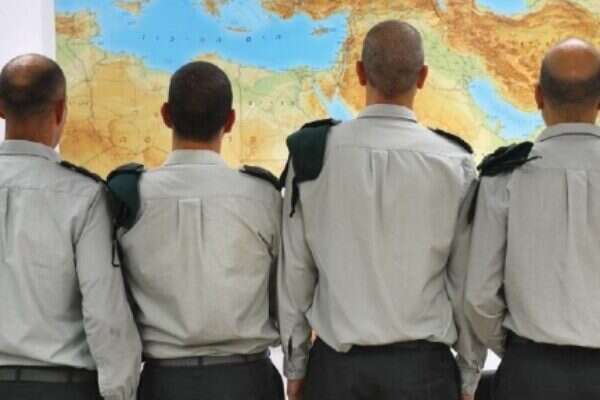
At the height of the War of Attrition in the late 1960s, Israel needed a solution for a critical operational challenge: how to take photographs deep within Egypt. The obvious solution of using fighter jets proved problematic because of Russian anti-aircraft missile batteries deployed in Egypt after the 1967 Six-Day War. But someone had a crazy idea: to affix a camera to a toy airplane and fly it over the border. After one test flight it became clear that the camera, which was glued to the toy in an improvised manner, would have to be affixed in a more clever way. The IDF then approached the defense industries and asked to turn this crazy idea into a military reality. The response was unequivocal: It can't be done. The camera is too heavy. The plane is too small. It can never work. So the IDF decided to build it themselves. The task was assigned to the technology division of the Military Intelligence Directorate. The best and brightest engineers pored over the problem for months and ultimately developed a high-resolution miniature camera that could be attached to an aircraft and used to take covert photos deep within enemy territory. This revolutionary development, completed in 1969, was actually the first prototype of an aerial photography drone. In fact, it paved the way for Israel to become a superpower in the global drone industry. This anecdote, told here for the first time, offers a rare glimpse into the work of the technological R&D unit -- one of the most secretive units in Israel. It is part of the IDF's special operations and its contribution to Israeli security has been immense. The 33 Israel Security Prizes the unit has been awarded over the years for its unique developments and solutions will attest to that. In fact, it has been known to do the impossible. "Our job is to collect intelligence in a special, different way," says Lt. Col. Z., head of mechanical development in the unit. "We germinate ideas here. We understand the need or the problem and we find a solution," adds Lt. Col. S., the head of electronics and software. "They tell us to get to 'there' and wish us luck. Our job is to find a way to do it." Ever since its establishment in 1948, the unit has come up with hundreds of such solutions. A simple search will yield some of the unit's developments from the distant past. The imagination can serve to bridge the gap between then and the current, hyper-technological era. Naturally, everything that is developed on the base is top secret for two key reasons: The technological solutions developed here are used to collect intelligence, and exposing the means would rob Israel of its unique edge. In addition, the developments, comprising innovative and cutting edge technology developed or invented by the unit, are not patented. Exposing them would immediately result in copycat attempts and the development of counter-technology to block or limit Israel's abilities. Some of the innovations developed by the unit have taken years to complete, and many have cost fortunes, but the breakthroughs they enable -- in terms of intelligence, operations and technology -- have paid off immensely. The systems developed by the unit work on a plethora of platforms, anywhere from the ground to outer space. They serve the IDF's intelligence and operational needs in a myriad of ways, sometimes remotely and sometimes operated by the fighters themselves -- chiefly by fighters in the elite Sayeret Matkal commando unit -- in enemy territory. These are critical, one-of-a-kind systems, which requires them to be 100% reliable. Under the express objective of "zero glitches," the systems undergo rigorous quality assurance to ensure their operational performance and to prevent their discovery. "There is not another unit like this anywhere in the world," says I., the head of the dependability unit, who has been working in the unit as a civilian for decades. "We are not a commercial company that can send out a technician to fix problems with the product. That's why everything that comes out of here has to be 100% dependable if it is to complete the mission and yield results without putting anyone's life in danger or harm security." Tested to the extreme To make sure that every system is in fact 100% dependable, it is subjected to a rigorous series of tests and experiments. I. compares it to a "match that has to be guaranteed to light up on the first try in the field under stressful conditions. You can't light it ahead of time because it will burn out by the time you need it. So our job is not only to develop it, but to know without a doubt that when the fighters take it to the field, it will light successfully." The unit operates inside a gray building complex somewhere in central Israel. The buildings house the offices as well as the labs where different tools are developed and tested. Quite a few of the individuals manning this unit are civilians, including a number of experts in the fields of physics and engineering. But most of the personnel are military, and quite possibly the best of the military. At times, the solution or breakthrough comes from a rookie who brings a fresh outlook. Most of the time, the solution is a result of collective brainstorming within the unit and in collaboration with outside units, mainly within the intelligence directorate's special operations unit -- the same units that make use of their services. "The work culture here gives room for everyone to express themselves," says S., adding that the unit is not comprised exclusively of computer geniuses and civilian engineers. "We are a unit of professionals, and most of us do specialize in tech, but there are quite a few low-tech positions as well," says Lt. Col. D., head of the electronics and software development division. "The trick is collaboration -- when a welder can collaborate with a tech guy and find a solution to a problem, we can provide a unique solution to our unique client with extremely unique specifications." The challenge ("problem" or "demand" as the unit members call it) is usually defined by the Military Intelligence Directorate. Very seldom is a demand raised by other security bodies. "Our client is usually not tech savvy, but knows how to define the problem and together, we look for a solution," says Z. "He [the client] says 'let's jump' and our job is to find a way to get him to jump as high as possible." A., the unit's chief engineer, joined it 28 years ago, at a time when only a few people even knew it existed. When he completed officers' training, he recalls being envious of a friend who was assigned to an Israeli Air Force base in Mitzpe Ramon. "Because they had a pool," he says. But another friend, a graduate of the Israel Institute of Technology, convinced him that his assignment was far better because he would be "serving where they put mirrors on the moon." Today he can say that his friend underestimated the unit. "We actually put mirrors on Mars," he says. The path to Mars relies on the unit's fundamental view that there are very few problems that cannot be solved. Z. says that if his college professors saw some of the things that the unit is working on they would surely expel him from their courses, because they appear to defy science. "We won't always succeed in getting to where we are headed," he says, " but we try to deconstruct the problem and move forward, even if it is a slow progression, so that someone, at some point, will reach a solution." This is done mainly thanks to the unit's ability to invest all its resources into a specific project and bring the people with the best skills to work on it. "We don't have more money than Google," S. explains, "but we have the ability to take things from the foundation and build an enormous project that will yield results." In order to succeed in this endeavor, the unit needs to be an infinite "playground," as its members describe it. A place where there are no limits on imagination and possibility, and money and resources are almost no object. This is how the unit lures the people it wants to keep for the long term -- all of them the brightest in their fields who could easily land better-paying jobs in the high-tech industry. Not everyone agrees to stay, but it is unlikely that any of them encounter the same level of challenge and responsibility in the civilian world as they do here. Not to mention the fact that here, their efforts go toward ensuring national security rather than just commercial profit. "There are three elements that inform people's decision to stay here, or anywhere: the work environment, the nature of the work and money," says I. "The money here is not great, certainly in comparison to the opportunities out there today, but the work environment and the nature of the work are exceptional." A. recalls how a year ago, when he was awarded the Chief of Staff Medal of Appreciation, he thanked the chief of staff for allowing him to be a part of this "fascinating playground." "It sounds like a cliche," he admits, "but I am in a place where I can reinvent myself every day, and serve the greater good. Whatever we don't do, no one will do for us." Zionist pride There is also the matter of Zionism. Knowing that you are a part of something big, for your country. That is why the unit also uses its resources in other areas, like giving back to the community for example. The Atidim project, which offers enrichment programs for gifted students from disadvantaged communities, was started here when the heads of the unit realized that there was a shortage of technologically oriented youth, so they expanded their search to include the periphery. Today, one of every two university graduates who enlist in the IDF, through a special program that allows students to defer their mandatory military service until after completing a degree, is an Atidim alum. Most of them, however, don't end up in this particular unit. Upon leaving the unit, members often encounter the work they did in the military when they enter the civilian industry as part of commercial technological breakthroughs. Much of the tech developed here has gone on to make billions in the private sector. Consequently, many of the people who served in the unit are now very wealthy. "There's no reason to be angry," says I. "These are our people who are making a contribution to the country, both technologically and financially." Nevertheless, some of the more specialized solutions are kept as secret as possible precisely for that reason -- to keep them from leaking into the private sector and becoming civilian technology. The unit's work is therefore highly compartmentalized and closely guarded, even in retrospect. Over the years, the unit has been involved in developing a number of technologies that have since become very popular in the civilian world, but secrecy is still maintained in an effort to prevent the enemy -- and sometimes even friends -- from figuring out exactly what is done here, so that they cannot make inferences regarding the present or the future. In this era of hyper technology, the unit faces three key challenges. The first is recruiting, and keeping, the best and brightest in order to ensure that the unit remains one step ahead. The second is the current rate of technological advances. These advances provide opportunities but at the same time impose limitations. In a world where heavyweights like Google or Facebook, and superpowers like Russia and China, have the resources -- both financial and human -- to confront any challenge, the unit finds itself in stiff competition where, in the past, it operated relatively alone. The third challenge is the enemy, which also has access to cutting edge technology. Today, terrorist groups such as Hezbollah and Hamas possess sophisticated rockets and aircraft and cyber systems designed to attack and collect intelligence. These are just a few examples of the reasons why Israel has no choice but to be at the forefront of this field, at least one step ahead. "We work very hard to be there and to come up with unique solutions," says D. "Every day is a challenge," Z. adds. "You know that if you stop, even for a minute, you become irrelevant and you die."
טעינו? נתקן! אם מצאתם טעות בכתבה, נשמח שתשתפו אותנו