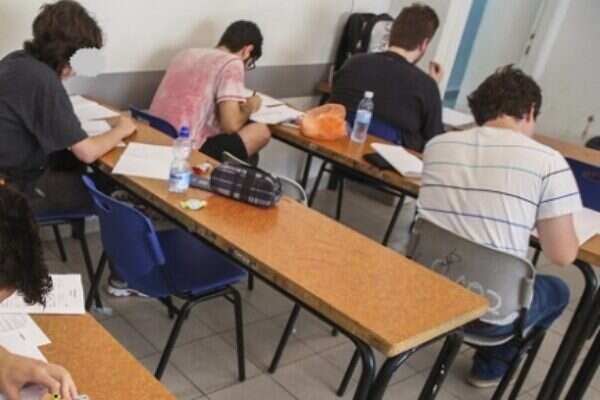
Israeli students made an all-around poor showing on the Program for International Student Assessment tests by the Organization for Economic Cooperation and Development, chalking up scores in math, reading and science that were below the average for developed countries. The test also highlighted the immense gap between the successful and unsuccessful students in Israel, which is also evaluated by the exam -- a subject in which Israel had the dubious honor of earning the top spot. The PISA test results were published on Tuesday by the National Testing and Evaluation Authority. The Israeli test was held in March 2015, when Shai Piron was education minister. A sample of 6,598 students from 173 schools nationwide, mostly 10th-graders, sat for the exam, which examines literacy in three fields -- science, reading and math. A total of 70 countries took part in the testing, including 35 OECD member nations. The figures for 2015 show that compared to the PISA test from 2012, Israeli students have not improved in any of the three test subjects, which are scored from 200 to 800. The average score in Israel for the math section of the test was 470 out of 800 (compared to 490 in the OECD), placing Israel 39th out of 70 countries. The average Israeli score on the reading section was 479 (the OECD average is 493), putting Israel in 37th place; in science Israelis scored an average of 467 (compared to 493 in the OECD), putting Israel 40th for that subject. The PISA scores also ranked Israel as No. 1 among OECD member countries in terms of the gap between the country's strongest and weakest students. Compared to all 70 countries that participated in the test, Israel had the third-largest gap between its highest and lowest scores on the math section (only China and Malta had worse gaps). In reading, only Malta and Lebanon had worse gaps between the top and bottom performers, and in science only Malta beat Israel in terms of the gap between high and low achievers. The test results indicate that 3% of Israeli students excel in math, reading and science, similar to the 4% average in the OECD. But 20% of students in Israel have difficulty with all three subjects, compared to 13% of OECD students who struggle. There were also notable gaps between the scores of Hebrew-speaking and Arabic-speaking Israeli students, and between students from strong and weak socio-economic backgrounds. On all three sections of the test, Hebrew-speaking students outperformed Arabic-speaking students by a margin of 104 points on the math section, 116 points on the reading section, and 87 points on the science section. The scores of Hebrew-speaking students alone were similar to the OECD averages, while Arabic-speaking students scored closer to the average in developing nations such as Indonesia. Students from stronger socio-economic backgrounds scored higher than students from poorer backgrounds by 87 points in math, 89 points in reading and 91 points in science. The Education Ministry stressed that this is the third year the ministry has enacted a differential budget that allots more classroom hours to students from weaker socio-economic sectors. "The results [of the PISA test] emphasize the need to close education gaps," Education Minister Naftali Bennett said. "The test, which took place a few months before I assumed this role, presents a picture that demands major improvement in achievements and a reduction of the gaps between the weak and the strong. Test results show that we are identifying gaps in education, but have a lot of work ahead of us," Bennett said.
Israeli students score low marks on international literacy test
Israeli students score below OECD average in math, science and reading • Test shows gaps between high and low achievers, rich and poor students, and Hebrew and Arabic speakers • Education Minister Naftali Bennett: We have a lot of work ahead of us.
Load more...